Người đăng: Unknown on Thứ Hai, 7 tháng 1, 2008


Number 244


Danger Trail


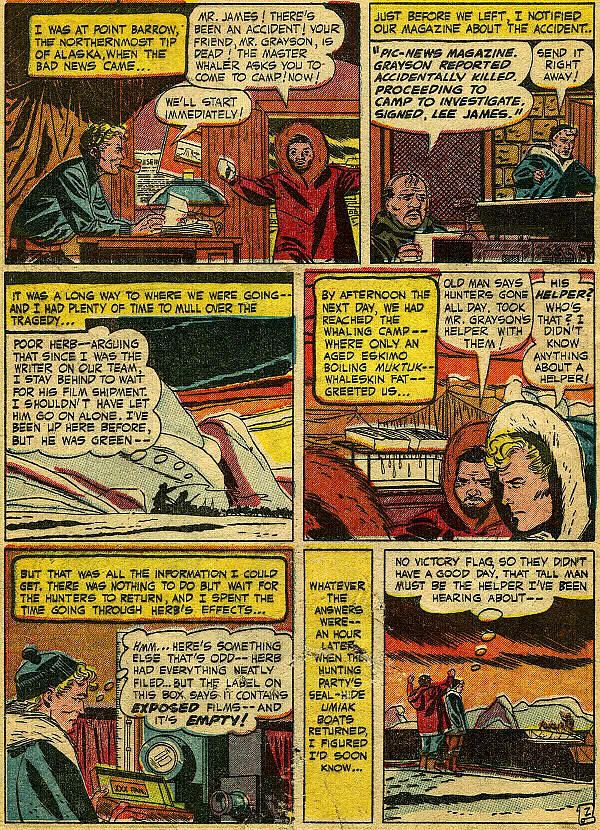
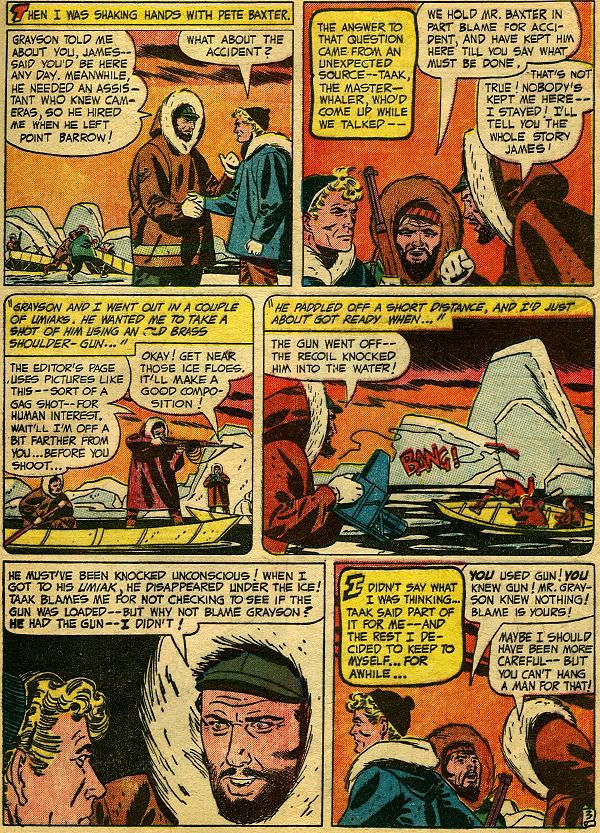
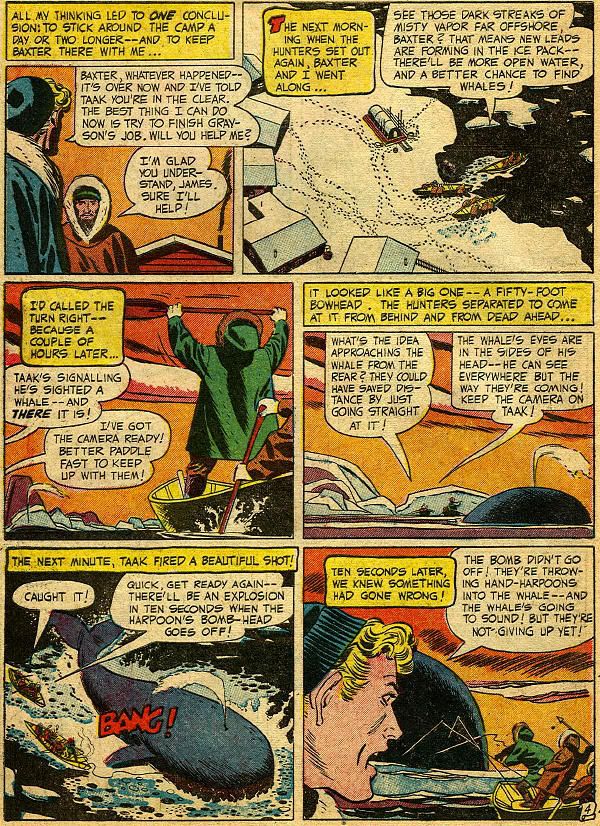
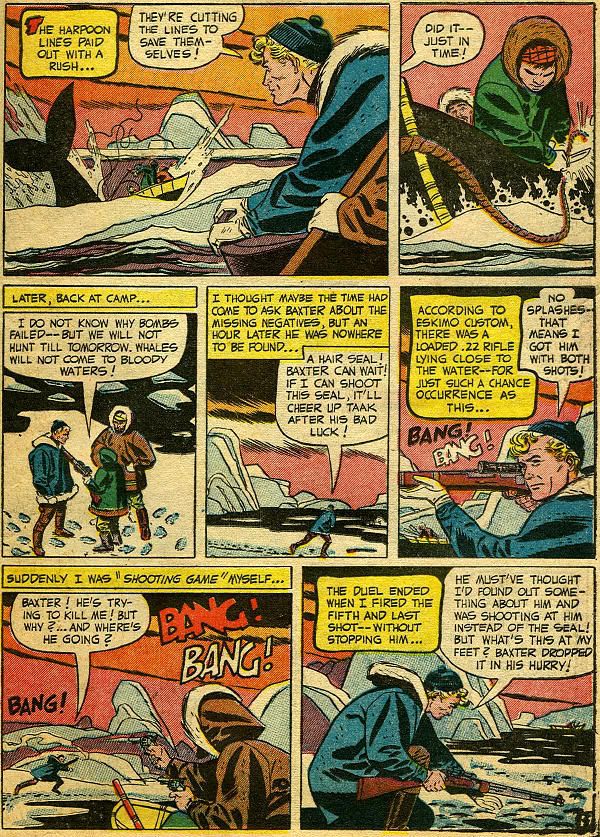
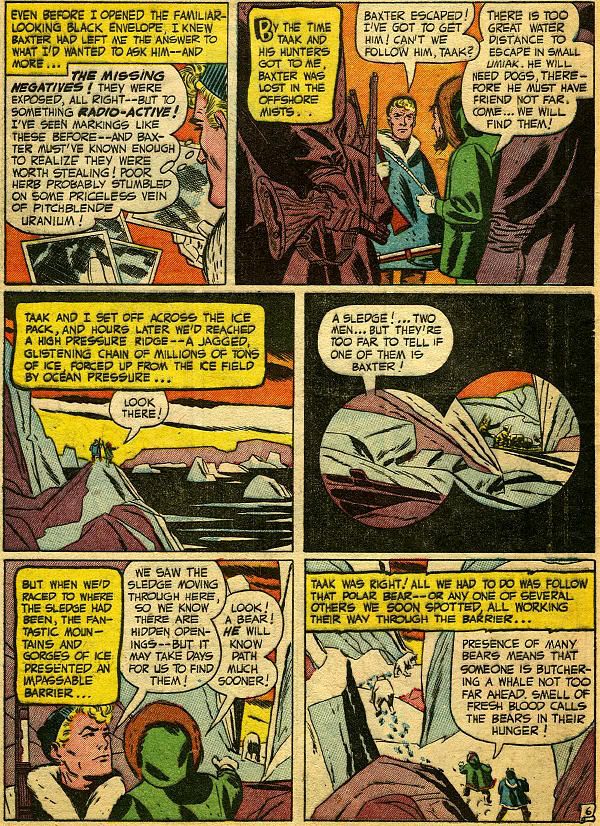
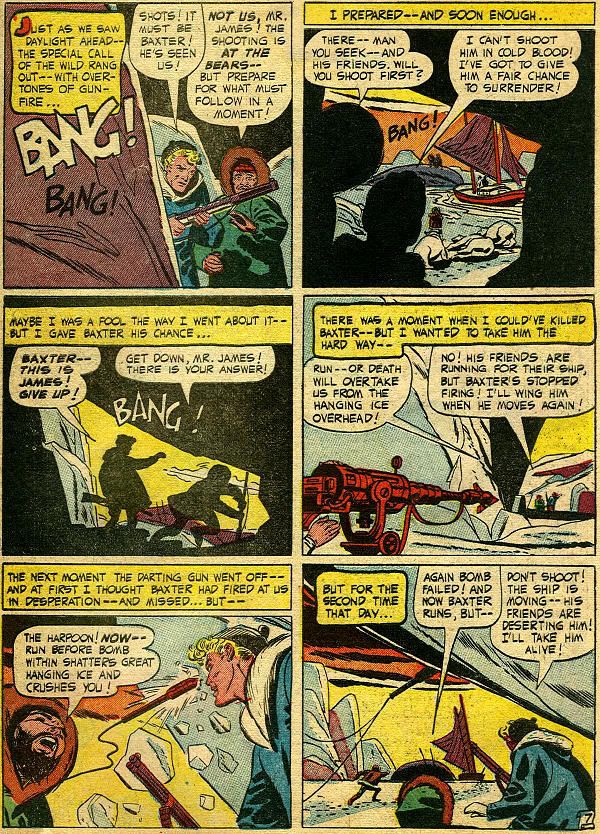
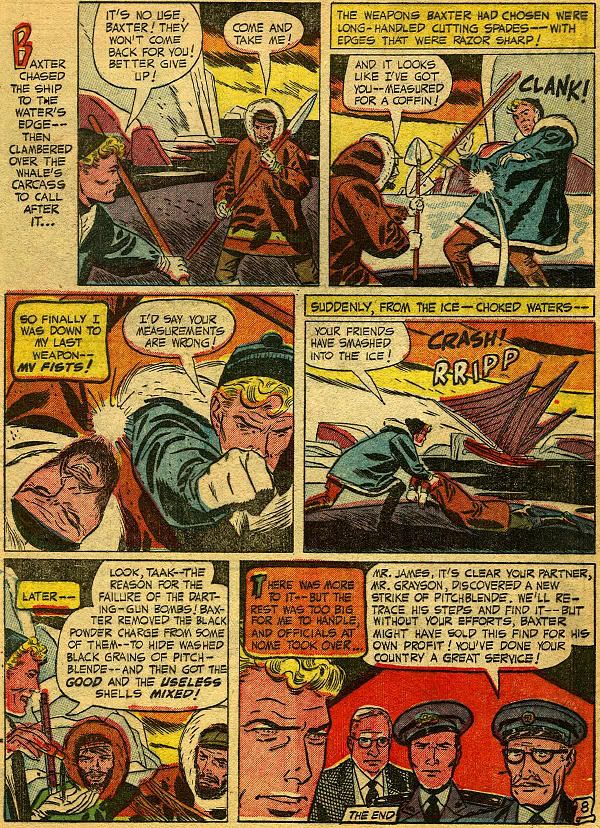
Danger Trail, the 1951 version, is one of DC's rarer titles, which is why I'm glad to have even an incomplete copy of #4; only two stories are intact, but they're by Infantino and Toth.

"End Of The Arctic" has a whale hunt using a grenade on the end of the harpoon. The grenade doesn't explode. The lead character shoots a seal just so the whalers won't feel bad about missing their whale. The seal shooting isn't shown, and since the grenade didn't explode and blow off part of the whale's top we missed that, but no one tell any animal rights group, OK? I'm on their side, but I'm just presenting the story as it was published 57 years ago. Besides the hunting aspect to the story, there's some mystery and intrigue going on. All political incorrectness considered, it's a good story with good art.

The Grand Comics Database tells us that David Vern wrote the story, Alex Toth penciled it, Bernard Sachs inked it, and Julius Schwartz was the editor.

Page 1 / Page 2 / Page 3 / Page 4 / Page 5 / Page 6 / Page 7 / Page 8
More about

Người đăng: Unknown on Thứ Sáu, 4 tháng 1, 2008


Number 243


"…I strongs to the finich..."


Animation fans of the Fleischer Brothers, and of Popeye cartoons, should be thrilled by the four-disk DVD set of the venerable sailor. Sixty cartoons, plus extras like documentaries on Popeye creator Segar, voice actors like Billy Costello and Jack Mercer as Popeye, and other extras like old Bray silents and Fleischer "Out Of The Inkwell" series cartoons. Whew. That's a lot, and like most of these types of compilations, comes at a price. I got mine for $42.99 from Amazon.

Like other Americans of my generation, I grew up with these cartoons on afternoon television, and also with the Popeye comics strips and comic books, then drawn by Bud Sagendorf. I knew there was a difference between the print Popeye and animated Popeye.

For one thing, with only seven minutes per cartoon to work with, there was no room for subtlety. They reduced the intricate storylines of the Segar strips down to a very basic formula: a love triangle, sexual jealousy, and cartoon violence. They also turned Popeye into a Fleischer character with the anthropomorphic stuff they were famous for; the Fleischers really understood how to use cartoons to their true potential. Rather than trying to duplicate reality in these early cartoons they made sure that reality rarely intruded.

In the 1934 cartoon, "Barnacle Bill," one of my favorites because most of the cartoon is sung using the popular song of the day, the formula is clear. Bluto, as Barnacle Bill, is Olive's boyfriend, even though Popeye refuses to go away. There is the inevitable fight, which Popeye wins after eating his spinach. When he beats Barnacle Bill the fickle Olive then wants him, but he doesn't want her. You could about set a stopwatch to each of the cartoons in the series to see when the fight would start, and there were endless variations on the actual fighting, but the outcome was always the same: the spinach, the victor, Popeye, gets the "prize," Olive.

In the strip there was more room to tell a story. In this comic strip sequence from the same year, 1934, Popeye is a newspaper man, who hires a cartoonist, B. Loony Bullony, because comic cartoons is what readers want! I've scanned a sampling of these from the original printed strips, clipped from a newspaper of the day. The strips are printed longer than my scanner bed, so I've split them in half. There was a lot going on every day in the strip.

The Segar Popeye and the Fleischer Popeye were two characters with the same name, appearance and some of the same subsidiary characters. Each medium had its own needs and limitations. Segar, in his silent strips, couldn't provide the catchy theme song, inspired gravelly Costello/Mercer voice of Popeye or the screech of Mae Questal's Olive. On the other hand, by reducing the animated Popeye to stories of such short length none of the richness of Segar's strip could be presented. Despite those differences, Popeye was one of the Twentieth Century's greatest comic creations. The cartoons are a joy to watch, just as the strips are a joy to read.

More about

Người đăng: Unknown on Thứ Tư, 2 tháng 1, 2008


Number 242


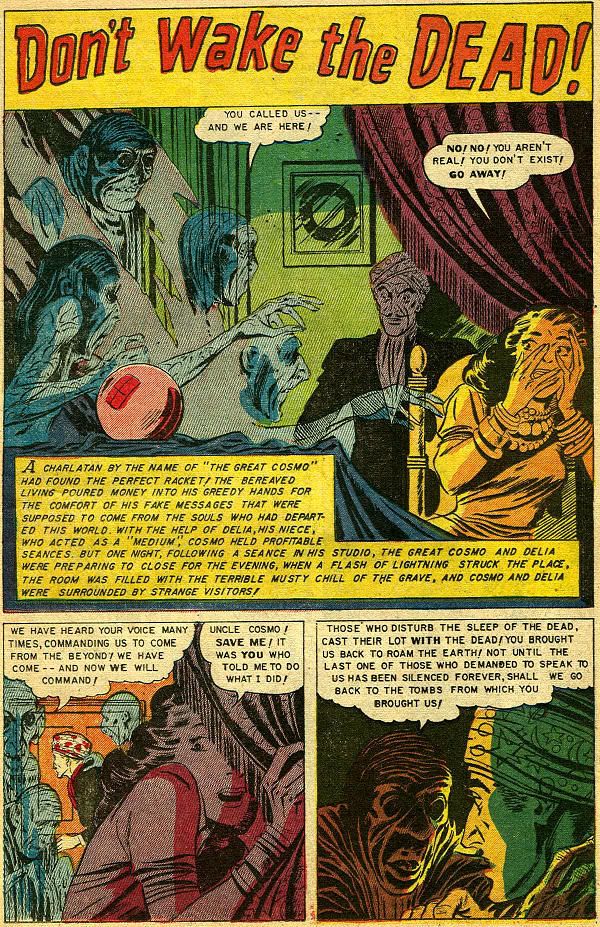
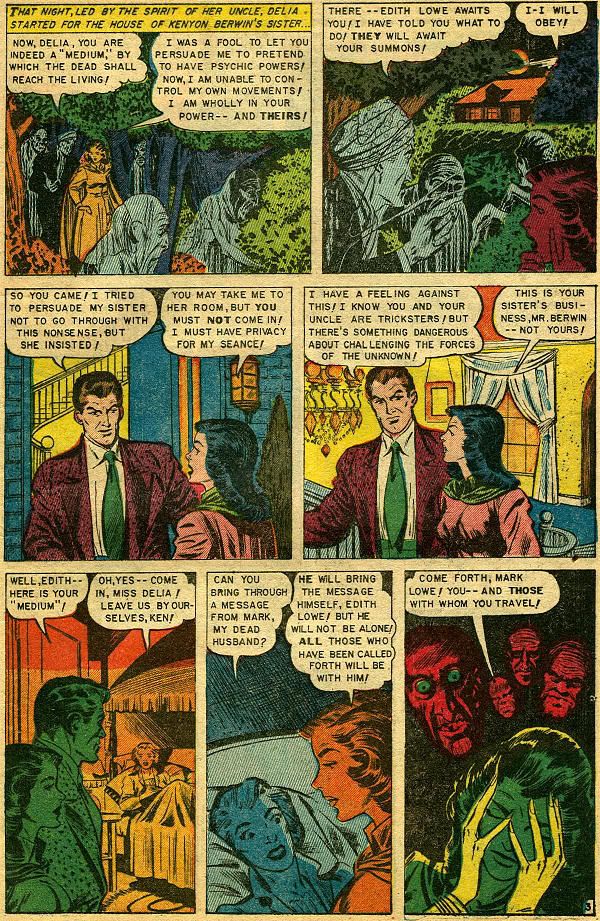
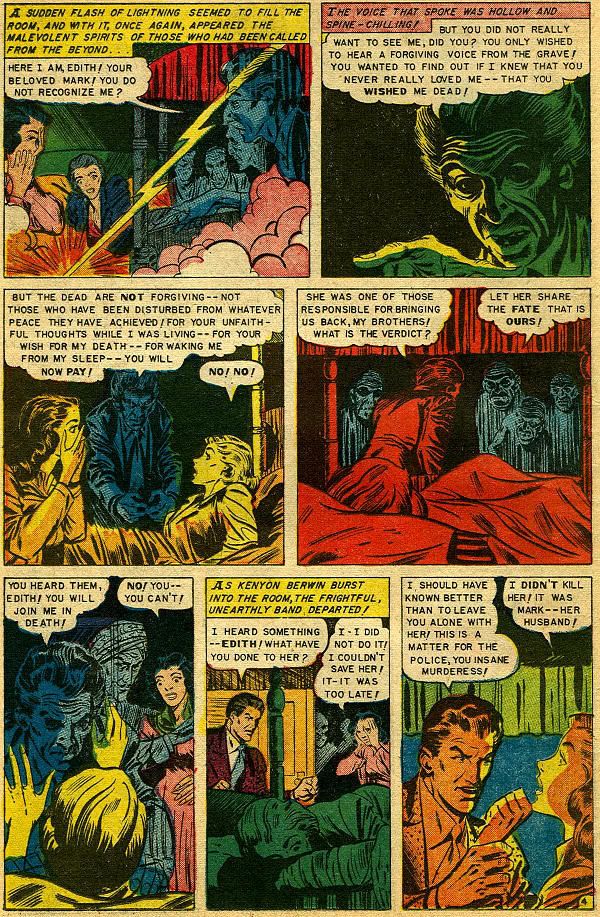
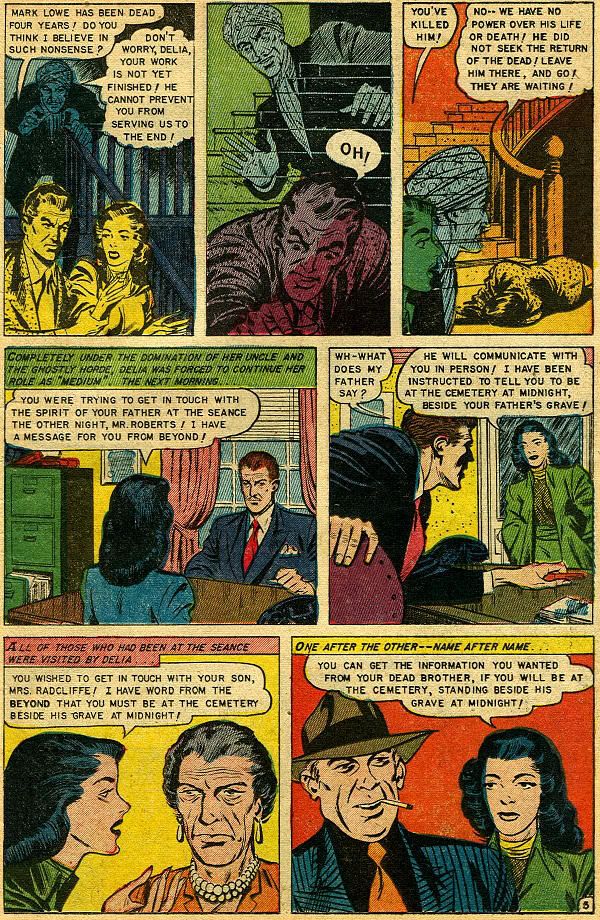
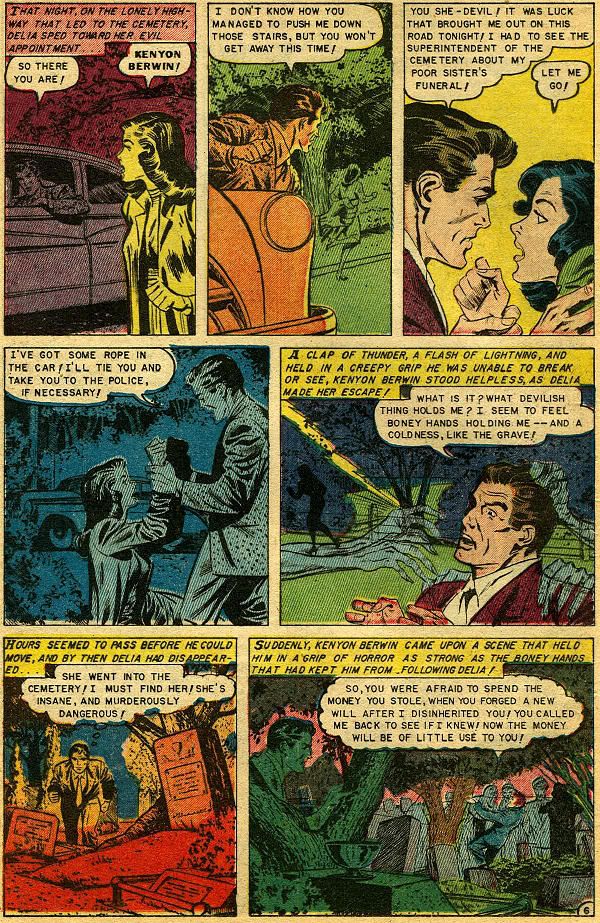
Don't Wake The Dead


I've got to go back to work today. I've been off since December 21, during which time I have been practicing retirement. I do this just about every year. I want to retire. I'm ready for retirement. When I'm not working I don't have to get up at 4:00 in the morning, which is why a title like "Don't Wake The Dead" seems appropriate.

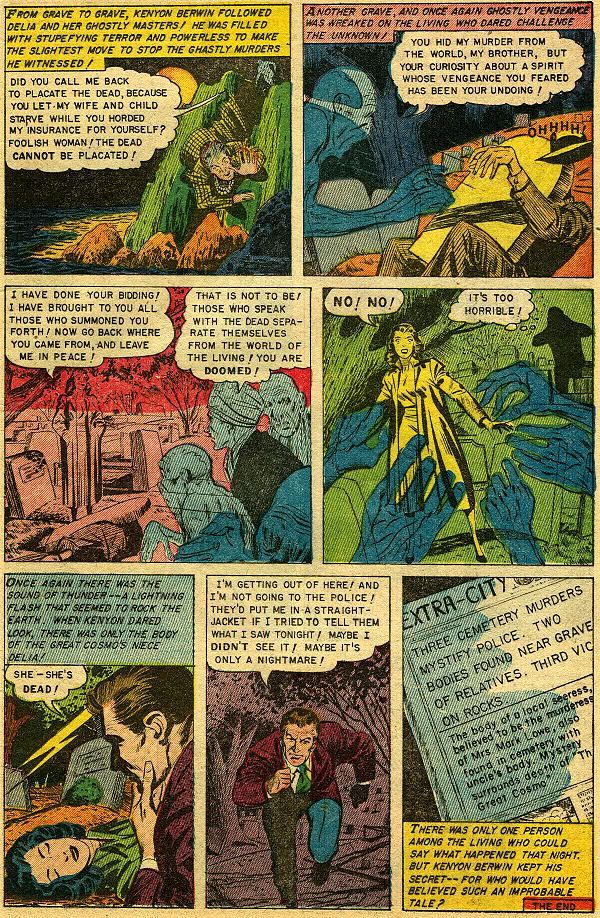
You think this story from a coverless issue of Ace Comics' The Beyond is a horror story…how about being a wage slave going back to 1965? Now that's a horror story.

Page 1 / Page 2 / Page 3 / Page 4 / Page 5 / Page 6 / Page 7

******

During my time off I read the biography, Schulz and Peanuts by David Michaelis. In 1947 Schulz, besides his day job at Art Instruction, Inc., was moonlighting as a letterer for the Catechetical Guild in St. Paul, Minnesota. According to page 167 of the biography, "[His boss, Roman] Baltes rewarded his efficiency, reliability, and thoroughness by having him draw the climactic panels of Is This Tomorrow--a dire prophecy of a Communist takeover tricked out as a "public service comic book.

I have never seen Is This Tomorrow, although I've seen the cover reproduced many times over the years. According to the biography, the comic book had over 4,000,000 copies in circulation at one point, so there have to be a lot of them out there. Has anyone ever looked at the last few panels and said, "By god, there's Charlie Brown!"?

More about

Người đăng: Unknown on Thứ Hai, 31 tháng 12, 2007


Number 241


John Stanley chills us


It seems right to show this chilling tale on a day when in my neighborhood the thermometer peaks around 0 degrees F. It's from the 1962 Dell Giant, Tales From The Tomb, written by John Stanley, scanned from the copy I bought 45 years ago.
Stanley, who had written and guided Little Lulu through that comic's classic years, had stayed behind at Dell when Western Publishing took their licensees and most of their talent and split off into Gold Key Comics. Despite the promise on the cover, Tomb wasn't what I thought of as a horror comic, but more like a collection of stories told by kids around a campfire. Some of Stanley's work--the Oona Goosepimple stories from Nancy, for example--reminded me of Charles Addams. Stanley had a sometimes macabre sense of humor, and stories of this style would appeal to him. Tales From The Tomb is probably what DC's Plop! should have been a decade later.

As good as Stanley's writing is, the anonymous art is OK, not great. It likely scuttled this title.

These three shorties, vignettes, really, are typical of the weird humor of Tomb. The black-and-white one-pagers are the inside front and back covers respectively. The story, "Turnabout," is one of the shorter stories in the book, and is told in as few words as possible. The grim but funny joke it tells is beyond logic, and is told in visuals rather than dialogue or captions.


Finally, it's the end of another year. I'd like to thank Pappy's readers for making this a very successful year for this blog. HAPPY NEW YEAR, everybody.


Your Pappy loves you!

More about

Người đăng: Unknown on Thứ Sáu, 28 tháng 12, 2007


Number 240


Who's Yehudi?


Irv Novick was an artist who produced a staggering amount of work for comics in his lifetime. I didn't appreciate him as much as I should have because he always seemed to be published in comics along with some real hotshots. When I saw his work in DC's war comics he was being published alongside Joe Kubert and Russ Heath.When he did Batman in the early '70s Detective Comics he was alternating issues with Neal Adams. All of those contemporaries were hard acts to follow.
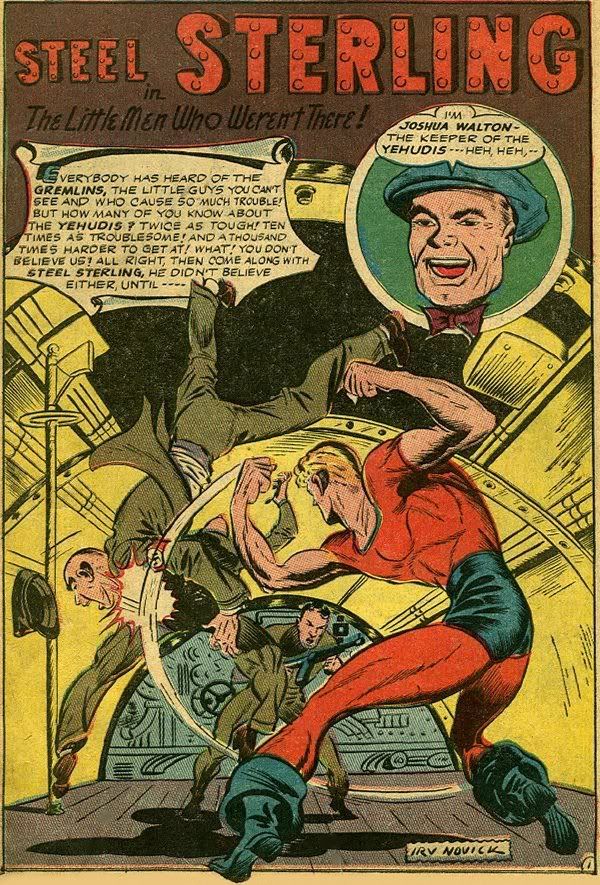
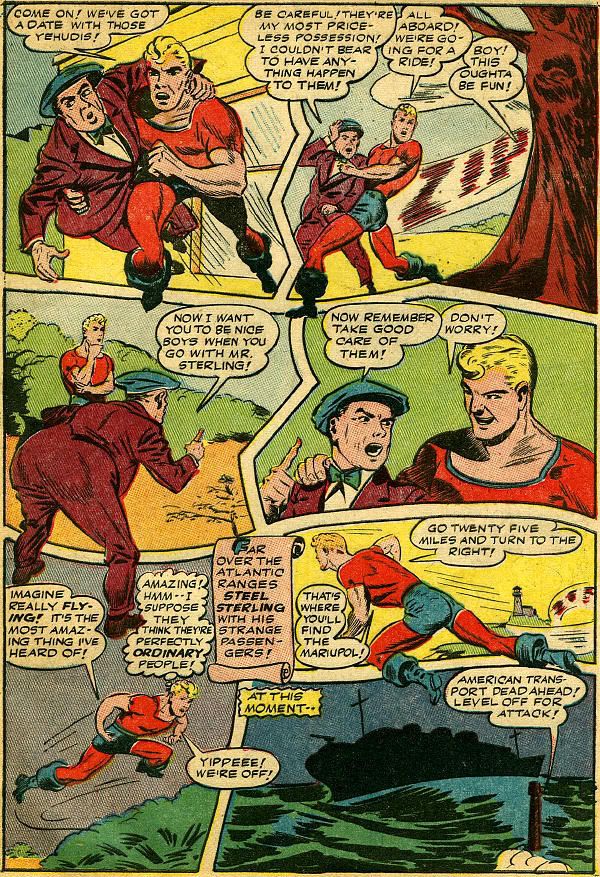
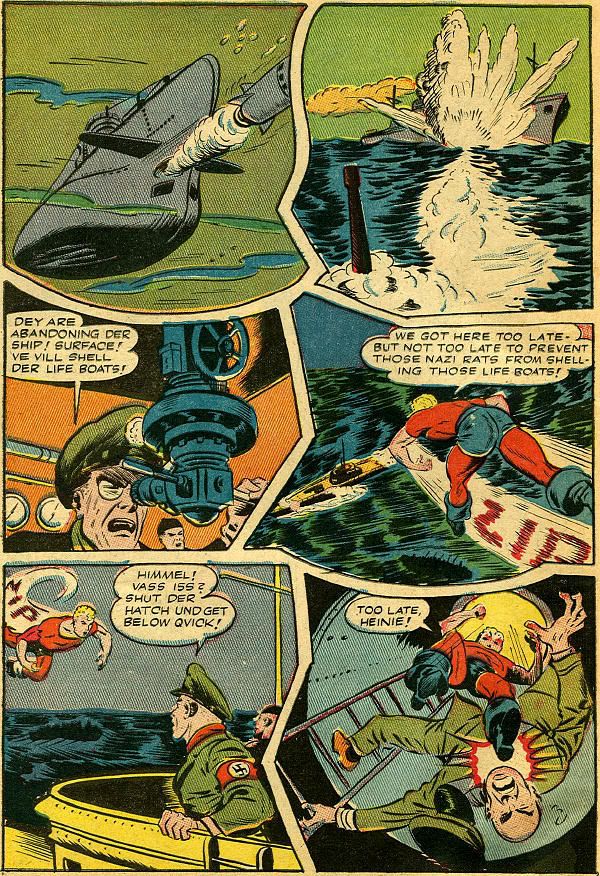
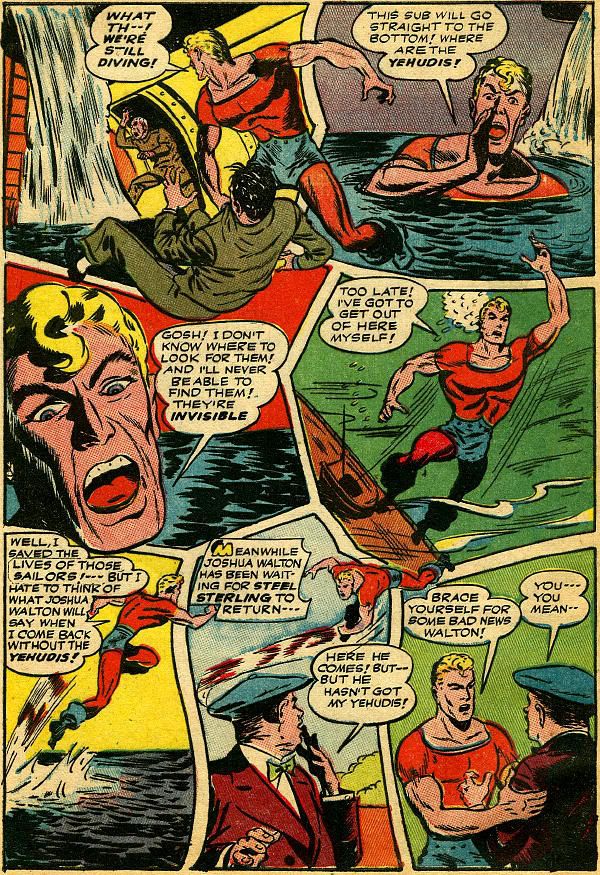
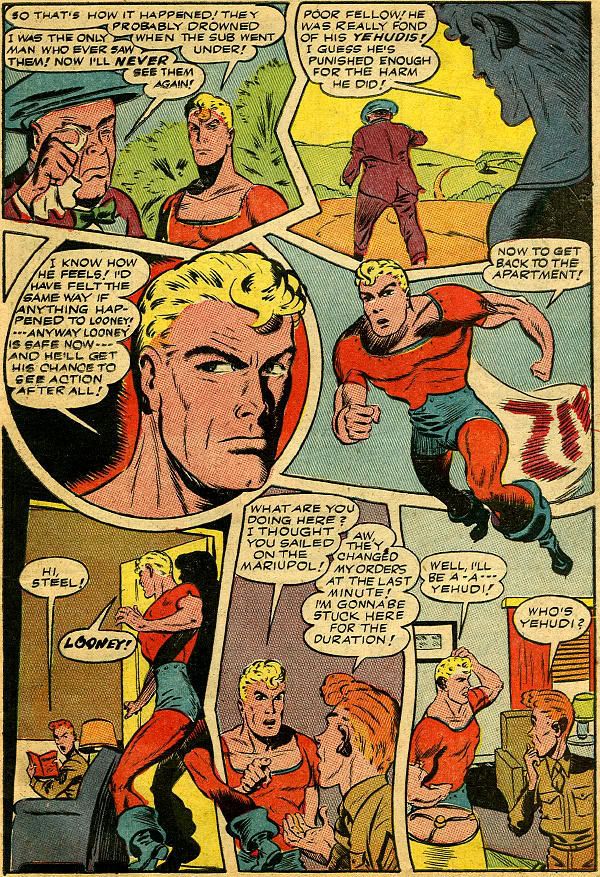
Novick had gone to DC Comics at the invitation of Robert Kanigher, who was writing and editing the war comics. Kanigher had worked with Novick at MLJ Comics in the early 1940s, where he was doing strips like the action-packed Steel Sterling story here, scanned from July, 1943's Zip Comics #38.

Novick died in 2004, and the obituaries I've seen for him are universally respectful of his talent and of his long tenure in the industry.

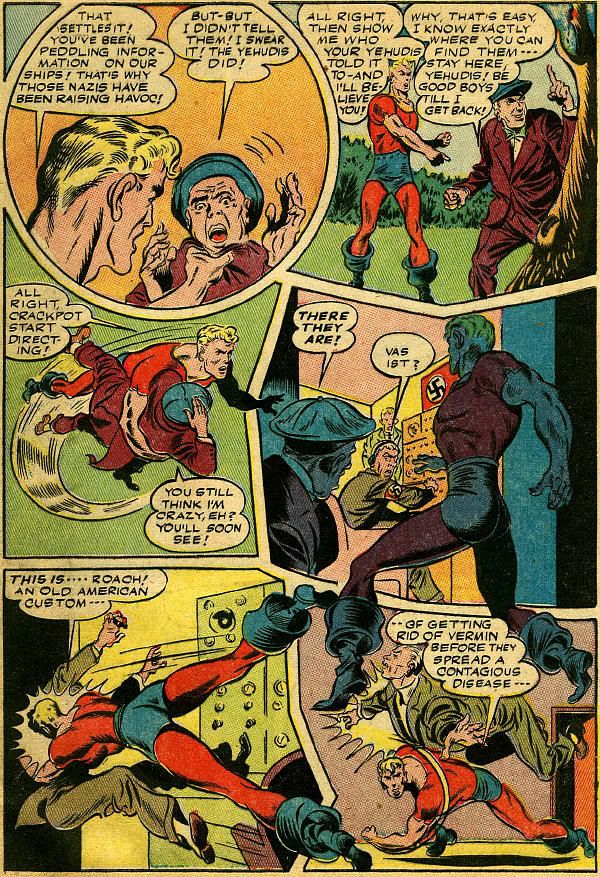
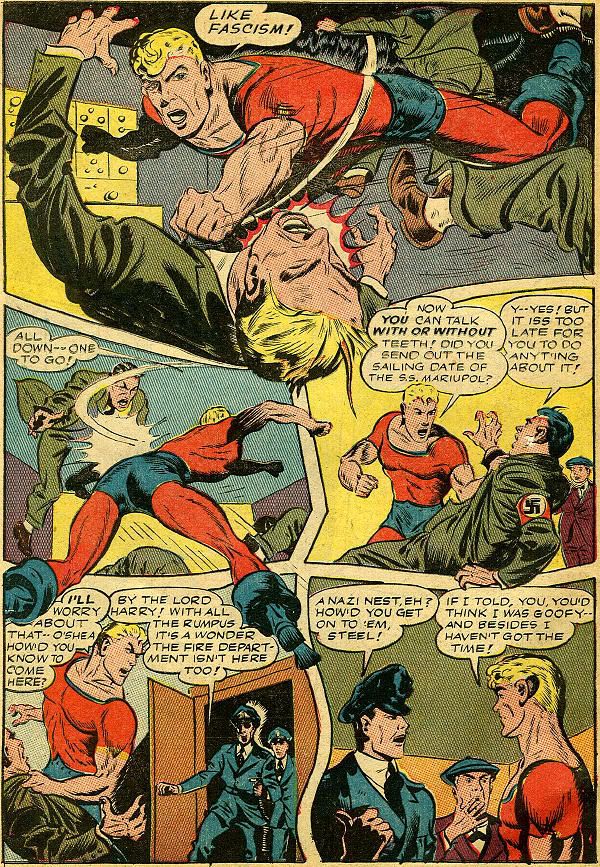
The "Yehudis" in the story are from a long-running joke by comedian Jerry Colonna on the old Bob Hope radio show. A Yehudi was "a little man who wasn't there," hence the question that became a catchphrase, "Who's Yehudi?" This was also the era of the Gremlins, little guys who sabotaged aircraft used for the war effort. That story is told in the latest issue of Hogan's Alley, #15, in "The Trouble With Gremlins, The True Story Of A Never-made Disney Classic," by Jim Korkis.

Page 1 / Page 2 / Page 3 / Page 4 / Page 5 / Page 6 / Page 7 / Page 8 / Page 9 / Page 10 / Page 11

More about

Người đăng: Unknown on Thứ Tư, 26 tháng 12, 2007


Number 239


"Can I choose waterboarding instead?"


I read that the Clock is considered the first masked character to appear in comic books. There were costumed and disguised characters in the pulps; the Shadow and Zorro spring to mind, but apparently before the Clock there weren't any characters in comic books who wore masks.

Well, how 'bout that for trivia?

I can't say a lot about the Clock's mask, though, since it is just a piece of black cloth with an odd little flounce at the bottom. It doesn't look like it would inspire terror in any criminals.

This story is from Feature Comics #26, November 1939. The drawing, by Clock creator George Brenner, is 1930s-styled comic book artwork: static figures, strict eight panel pages. The story is straightforward: The Clock is being framed and he goes right at the villain. The coloring, as in a lot of old comics from the Quality Comics line, is primary, and leads to interesting color choices, like a bright red car with yellow fenders. The colorist, obviously blinded by his or her colors, has completely screwed up the coloring in the last three panels, where Captain Kane and Fingers Holts switch colors, and then Captain Kane's suit changes again in the last panel to bright green.

There's one bit that struck me when the Clock threatens Fingers to make him confess. He tells him he's starved a rat, and what if he puts the rat on Fingers' belly under a metal bowl, and then heats the bowl? The rat can't chew the bowl to get out, so what does he chew? Bwooowaaahahahaa. Don't show this to the CIA. They might drop waterboarding in favor of this tasty torture.


More about

Người đăng: Unknown on Thứ Hai, 24 tháng 12, 2007


Number 238


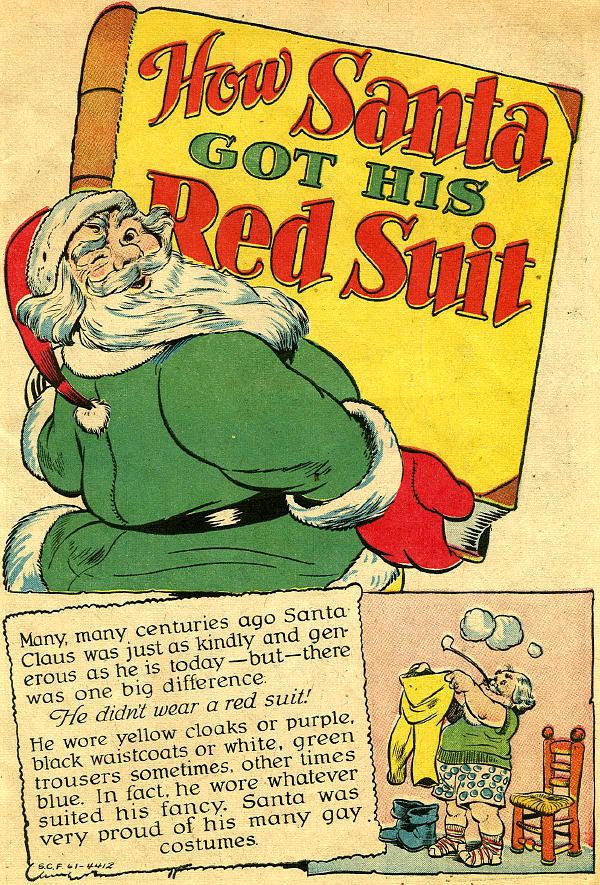
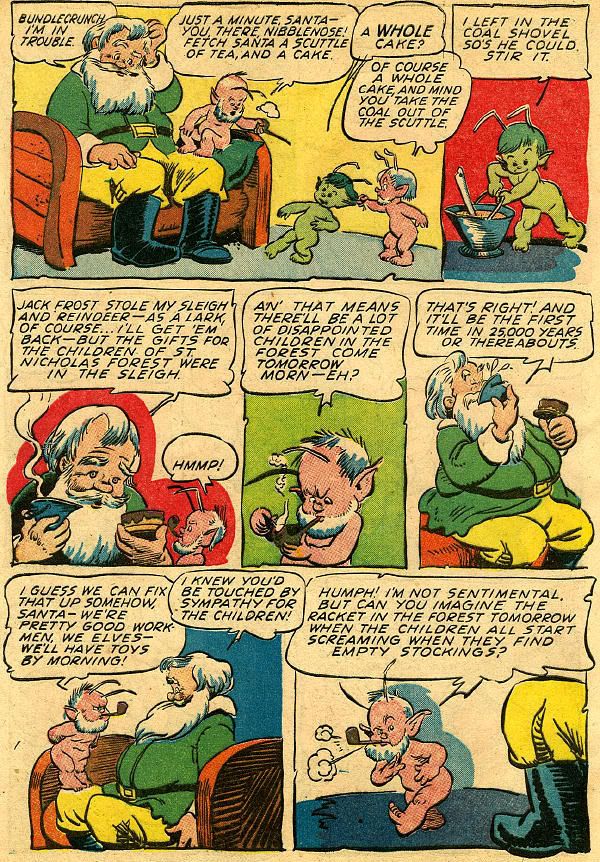
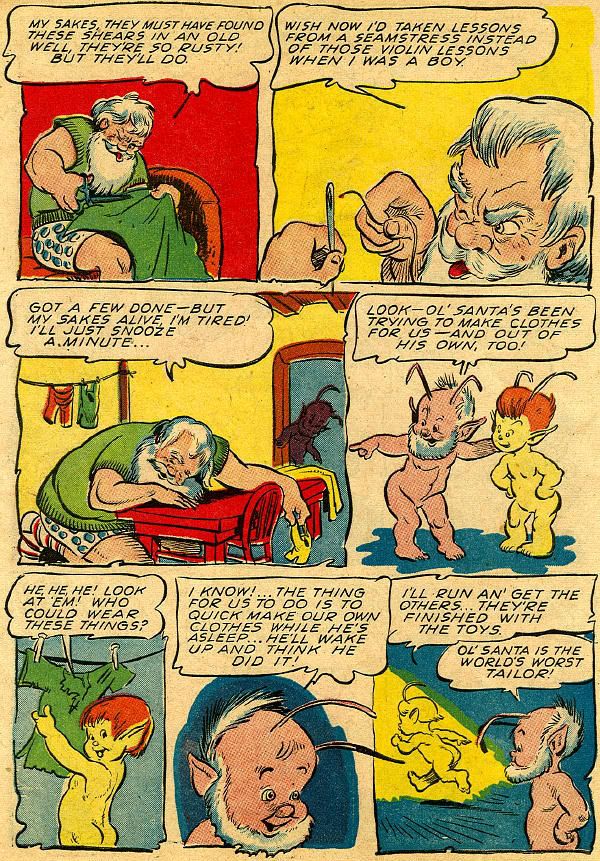
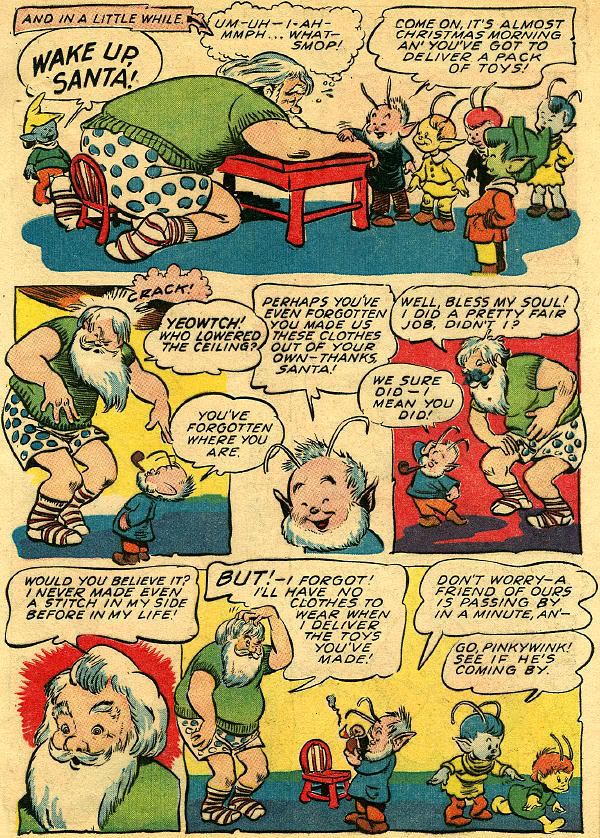
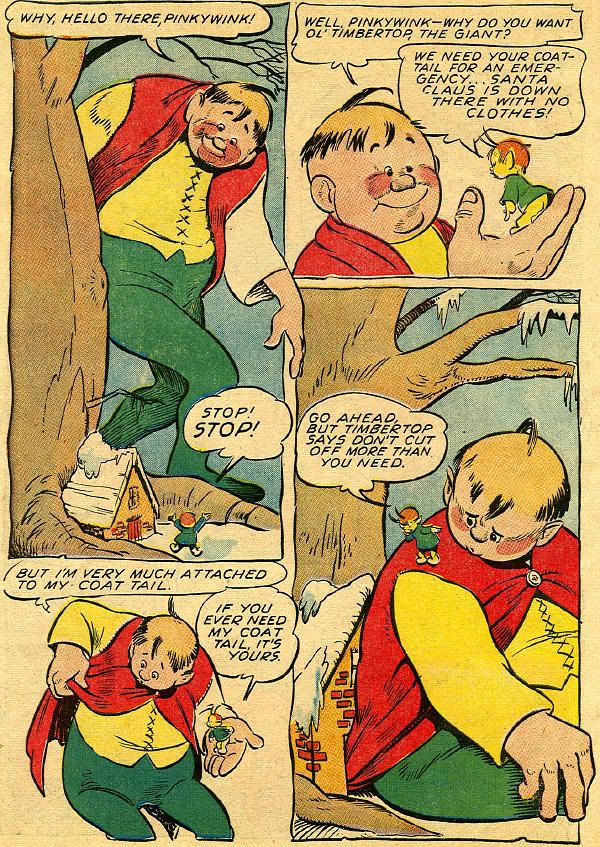
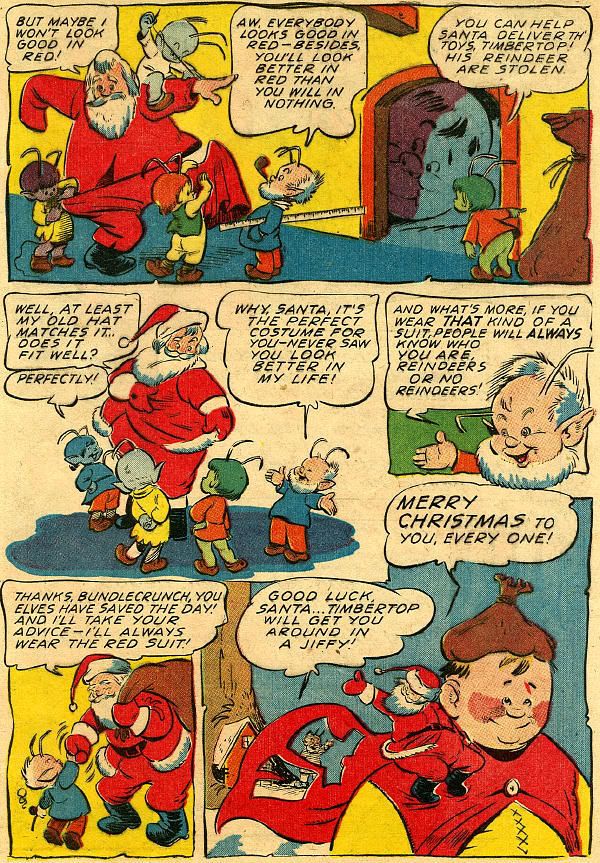
How Santa Got His Red Suit


It's Christmas Eve! Hope you boys and girls have been good this year, so Santa will give you what you want.

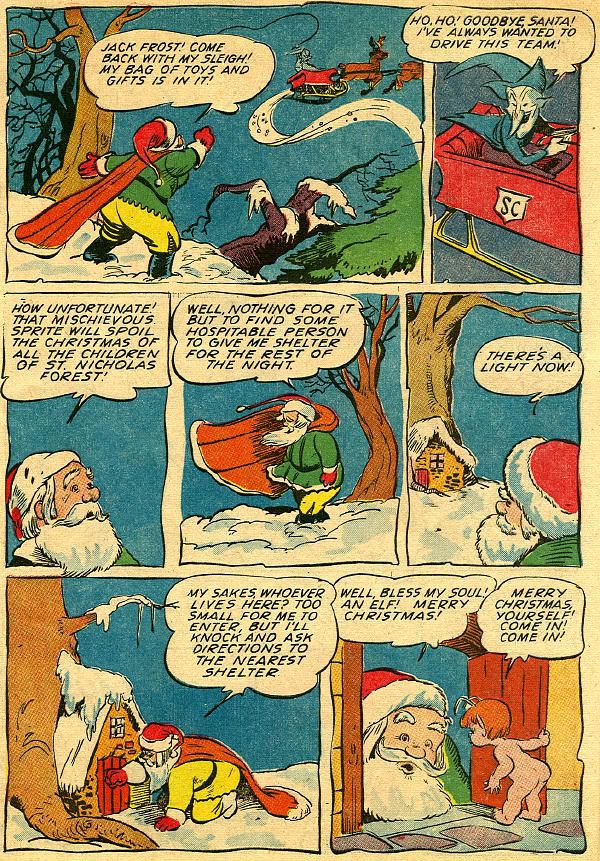
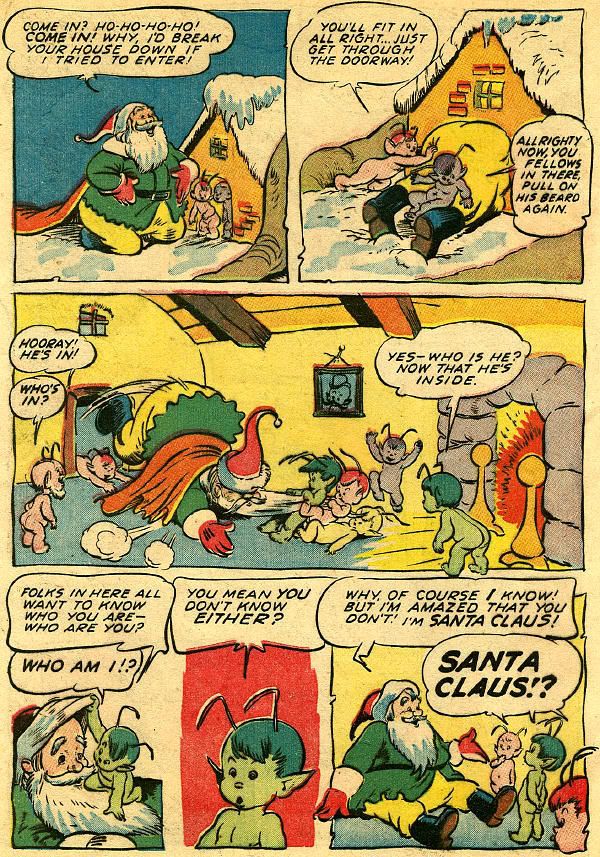
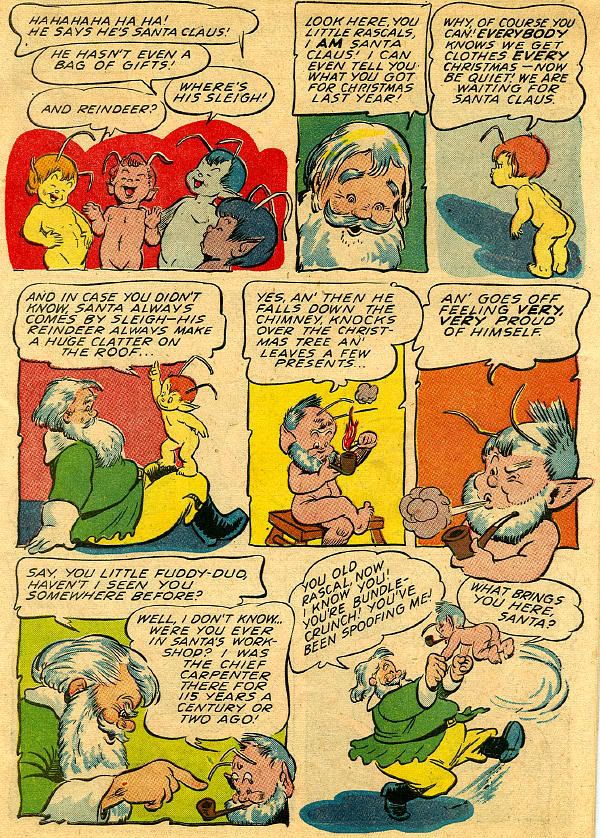
What Pappy wants is to give you are some good comics for Christmas, and here's a Walt Kelly strip from Santa Claus Funnies, Dell Comics Four-Color #61, December 1944. Santa, who doesn't wear his familiar red suit at the time, but dresses in his "gay costumes," goes on his yearly run, only to get sleighjacked by Jack Frost. Santa ends up with a bunch of naked little guys, who eventually get some clothes made from Santa's suit, and then make Santa the red suit we all know.

"How Santa Got His Red Suit" was reprinted two years later as the second of the March Of Comics giveaway series. The first three March Of Comics were by Kelly, which showed his popularity, even before his fame exploded into the mainstream with the Pogo comic strip five years later.

Page 1 / Page 2 / Page 3 / Page 4 / Page 5 / Page 6 / Page 7 / Page 8 / Page 9 / Page 10 / Page 11

*******

Ho-ho-ho! As a bonus, here are a couple of Santa Claus covers from vintage issues of Galaxy Science Fiction I picked up a couple of years ago. Santa has an extra set of appendages in these gorgeous Ed Emshwiller illustrations. This unearthly Santa embodies the old saying, "Forewarned is four-armed."

Merry Christmas, everybody!


More about