Hiển thị các bài đăng có nhãn Batgirl. Hiển thị tất cả bài đăng

Review: Batgirl Vol. 4: Wanted hardcover/paperback (DC Comics)

Người đăng: Unknown on Thứ Hai, 2 tháng 6, 2014

I had a little difficulty with Gail Simone's Batgirl Vol. 4: Wanted because for the most part it wasn't the story I was expecting given the end of the last volume. That's on me, however, not Simone, and indeed I found the story particularly moving at times and enjoyed it on final reflection. But surprisingly, what really sold the book for me was new series artist Fernando Pasarin's art, which I had not favored in Green Lantern Corps but which really, really works here, giving the book a realism it in some ways lacked previously.

[Review contains spoilers]

Batgirl: Wanted essentially contains two stories, the Villains Month-linked Ventriloquist story and then the "Wanted" story. The Ventriloquist story does reflect the overall circumstances of "Wanted," namely that Batgirl Barbara Gordon is being hunted by her father Commissioner Gordon for the apparent murder of her psychopathic brother James Jr., but it does not delve into it too much in earnest. The story tends to favor the new Ventriloquist villain more than Batgirl (the caper is all the Ventriloquist's, and Batgirl "just happens" to show up when trouble starts) and so the focus feels off if, like me, you're expecting Fugitive-esque Batgirl action. I don't mind a new villain like the Ventriloquist getting a profile story; I just wasn't expecting the spotlight to go off Batgirl so quickly after Batgirl Vol. 3: Death of the Family's strong finale.

Given that, I thought Simone did well enough with the new Ventriloquist. It continually surprises me that the original Ventriloquist Arnold Wesker first appeared in 1988, given how "classic" a Batman villain he seems now, and it's likely a testament to it that we get a new New52 Ventriloquist as well. The two-part story reads like a horror flick (the ongoing tone of Batgirl to some extent) and Simone presents well the common "evil puppet" tropes, with the dummy Ferdie skittering along the floor and stabbing people's eyes with the blades in his hands.

I tend to like my Batman villains "real" (or at least "magically real"), and Simone giving the Ventriloquist metahuman powers to control Ferdie, among others, felt too "superheroic" to me. At the same time, I can't argue with the creepiness of Batgirl having to fight two animated, decaying corpses, even having to go so far as to handcuff them, so Simone makes good use of it all. Again, if this didn't feel as though it interrupted "Wanted," I might be even more satisfied with it.

"Wanted" starts with a prelude issue that mainly involves Barbara out on a date. With twenty-some issues past, Simone has by now established the character of the "new" Barbara Gordon, but I believe this is Batgirl's first issue with the hero out of costume the entire time. As such, I felt I got (or got again) who this Barbara Gordon is, her likes and dislikes, her sense of humor, and so on. Simone does especially well showing, often at the same time, Barbara's Batgirl-given confidence and also her brainy social awkwardness -- Moreover, given how confident and in-control Oracle usually was, I felt I could really see here how different, appropriately, this Barbara was from Oracle, but also how one could reasonably some day become the other.

The story gets darker after the date issue, and ultimately Simone ties it all together such that the date issue is relevant. But in reading it the first time, I still felt the book was "off"; there's two not-really-"Wanted"-related Ventriloquist issues plus a tonally light date story, and at that particular point I was wondering whether the book, called Wanted, would ever quite get down to it.

Fortunately, "Wanted" gets serious almost right away, when after a series of events Barbara appears to fail to stop her father from shooting said date, Ricky. Ricky is an interesting character here, who seemed in his first appearance to just be a one-off victim of the villain Knightfall, and who was brought back not by Simone, but by Ray Fawkes during his short stint on the title. Simone kept the character and impressively built a convincing relationship between unlikely partners Barbara and Ricky in the aforementioned date issue. But given Ricky's tenuous role in the book, Simone had me pretty convinced the character wouldn't make it. That's not the case -- Ricky recovers miraculously in the end (unless it's the Ventriloquist) -- but the pages leading up to the shooting are among the most harrowing in the book, intercut well by Pasarin.

"Wanted" ultimately arrives at the Batgirl/Commissioner Gordon conflict, though there's a convoluted series of events in between involving the villain Knightfall that I didn't think was necessary (I like Knightfall and would rather see a story about her conflict with Batgirl than have Knightfall's goons play second-fiddle to the Gordons' story). The conclusion is quite affecting, though -- not when Batgirl tries to unmask to Gordon (with too many shades of No Man's Land here), but when she turns Gordon's anger around on him somewhat psychologically, demonstrating that he's really mad at himself, not her. This was unexpected, but made sense, and served simultaneously to assuage both father and daughter's guilt. I might have preferred more of Commissioner Gordon chasing Batgirl through the streets in this book, but the end is exactly what I would have wanted irrespective.

The book also includes the Villains Month Ventriloquist issue by Simone (Batman: The Dark Knight #23.1) and the Zero Year tie-in, Batgirl #25 by Marguerite Bennett. Both are fine if not necessarily notable issues, and I'd prefer that DC included them than not (some books are omitting their issue #25 in favor of the DC Comics: Zero Year collection, but maybe a Bat-title gets an exception); that Pasarin draws Bennett's issue offers nice continuity despite Simone's absence. My key problem with each is that obviously something has happened in the DC Universe -- people seem hungry and desolate in both -- but neither issue takes pains to explain what the situation is. Bennett's sudden introduction of Gotham's Coldlight Island is especially confusing, and I wonder if that appears in Scott Snyder's Batman: Zero Year or not. For a reader not "in the know" about other events in the DC Universe, it seems to me this trade needed a text page or two.

Batgirl Vol. 4: Wanted does not take as direct a path as I'd hoped, but there's still some excellent character work from Gail Simone here and plenty of surprises and chills. Artists like Ardian Syaf did a fine job on this book at the start, but Syaf and Ed Benes have a rounded, animated style; I felt Fernando Pasarin's figures were too human-looking to follow Patrick Gleason drawing aliens in Green Lantern Corps, but his actually-human figures in Batgirl are just right. Though Wanted gets serious, it is in some ways not as "serious" as the previous Death of the Family collection, but Pasarin does well in making the characters seem "real." That reality contributes mightily to how Barbara Gordon's personality comes forward in this book, and I hope DC keeps Pasarin on this series for some time to come.
More about

Review: Batgirl Vol. 3: Death of the Family hardcover/paperback (DC Comics)

Người đăng: Unknown on Thứ Hai, 4 tháng 11, 2013

There's a lot going on in Batgirl Vol. 3: Death of the Family. It's a thick hardcover, collecting seven issues, an annual, and a short story. It has three writers. It includes a sizable component of the latest Batman crossover and the tertiary "Requiem" event. And it collects the issues during the span of which writer Gail Simone was fired from, and then rehired to, the Batgirl series.

And despite a number of factors that would derail any other book, it's pretty darn near perfect.

Simone's Batgirl is a series that started strong and has just grown stronger, and Death of the Family is the strongest chapter yet. There is blood and danger and horror on every page of this book; as riveting as Scott Snyder's main Death of the Family book was, Simone's "tie in" rivals it page for page.

[Review contains spoilers]

As controversial as returning Barbara Gordon to the Batgirl cowl in the New 52 was, it has afforded Gail Simone the opportunity to introduce to modernity the character we didn't realize we were missing all along -- to write Batgirl Barbara Gordon as if she'd never disappeared, as if The Killing Joke were just a storyline for the character to surmount. Simone's Death of the Family serves as something as a sequel to Killing Joke, the confrontation between the Joker and a newly-recovered Batgirl that we probably should have seen twenty years ago (though it was worth the wait). There's plenty to enjoy in Batgirl matching wits with the Joker, but the initial scene where an unarmed Barbara thrashes three invaders in her home, turning Killing Joke on its head, is undoubtedly cathartic for both the character and the readers.

Simone plays the story with equal parts horror and intentional camp; the Joker's harebrained scheme to marry Batgirl might be something out of the wacky Silver Age, if not for the Joker slicing off Barbara's mother's finger and offering it up, wedding band and all. The result is a sickly feeling in the audience's stomach the whole time; if there are moments we might laugh, we get the sense they're only fleeting. Though not gratuitous, this is a significantly violent book, underscoring the seriousness of the threats Batgirl faces here; Death of the Family is no light read.

Cleverly, Simone gives "Death of the Family" a double meaning; the book starts off as a fight between Batgirl and the Joker, but ends with Barbara squaring off against her own psychotic brother, the Black Mirror's James Gordon Jr. In the gripping ending, I really did think Barbara was going to kill James, and though she does not (or did she?), Batgirl is still branded a murderer, hunted by her own father. I will be curious to see how Barbara maintains her relationship with Commissioner Gordon while he's her enemy in the nighttime, and how Barbara's mother, who knows her secret identity, will play into the mix.

Simone writes issues #14-16 in the collection, and then Ray Fawkes takes over for issues #17-18 before Simone returns with #19 (the aforementioned "firing" period). Were it not for the hubbub, reading the issues might almost seem like business as usual. Whereas Simone usually has Barbara narrate the issues, Fawkes narrates from James Jr.'s point of view, so there's no sense that the narration voice is "wrong," just different. Fawkes picks up on a moment between Batgirl and her informant Ricky that lead from both Simone's Batgirl Annual #1 and also in Fawkes's Young Romance story (collected here), such that the plot developments feel very natural. The villain Firebug that Fawkes introduces is goofy, but it's the kind of misstep that's forgivable for what turns out to be just a fill-in writer.

Where Death of the Family handles the "Death" crossover exceptionally well (unlike "Night of the Owls," if you didn't know better you'd think "Death" was solely a Batgirl event), "Requiem" gets short shrift. While this is also forgivable, given how much else is going on in this book, Batgirl's reaction to the death of Robin Damian Wayne is limited to a page plus a panel (and an affecting cover by Justice League Dark's Mikel Janin). The "Requiem" issue is Fawkes's #18, and Damien isn't mentioned again through Simone's #19. This is surprising given such a momentous event, but then again maybe not so surprising given again what one imagines to be the hubbub behind the scenes.

Inasmuch as the "Night of the Owls" crossover seemed incidental to the Bat-titles it tied in to (especially given how much more meaningful "Death" turned out to be), it's a pleasant surprise to see "Batgirl's Talon" Mary show up in the Batgirl Annual that starts off the book. Though Mary, as I understand it, moves on to Birds of Prey, the Batgirl "Night of the Owls" issue seems less incongruous now that Mary is part of Batgirl's rogues' gallery/ally set. Simone also offers insight into the continuing Court of the Owls organization, something we haven't found over in the Batman book.

I also like that Simone is able to write the "official" first meeting between Batgirl and Catwoman. One benefit to the New 52 is that Batgirl and Catwoman's "old" first meeting is likely lost to the ages or has been told and retold a number of times, but here now we can point to it and say, yes, they met in the Batgirl Annual #1. Simone writes an appropriately morally-conflicted Catwoman; why DC Comics hasn't given Gail Simone a shot at writing Catwoman yet, I don't know.

At 224 pages, Batgirl Vol. 3: Death of the Family is a weighty book, and it deserves to be. Batgirl battles her way through two of the Bat-family's deadliest villains, and the blood spattered page to page does justice to what Batgirl encounters here. Each volume of Gail Simone's Batgirl gets better and better; I'll be eager to see how Simone tops this one.

[Includes original covers, sketches of Firebug by Daniel Sampere]

Coming up -- Justice League of America: World's Most Dangerous!
More about

Review: Batgirl Vol. 2: Knightfall Descends hardcover/paperback (DC Comics)

Người đăng: Unknown on Thứ Năm, 7 tháng 2, 2013

Gail Simone's second volume of the New 52 Batgirl series, Batgirl: Knightfall Descends, is a compelling book. It veers a tad into generic superheroics, but at other times delivers wonderfully shocking horror, and a good deal of heart, that speak well for the title. Batgirl, on occasion, seems to work too hard to remind the reader of the "girl" sharing the title with the "bat," though its hard to argue with the title's right to do so; even so, the second volume of Batgirl is better than the first, and suggests even better things to come.

[Review contains spoilers]

Knightfall Descends includes two main storylines -- Batgirl's battles against the villains Grotesque and Knightfall respectively -- and then two one-issue stories, the Zero Month origin and the "Night of the Owls" crossover tie-in. Purists may have some objection to Simone's new Batgirl origin but I found it passably fine, neither worrisome nor especially moving. Simone has Barbara Gordon stop an inmate rampaging through the Gotham police department with the help of a borrowed Bat-costume, ultimately meeting Batman himself. The story generally negates but does not specifically rule out the "costume party" origin, which is a nice touch; its larger goal seems to be to bring the maddened James Gordon Jr. into Batgirl's origin, which becomes more important as James's role in this title grows.

The "Night of the Owls" chapter is plenty understandable even if you're not reading the crossover itself. Simone uses the immortality of the Owl organization's Talon warriors as an opportunity to get into some fascinating World War II history. Also there's a bit in which the Owls threaten and actually control Commissioner Gordon for a while, which is harrowing (and leads me to wonder if the Joker will be able to do the same in the upcoming "Death of the Family" crossover), even though it seemed Gordon was turned too easily for so seasoned an officer. The Batgirl aspects are fine and artist Ardian Syaf begins to draw a smaller Batgirl that better physically resembles the more familiar Stephanie Brown and Cassandra Cain (see the "Holy cats" splash page, for instance).

My one qualm about the "Night of the Owls" chapter, and this carries through to the rest of the book, is that Batgirl starts to become the distaff Bat-title. Granted, Batgirl has fought the men Mirror, Grotesque, and Harry X, but it's glaring that she's pitted against a female Talon (whereas the male Bat-family fight male Talons). Then, she fights the female Knightfall and her predominantly female henchmen, with backup from Batwoman and the female Detective McKenna. It begins to look like the Batgirl title won't let Batgirl fight men or needs her foes to be predominantly women (a problem Wonder Woman titles sometimes have, too). I don't imagine such a thing would come from Simone, and again if any title had a right to spotlight DC Comics's female characters, it's Batgirl, but the same wasn't a problem, for instance, in Bryan Miller's Batgirl series before this one.

In the "Grotesque" story, Simone continues to examine Barbara's shooting by the Joker. I respect that rather than set aside the shooting, which was bad for comics itself, Simone keeps returning to it and unpacking it, trying to really look at what happened and what it means. Here, Batgirl meets one of the Joker's former henchmen, Danny, now working for Grotesque, who actually called an ambulance for Barbara after the Joker shot her. This brings a hint of grace to the otherwise horrific event, and in its way actually redefines The Killing Joke -- as recently as this book's zero issue, artist Ed Benes redraws that iconic panel of the Joker standing in Barbara's doorway, but now the reader can also see Danny standing behind the Joker and think of mercy, not solely of the horror. When the Danny tells Batgirl that "something went wrong" with the Joker's plan, this could as easily be a commentary on Killing Joke itself.

What I mainly didn't like about the "Knightfall" arc is that Simone creates for Knightfall three henchmen who, at least at the beginning, seem very run-of-the-mill ("strong lady," "flying lady," and "electric guy"), the kind of forgettable villains that never assert themselves and take up space in the annals of DC Comics trivia; that Knightfall herself, Charise Carnes, is introduced very quickly as someone known in Gotham for years, which is hard for the reader to feel since indeed she's really a new character (and her "double C" initials only belabor the point that she's Batgirl's new "Lex Luthor"); and that I was never quite convinced that Carnes earns the name Knightfall, a phrase so tied up in Batman's 1990s Bane encounters -- it would be like calling one of Superboy's minor New 52 enemies "Doomsday."

All of that aside, however, I was quite on board with the "Knightfall" arc by its conclusion. Knightfall emerges as a Bizarro Batgirl -- her father was a criminal businessman, not police commissioner; Carnes, too, experienced a tragedy; whereas Barbara became a crime fighter like her father, Carnes became a diabolical cult leader. That Batgirl will have an archenemy, especially one who seems to have some talent for technology a la Batgirl's former identity Oracle, is a great step for the character, and I look forward to the "rogue war" that Simone teases.

Also, Simone's DC work has gained a great element of horror especially since Secret Six, and such was apparent on her second run on Birds of Prey, too. The "Knightfall" arc presents this horror as well; the gruesomeness is slightly muted by Benes's and Syaf's more cartoony artwork, but it still comes through in Knightfall's origin and in the plight of Ricky, a car thief that Knightfall tortures. When it's just Knightfall's henchmen, Knightfall Descends begins to seem a little silly, but by the time Batgirl and Knightfall throw down at the end, no doubt the book is deadly serious, and it's tough to turn away from it.

It's fun to see Batwoman in these pages, though I wish there had been more direct interaction between Batgirl and Batwoman; Batwoman's real role in the Bat-family remains undefined, and I think her appearance here just around the edges of the story reflects some uncertainty about how the character is meant to be used. Ardian Syaf should be commended for a great J.H. Williams homage in the first pages where Batwoman is introduced, artfully "shattering" the panels and overlaying a bat-shape much like Williams does.

Batgirl: Knightfall Descends, if it has fits and starts, runs headlong into a fantastic conclusion, and that's enough to keep me excited for the next volume. It's certainly a boon to fans that Gail Simone will be remaining on this title -- with all she's set up here, between Knightfall, James Gordon Jr., and the return of the Joker in "Death in the Family," I'm eager to see her have plenty of time to bring these stories to fruition.
More about

Review: Batgirl: The Greatest Stories Ever Told trade paperback (DC Comics)

Người đăng: Unknown on Thứ Hai, 8 tháng 10, 2012

[Guest reviewer Zach King blogs about movies as The Cinema King]

After looking at some of the heavy-hitters of the DC Universe, we return to my comics hometown of Gotham City, the place where I feel most comfortable, the place where I was "born" into comics at age 3. This time, though, we're looking at a different member of the Bat-family -- Batgirl: The Greatest Stories Ever Told.

As with the Green Lantern trade, though, the title is something of a misnomer; what this volume really collects are the "greatest" Barbara Gordon Batgirl stories. A "best of" Batgirl trade ought to acknowledge that Babs isn't the only woman to don the cowl, so the omission of Cassandra Cain and Stephanie Brown is a glaring one.

What's more, the volume is slim -- only seven complete stories and 160 pages -- noticeably so in hand and on the shelf next to the other "Greatest Stories" trades. I'll kibitz more about what's not in the trade at the end of this review, but as for what we do have? It's actually a very good profile of Babs's stint as Batgirl.

The sum of the parts being more than the whole in this series, let's take a look at what's inside this volume.

"The Million Dollar Debut of Batgirl" (Detective Comics #359, January 1967): While we all know that this story was a backdoor opportunity for the campy 60s TV show to introduce Batgirl, Gardner Fox and Carmine Infantino turn in a story that still works, especially the bit about Babs as an accidental hero in what is essentially a Halloween costume (a detail nearly every other version of the character has used). Killer Moth is admittedly an odd choice for a first foe, but his pushover status lets Batgirl shine while allowing Batman and; Robin to step aside bemusedly and let her take center stage. An unsurprising inclusion, "Million Dollar Debut" still works.

"The Orchid-Crusher" / "The Hollow Man" (Detective Comics #396-397, February-March 1970): This is the only story that really falls flat in this collection. There's nothing truly "great" about this, although its uncomplicated plot allows us to see Batgirl in action without the Damoclean Sword of Continuity hanging over her every decision. What doesn't work, however, is the thinness of the procedural plot, in which Batgirl joins a dating service to track down a serial killer with a proclivity for redheads. Under Frank Robbins's script, Babs is surprisingly condescending, and the clues/red herrings are so flimsy that I had to read the story twice to figure out how the story's conclusion fit with what I'd just read.

"The Unmasking of Batgirl" / "Candidate for Danger" / "Batgirl's Last Case" (Detective Comics #422-424, April-June 1972): At first, there's nothing remarkable about this story, until Babs decides she's going to run for Congress -- and then we, the readers, realize she's going to win. Robbins begins to redeem himself here; while the story isn't particularly well-written (much of the politicking here is cliched and one-dimensional), it's much better than the previous entry, and you get the sense that this story matters. More importantly, the story gives a good sense of who Babs is, since she spends a lot of time out of costume; it might be no surprise that this storyline was published almost immediately after the O'Neill/Adams Green Lantern/Green Arrow realism road trip. And it's a mercy when Jim Gordon admits he knew his daughter's identity all along, although "Kick off, baby!" is a little too hip for my Commish.

"The Invader from Hell" (Batman Family #1, September/October 1975): Elliot S! Maggin and Mike Grell introduce the Batgirl/Robin team with an off-the-wall adventure in which Batgirl and Robin fight the revivified Benedict Arnold and his accomplice, Satan (who, Chris Sims has noted, looks suspiciously like Stan Lee). While the premise is wonky and the conclusion jingoistic at best, there's a real sense of chemistry created between the two youngsters, and the moment when they kiss is explosive. This kiss, and the story overall, really works thanks to some inventive work by Grell, who plays with panel structure and sequencing to create a dynamic reading experience. The action may be bizarre, but the longevity of the Dick/Babs relationship speaks to the emotional backbone of the story.

"Startling Secret of the Devilish Daughters" (Batman Family #9, January/February 1977): Here we're introduced to Duela Dent, and for that alone this is a significant entry in DC continuity. It's not, however, a Barbara Gordon story, although she does team up with Dick Grayson to take down Duela. The true star here is Robin, who deduces Duela's true identity with such aplomb that even the narrator can't explain it (honestly, this is more of a storytelling cheat than it sounds). Babs tangles with Duela and gets honored for her work as a Congresswoman, although her devotion to the job has already been established within this anthology, making this tale somewhat superfluous. That said, it's a fun and compelling read, even if the "startling secret" is a bit easy to predict.

"Photo Finish" (Batman Chronicles #9, Summer 1997): With "Photo Finish" we jump to a post-Crisis world for a different look at the debut of the Batgirl and Robin team. Written by Devin Grayson (surprisingly and/or disappointingly, the only woman contributing to this trade), we find Batgirl and Robin taking down museum robbers in what quickly starts to feel like a "first date." Again, the chemistry between the two is palpable, and it's not difficult at all to fall in love with either one of these crimefighters. Duncan Fegredo's art is solid here, too; while he's best known for his work on Hellboy, Fegredo does great work with facial expressions, giving vivid emotion and character to our protagonists.

"Folie a Deux" (Legends of the DC Universe #10-11, November-December 1998): We close with this Kelley Puckett and Terry Dodson story that is full of surprises. Not in the story it's telling, but in the manner in which it's told: after a long and silent opening scene, we find out how the parallel narratives are connected in a shocking visceral moment, and the story is populated with many moments of elegant emotional simplicity that hit the reader in a place they didn't know they could be touched. Indeed, "touching" is a word I'd use to describe the whole story; the difficulty Jim and Babs have in communicating with each other is telegraphed loud-and-clear to us, allowing Dodson to speak volumes for them with an arched eyebrow or a sideways smirk. "Folie a Deux" is an unqualified success, easily the "greatest" collected here.

All told, I'm of two minds on this trade. On the one hand, calling the book Batgirl: The Greatest Stories Ever Told leads me to expect some treatment of the character's legacy, which could have easily been accomplished, for example, by including the No Man's Land chapter where Helena Bertinelli passes the torch to Cassandra Cain, or by including any of the Stephanie Brown appearances (she'd been Batgirl for more than a year before this trade was published). Heck, even Misfit wouldn't have been out of place in this trade.

On the other hand, if this is a strictly Barbara Gordon book, there's a gaping hole-in-things with nary a mention of her tenure as Oracle; of course, The Killing Joke wouldn't fit in here for a number of reasons, but there are so many ways to work in her decades-long run as the DCU's resident computer genius -- her identity confession to her father in Gail Simone's Birds of Prey or anything from Scott Snyder's Batman run (which, admittedly, would have been too late for inclusion).

Either way, Batgirl: The Greatest Stories Ever Told is brief enough to accommodate at least three more stories, and with so much good material out there (especially the issue of Batman Adventures where Babs attends a costume party but ends up debuting as Batgirl to fight Poison Ivy and Harley Quinn) the treatment here is almost criminal. As I said in my introduction, what we have here is very good, but this is a collection that begs for expansion and republication.

Next time, we return and begin again with a second journey to Metropolis for Superman: The Greatest Stories Ever Told, Volume 2. See you then!

More Greatest Stories reviews: Superman, Batman, Wonder Woman, Green Lantern, Flash, Justice League, and Shazam.
More about

Review: Batgirl Vol. 1: The Darkest Reflection hardcover/paperback (DC Comics)

Người đăng: Unknown on Thứ Năm, 6 tháng 9, 2012

Perhaps the most controversial single aspect of the DC Comics New 52 relaunch was Barbara Gordon's return to the mantle of Batgirl, mitigated only by the fact that Gail Simone, the long-time writer of Barbara's "old" DC Universe alter-ego Oracle in Birds of Prey, would be heading the series. Simone's first outing on the title has now arrived in the form of Batgirl: The Darkest Reflection, and it is a rousing success.

Simone embraces all the controversy that surrounds taking Barbara out of her wheelchair and undoing her paralysis, distilling it into a mystery that examines issues of right and wrong and fair and unfair, survivor's guilt, and the existence of miracles. Amidst a background of creepy horror, Simone also reintroduces a Barbara Gordon who's surprisingly bright and chipper, at once both the iconic original Batgirl and also reminiscent of the Batgirls who once followed her.

[Review contains spoilers]

Gail Simone's wisest move in Batgirl: The Darkest Reflection is to not have Barbara Gordon have exercised her way out of the Joker's gunshot that shattered her spine, nor to have had Dr. Fate magically realign her nerves. Rather, the cause of Barbara's recovery remains a mystery for now -- essentially, it "just happened." With this, Simone avoids belittling the real-life seriousness of spinal injuries, and neither at the same time makes Barbara's recovery trite. Rather Barbara Gordon was Batgirl, was shot by the Joker, fully believed she'd never walk again nor swing from the rooftops, and now she's just as surprised as the reader -- and also she's more than a little scared -- to have her old life back.

This takes some onus off the Barbara Gordon character to be responsible for or "worthy" of her recovery. Geoff Johns tried to do the same thing, with less success, when he brought Barry Allen back from the dead around Flash: Rebirth -- Barry neither caused his own resurrection nor did he feel worthy of the legend that had built up about him in his absence. Barbara emerges once again as Batgirl more than a little unsure of herself and whether she deserves her recovery -- what misgivings the reader has about the loss of Barbara as Oracle and as a symbol of a disabled, therefore, are encompassed in Barbara herself.

It is a theme evident on every page of Darkest Reflection -- Batgirl is not a series, by miles, that intends to take Barbara out of her wheelchair and simply forget about those days. Her foe Mirror, in the first four chapters of the book, targets those he believes have been unfairly granted miracles, including Barbara, because Mirror himself was unable to prevent his family's tragic death. In the second story, Batgirl faces Gretel, a woman with mind-control powers traumatized after a brutal attack. In both stories, Barbara is implicated, whether made to second-guess her own good fortune or faced with the different paths her life could have taken.

As well, Barbara is far from "healed" in this story. Her inaction during a flashback to the Joker's attack literally costs a man his life, and there's numerous times in the book that Barbara is beaten or injured due to her inexperience and time away from crimefighting. In fact, it's near startling how difficult the adventures turn out to be for Barbara, and the number of innocents that she fails to save over the course of the book. Simone's choice here adds realism to the story -- Barbara doesn't easily fight a man twice her size, but rather must struggle to do so -- and works to continually remind the reader that even though Barbara can walk again, her past injuries still affect her present.

Simone's Oracle, in Birds of Prey: The Death of Oracle and elsewhere, had been dour of late, super-serious and often self-depricating, far cry from the more personable Oracle who mentored Stephanie Brown in Bryan Miller's Batgirl series. Simone's new Barbara Gordon, however, is not only considerably younger than Oracle, but she quips while beating the bag guys and cracks wise out on a date. In many ways the new Barbara is more similar to Batgirl Stephanie Brown than she is to Oracle, which itself suggests how Stephanie evoked the iconic Barbara Gordon in the first place. To read Darkest Reflection is to suspect Stephanie's instant popularity as Batgirl may have been actually tapping a latent wish for the return of Barbara (Miller's considerable work notwithstanding).

It's late in the book, however, that certain tics, apparent also in Simone's Birds of Prey and Secret Six work, creep in to Batgirl. Both the appearances of Batman and Nightwing are well-handled, but Barbara's narrative begins to dwell on whether the Bat-family loves her and how they show their affection for one another, something that worked in Secret Six's multi-character drama but that becomes repetitive and sappy here. When Bruce Wayne hugs Batgirl, just past a mind control-induced fight, and tells her "You were always meant to be Batgirl, Barbara," the moment comes about so unceremoniously as to feel forced.

Simone's Barbara also dallies over emotionally embracing or rejecting her well-meaning friends. This is something Oracle struggled with as well, which connects the two characters nicely, but it was a conflict seen once too many times with Oracle and thus feels tired when Barbara considers the same.

Barbara, significant as a member of the core Bat-family in that she's both female and wasn't raised by Bruce Wayne, will necessarily have a different perspective on the group than Nightwing or Red Robin. It is not as though Nightwing or Red Robin never wondered about Bruce's paternal affections, however; but in Batgirl and oftentimes in Simone's Birds of Prey, this seems Barbara Gordon's primary concern and not one secondary or tangential from her current conflict. This may not be a bad thing -- perhaps it helps to define Simone's work -- but it has the effect of slowing the action in some parts here.

In all, however, Batgirl: The Darkest Reflection is rousing in its own right, and maybe even a worthy trade-off for the losses of both Oracle and Stephanie Brown in the DC New 52. Not everyone will be convinced, but especially given how dark the "old" DC Universe's Birds of Prey title had become of late, the new Batgirl is fresh and adventurous, and that can't be a bad direction for DC Comics to go.

[Includes original covers, sketchbook and design page by Jim Lee]

Next week, the New 52 debut of Wildstorm's Grifter, and more!
More about

Review: Batgirl: The Lesson trade paperback (DC Comics)

Người đăng: Unknown on Thứ Hai, 6 tháng 2, 2012

I've chastised DC Comics before their release of copious tie-in series to each and every event they publish, a kind of maniacal "throw it at the wall and see what sticks" mentality. Every once in a while, however, this practice proves valid for DC. While neither Gotham City Sirens, Streets of Gotham, nor Azrael ever made headlines as "Batman Reborn" spin-offs, on the other hand you have Bryan Q. Miller's Batgirl. If ever a DC series warranted the title of "instant classic," Batgirl is it; more's the shame that Miller doesn't have a series in DC's New 52, because after Batgirl I'd read Miller writing the DC phonebook.

Miller's final collection, Batgirl: The Lesson, reflects a little bit of the rush to wrap things up before the DC relaunch, but nonetheless Miller completes the book in quite satisfactory fashion. If we accept that there was a general ennui in the DC Universe that necessitated the relaunch, here we can say the opposite: Batgirl went out while the series still shined, a specific book to be proud of in the waning days of the old DCU.

[Contains spoilers]

If Batgirl Rising was the story of former Spoiler accepting the mantle of Batgirl and Batgirl: The Flood was the story of those around her accepting Stephanie in the role, Lesson is where Stephanie's story comes full circle -- the apprentice, if you will, becomes the master. Almost every story in the book is a team-up, notably with Stephanie's innocuous stalker, the Grey Ghost.

Most striking, to be sure, is toward the end of the book, when Batgirl warns of Grey Ghost from crime-fighting lest he hurt himself, and even threatens him to make her point. Miller doesn't dive into this directly, but it's clear how far Stephanie has come as Batgirl when she's discouraging untrained heroes just the same as Robin did to her when she was Spoiler. The Gray Ghost follows an equally Spoiler-y path and tries to infiltrate the villainous Reaper gang, meeting his death; I'd like to think Batgirl pursues the Reapers so stringently in the end in part because she recognizes that there by other circumstances she might have gone herself.

Another study in contrasts is that even as this book is filled with team-ups, it's actually a story about Batgirl growing increasingly alone and learning to rely on herself. With her mentor Oracle declaring herself dead, "Team Batgirl" becomes Stephanie and the computer-whiz Proxy only briefly before Proxy departs on a spiritual journey. Batgirl has plenty of company in the final pages, from the British Squire to Detective Gage to a bevy of her fellow young superheroines -- but it is Batgirl alone who ultimately faces down her father, the Cluemaster, and breaks the hold of the illusion-inducing Black Mercy plant (something, Miller is no doubt aware, gave even Superman pause).

Miller closes out Batgirl just right with seven splash page sequences, ostensibly Batgirl's Black Mercy illusions but perhaps, one hopes, maybe glimpses of the future. Each is more fun than the last, making the reader all the more reluctant that the series is at an end -- a "regular" adventure with Oracle, Batgirl, Proxy, and Robin Damian Wayne; the young heroines in storybook garb versus the Queen of Fables; Oracle, Batgirl, and Robin as multi-colored Lanterns fighting Black Lantern Zombies; a time-traveling team-up with the Blackhawks courtesy of Booster Gold, with Batgirls Barbata Gordon and Cassandra Cain (and is that Damian?); and Stephanie's college graduation, rife with an attack by the Royal Flush Gang.

The final two images are a married Stephanie putting her son to bed, the Bat-signal beckoning (let's hope the dark-haired child is Red Robin Tim Drake's, and we don't have an Anakin/Padme situation with Damian here); and that same Stephanie flying through the air as the new Nightwing, with the young girl Nell who's appeared throughout the series as her protege Batgirl.

Miller and artists Pere Perez and Dustin Nguyen know all the notes to hit (see Klarion the Witch Boy sitting "Batgirl style" on her car on the final cover, and the lurkng vampires). I also appreciated that Miller reveals Batgirl's identity to her mother at the end of the book (shame, again, we won't get to see that play out). Miller even breaks the rules and has Batgirl reveal Oracle's identity to Detective Gage in the end -- and why not? What's the end of the universe if you can't crack a couple eggs?

Still, it's clear the Batgirl title could have used another issue or two (or maybe that's just my wishful thinking). That Detective Gage was a member of the Reaper cult and that they killed his fiance seems too convenient and less dramatic than I expected -- I wondered if Miller simply went for the easiest tie with time running out. Proxy bows out suddenly and without much resolution; I also imagine that readers of just Batgirl will be confused by the "death of Oracle" references, which are not well explained here if one's not also reading Birds of Prey.

Also, as with the recent Chase trade, my copy of The Lesson's cover started curling the minute I brought it home from the store, and that got worse as I was reading it. You've got to love a ten-issue trade (and indeed, The Lesson offers a nice, lengthy read), but there's a lot of issues crammed in here on thin paper, and I wonder if the physical quality of this book is slightly less than others to put so much content in an affordable trade.

None of that, however, should keep any reader from running out and buying for themselves and any comics-interested friends copies of all three Batgirl volumes. This is fun comics, fun comics with a teenage star (when many often read like poor soap operas), and fun comics that's also a brilliant study in how every character is redeemable -- Bryan Q. Miller put a comic starring Stephanie Brown -- the erstwhile Spoiler, who became nearly unreadable during Batman: War Games -- on the New York Times bestseller list.

In its heyday, Batgirl was undoubtedly one of the best books DC Comics was publishing. At the end of Batgirl: The Lesson, Stephanie says with a wink that "it's only the end if you want it to be." I don't think we have quite the control that Miller would have us believe in this moment -- but it's certainly nice to wish so.

[Contains full cover. Printed on glossy (if thin) paper]

What Bryan Miller did for Batgirl, Sterling Gates did for Supergirl, no less of an uphill battle. We'll look at the final Supergirl trade coming up next, plus guest-reviewer Doug Glassman on the Marvel Handbook.
More about

Review: Batgirl: The Flood trade paperback (DC Comics)

Người đăng: Unknown on Thứ Tư, 22 tháng 6, 2011

Bryan Q. Miller's Batgirl: The Flood and Gail Simone's Birds of Prey: End Run take place concurrently, and both make use of the Oracle Barbara Gordon character. I faulted Simone's End Run recently for what I felt was a side-lining of Barbara (albeit uncharacteristic for Simone and Birds); except for one issue, Barbara mostly spends the book in the background fretting about her friends.

Enter Miller's Batgirl, which is a breath of fresh air in general and in regards to this particular issue. Though the main action of Flood has Barbara kidnapped by the Calculator -- a foe and plot repeated too often -- the preamble involves Barbara actually on the street fighting side-by-side with Batgirl Stephanie Brown against the zombified citizens of Gotham.

Though Simone, let's not be mistaken, has also taken Barbara out from behind her desk more than once, when you read the two books together it's clear that what End Run lacks is abundantly present in Flood -- a Barbara Gordon just as tough and capable as she was in her own Batgirl days.

[Contains spoilers]

In the kind of expansive, organic story that perhaps one can only find in comics, the conflict between Oracle and the Calculator spans at least five years and a considerable number of comics, including Birds of Prey, Teen Titans, the Oracle miniseries, and now Batgirl. Perhaps because of the vagueness of Calculator's "enhanced computing" skills, his stories of late involve a repetitive series of subpar threats, as when characters are attacked by electronic appliances or through their social networking avatars.

Miller deviates from this well at the beginning of Flood in his depiction of Gotham's cyber-zombies, which do indeed seem like a threat to Batgirl and Oracle. The story ends, however, in the all-too-familiar ground of Barbara fighting Calculator in a digital dreamspace, something I like far less than Barbara actually engaging in physical combat in the "real" world. The former seems a too-easy loophole by the writers to let Barbara fight as Batgirl would, instead of how Oracle would.

The joy in Miller's twice-told tale is the same as in Batgirl Rising, and what's made this series an instant hit despite controversies over Stephanie as Batgirl -- how much fun Miller has with the characters. Only scratching the surface is Batgirl and Oracle battling back-to-back against zombies, for gosh sake, and the running gag where Batgirl and Oracle accidentally speak their inner monologues aloud, to hilarious embarrassment.

That Stephanie is overjoyed at a thumb's up from Commissioner Gordon is markedly refreshing. At the point where Tim Drake's been doing this for over twenty-years "our" time and Damian Wayne couldn't care less, I like reading about a Bat-character still in training, with shades of Chuck Dixon's early Robin series. And, Calculator aside, Miller succeeds making established Batman villains seem not-so-staid, between Scarecrow last time and Man-Bat and Clayface here.

Flood ends with two stand-alone tales, a cute team-up with Supergirl, and a deceptively complex spotlight on Batgirl's Detective Nick Gage. The chapter's main issue focuses on Batgirl foiling Clayface's bank robbery, but in just two panels, Miller strongly implies that Gage has come to Gotham after suffering the death of his wife. The character never says such, and all the information is brilliantly conveyed instead in silence and reactions (kudos also to issue artist Pere Perez and to series artist Lee Garbett in general).

The revelation is sad, of course, but Miller has made these characters all so loveable that there's a sweetness too in learning more about them, good or tragic. Miller's writing also shines in a great scene where Gage commiserates with Stephanie over a victim he and Batgirl couldn't save, not knowing all the while that it's Batgirl in front of him.

Were Batgirl to be continuing, I'd highly approve of the introduction of former Teen Titan Wendy Harris as "Proxy," a young apprentice to Oracle. This would not only free Oracle to appear exclusively in Birds of Prey, but contributes to the youthful vibe of the entire book by introducing an "Oracle Jr."; it would also pull the new Batgirl farther out of the former Batgirl's shadow. That said, I'd like to think Barbara Gordon won't be taking orders from Proxy-as-Oracle in the new DC Relaunch Batgirl series. I've heard (and am glad) that Barbara will still remember her Oracle-time as Batgirl, but I'd rather see her charting her own way than taking orders in a diminutive way from someone else; it works for Batgirl-in-training Stephanie, but not for someone with as long a history (even rebooted) as Batgirl-the-first.

[Contains full covers]

Some of the funny in Batgirl: The Flood seems more on purpose and less natural than in Batgirl Rising. Nonetheless, this second Batgirl volume is smart and entertaining, fun and thoughtful, and a good model for what superhero comics should be (what a lot of readers liked about the Power Girl series is what I think I like in Batgirl). Flood hit the New York Times bestseller list, and the accolade is well-deserved; my strong hope is that DC finds something else for Bryan Miller to work on in the new DC Universe (a stint on Blue Beetle, maybe?), because he's a writer too good to let go.
More about

Interview: Adam Beechen talks Batgirl, Batman Beyond with Collected Editions

Người đăng: Unknown on Thứ Tư, 27 tháng 4, 2011

Adam Beechen has written Robin, Teen Titans, Batgirl, Countdown to Final Crisis, and more for DC Comics. He is the new writer of a "mainstream" Batman Beyond series; he is also an ardent Phoenix Suns fans. Recently we chatted by email about Batgirl, Batman Beyond, and of course, collected editions.

Collected Editions: After your Robin and Teen Titans stories were met with some controversy, it may have surprised some readers that you were tapped to write the Batgirl: Redemption miniseries. Why do you think DC Comics chose you as the writer of the series? What made you want to take on the project?

Adam Beechen: It surprised me that I was asked to write the Batgirl mini (which was originally called Redemption Road). I remember getting the call from Editor Mike Marts in which he offered me the gig, and asking him if he wantedto have himself burned in effigy outside the DC offices. But Mike laughed that off -- he knew the backstory of my work on the Robin and Teen Titans stories that involved Cassandra, and was extremely kind and generous enough to offer me the chance to write the story that tried to make sense of it all and bring her back on track.

Because the story hadn't ended the way I'd hoped it would however long before, I was taken with the idea of resolving it on my own terms, in a way that satisfied me, to finish it the way I wanted. And I think the Batgirl miniseries makes sense of what happened with Cassandra during that period. Maybe not to every fan's liking, but I think it's consistent with the rest of the story and it works on its own merits.

It initially came from a place of character that made sense to me. I'm proud of the work, and proud of the work artists Jim Calafiore, Mark McKenna and Jack Purcell put in on it. It's not a perfect story. But I've never disavowed it, and I never will. Still and all, to many fans, I'll always be "the guy who ruined Cassandra Cain," fairly or unfairly, because you never get a second chance to make a first impression. And I suspect some of my work since has been dismissed because I'm still tarred with that brush. But you'd probably be surprised by the number of fans I meet at conventions that tell me they actually liked Cassandra's story.

CE: What pleases you most about the end of Batgirl: Redemption?

AB: That the story has a definitive ending. At the end of the miniseries, why she turned to the dark side is fully explained, she goes through a personal trial, and she's firmly back on the side of good. Some readers may still hate that she turned evil to begin with, and some readers may not like how her redemption was executed, but in my mind, the story is complete and it makes sense.

CE: If it were not for the Cassandra Cain controversy, how would you like to be known by fans as a writer?

AB: I can't focus on that. I mean, every writer wants to have his or her work appreciated, of course, but I've learned, since I started and took a lot of criticism on the web, that there's just stuff I can control and stuff I can't control. I'm never going to make everybody happy. Every writer is someone's favorite and someone's least favorite. Every reader has different tastes. I try to write stories I think I would enjoy as a reader, and hope there are others that feel the same, but not everyone will.

That's just the way it is. All I can control is trying to write the best story I can, every time out. I want to do right by the characters, I want to tell what I think is a strong, fun, story, I want to please my employers (the editors) by writing quality stories on deadline and be easy to work with when they have notes or changes, and I would love for the fans to enjoy the work I do. But the reality is, I can only control the first two, I can control some of the third, and I have very little control over the last. All I can do is the best I can do and let the chips fall where they may. And what I've really learned is that it's best for me to not search out stuff on the web too much and just write the stories, because the criticism, which can get very personal, can really bum you out and shake your confidence if you let it.

CE: Your Batgirl: Redemption miniseries drew from stories begun in a number of other titles, including Robin, Teen Titans, and Supergirl; your Robin and Teen Titans stories equally had basis in earlier stories (not to mention Countdown to Final Crisis!). How do you negotiate the role of continuity in your comics writing? Do you find that working in a shared story universe benefits or limits the kinds of stories you want to tell?

I think the best word to describe it is "challenging," because when it works, it can be brilliant. But in a crossover event in particular, you have to have a great story to start out with, and you have to have all your creative personnel across all your affected books on the same page, and you can't change horses in mid-stream and start telling a different story, or it can be a disaster. There are just so many points at which things can break down. Again, though, if you can pull it off, it's absolute magic. In terms of day-to-day comics, when there's not a massive crossover going on, it can still be tricky, because the communication isn't always there between editors, or between editors and creators, to the point that everyone would like, and so if I have Superman show up in the book I'm writing, but he's on Alpha Centauri at the same time in another book, then it becomes a matter of figuring which one came first and how does this fit into the timeline, and everyone gets a big headache.

That's all by way of saying, for me, writing Justice League Unlimited was so wonderful, because I was beholden only to the animated series' continuity (and even then, only slightly, as we hardly ever referenced it), and because I was the only one working with those characters and that continuity. I could tell the stories I wanted without having to check with a hundred different people first. Batman Beyond is similar, but a little more tricky. I'm mostly beholden to the animated series' continuity, and I'm the only one working in it, so I can kind of cherry-pick what elements of current print continuity to mention. But when I do, I find it's best to check with the Editorial Batcave at DC so they know what I'm up to and can make sure I'm not throwing off anything they have in their plans. Fortunately, the decades-long gap between current DCU continuity and the future in which Batman takes place is so long, there are plenty of opportunities to write off or explain little things that might seem inconsistent. Anything could have happened in that time, you know?

CE: In both Batgirl: Redemption and Batman Beyond: Hush Beyond, Dick Grayson plays at times an antagonizing role. How do you see the relationship between Dick Grayson and Bruce Wayne (historically or in your own work)? How do you think your approach to Dick Grayson follows or differs from other writers of the character?

AB: A really interesting question I've never been asked before. My perspective on Dick is this -- he came to Bruce almost completely unformed, at a very young age. He came to worship Bruce as a father and a role model, but at the same time, he didn't get a lot of paternal love from Bruce because that's not how Bruce is wired. Bruce doesn't know how to express love very well -- so Dick, now that he's an adult, is more determined to let the next generation of "Bat-kids," like Tim, know they're loved.

Anyway, Dick grew up with this curious mix of awe and gratitude and resentment toward Bruce, wanting to be just like him, but be his own version of him, while knowing he was never going to be exactly what Bruce is as Batman -- for better or worse. He's always going to be thought of, first, by way of his connection to Batman/Bruce. That might make others want to rebel and go the other way, but Dick has such a strong sense of morality that he's super-loyal to Batman's mission -- and still, there's this undercurrent of anger below it.

In Batgirl, it made sense to me that Dick would be wary of Cassandra, given all the ups and downs she'd had prior to that storyline, even though she was theoretically "part of the family" and someone close to him. Having been through everything and seen everything, Batman wouldn't trust her -- therefore Nightwing shouldn't. And he hated that he found himself not trusting her. In Batman Beyond, Dick found out that, in the most extreme conditions of Batman's mission, even he, Dick, was expendable, or at least not of primary priority. On the one hand, having been raised by Bruce, Dick understands that. But on the other hand, as Bruce's adopted son, it's gotta be incredibly painful. It all makes Dick, I think, an incredibly complex and interesting character, always fighting conflicting impulses, never really finding peace.

CE: Despite a large fan following, Batman Beyond would seem to me a difficult title to write, in that it's removed from the ongoing DC Universe and to an extent crossovers and other methods of drawing in new readers are limited. How will you keep Batman Beyond relevant in a comics market often based around event tie-ins and such?

AB: The animated series has an incredibly devoted fan base that seems excited to see the character back in action in any form. And there's a certain percentage of fans that will pick up the book just because it's an extension of the Batman mythology. Our hope is that, by tying the series just enough to mainstream continuity through these little "drop-in" references, we'll attract more mainstream readers who might not otherwise give it a chance, and who will then regard it as sort of an island from the event tie-ins. A universe that crosses over with the mainstream universe just a little bit, like two circles in a Venn diagram.

CE: How does the fact that your stories will most likely be collected in trade shape how you put together story arcs? Do you find a certain benefit as a writer to the monthly versus the collected/long-form formats? In what formats do you enjoy comics as a reader? (Not to worry, I'm not biased just because it's "Collected Editions!")

AB: I thought about that a lot before we moved into the monthly series, and discussed it a good deal with Editor Chris Conroy. "Accessibility" became our watchword. We wanted to have the tension of ongoing stories, but not make them so long that new readers had to wait forever to jump in, if they wanted. We settled on three issue arcs (though we may go longer at some point, if the story dictates), with stand-alone issues in between them. That seemed to be the best of both worlds. If a new reader wanted to get in on the series and we were in the middle of an arc, they wouldn't have to go back too far to catch up, or wait too long for a story that served as a better jumping-in point. The stand-alones would spotlight important parts of the Batman Beyond universe and, to some degree, advance the larger story arcs, while the three-issue stories would be complete in their own right as well as lead into things down the road.

Speaking personally, that's the kind of storytelling in comics I enjoy. I like sitting down with a collected edition, but if it's enormous, or is part of a series of volumes all telling one story, I find myself getting impatient and having trouble keeping track of what came before. The essential meat of "The Great Darkness Saga," one of the great multi-part stories of our time, was told in five issues. Five! Nowadays, the temptation would be to have it run over an entire year and incorporate three or four other titles. I want Batman Beyond to be accessible to readers no matter where they start, and no matter how much of it they read. My goal is for every chunk of "Batman Beyond," whether it's a one-off or an ongoing storyline, or a mixed package of the two, to make sense on its own terms.

CE: Speaking of "The Great Darkness Saga," do you have other stories or runs that have inspired you as a comics writer over the years?

AB: Gosh ... if you were collecting the story arcs that have inspired me the most over the years, it'd be an awfully big collected edition! "The Great Darkness Saga" would be there, but so would there:

- Alan Moore's Marvelman
- Dave Sim's Cerebus
- Garth Ennis' Preacher
- Grant Morrison's Zenith
- Greg Rucka's and Ed Brubaker's Gotham Central
- Paul Grist's Kane
- Howard Chaykin's American Flagg
- Both runs of Frank Miller's Daredevil
- The "Who Remembers Scorpio?" arc by Dave Kraft and Keith Giffen in The Defenders, which deserves a color reprinting more than any storyline yet to be so collected.
- The "Panther's Rage" arc by Don McGregor in Jungle Action.
- The "Devils and Deaths" arc by Darko Macan and Edvin Biukovic in Grendel Tales.

The list could be a lot longer than that, but all of those would be absolutely indispensable arcs that affect me whenever I sit down to write comics.

CE: Finally, do you have a favorite Batman Beyond episode to share?

AB: "The Call, Parts 1 and 2," because they give us a glimpse of the world outside Gotham and how Terry's Batman might fit into it.

Thanks to Adam Beechen for taking the time to answer these questions. Don't miss our Batgirl: Redemption review from earlier this week, and be here tomorrow for the Collected Editions review of Adam Beechen's Batman Beyond: Hush Beyond. See you then!
More about

Review: Batgirl: Redemption trade paperback (DC Comics)

Người đăng: Unknown on Thứ Hai, 25 tháng 4, 2011

In writer Adam Beechen's Batgirl: Redemption, artist J. Calafiore draws Cassandra Cain relatively straight and angular, a far cry from artist Damion Scott's first depiction of the character -- rounded, small, often almost disappearing into corners of the panels until she might spring into action. There's a tendency among many, myself included, to decide in this difference that Beechen and Calafiore's Cassandra Cain is not "our" version of the character; rather I came to understand this change in presentation later as an indication of how much Cassandra Cain has grown as a character since her first appearance.

[Contains spoilers starting right now]

In Redemption, Batgirl Cassandra Cain embarks on a Heart of Darkness-type journey to find her father David Cain, encountering him finally in just the wee final pages of this book.  It's only there at the end of the story that a way to rationalize the recent controversial changes to Cassandra Cain really crystalized for me. David Cain taunts his daughter that despite her protestations that she's not the assassin he raised her to be, it only took minimal drug inducement by the villain Deathstroke in the pages of Robin, Supergirl, and Teen Titans to get Cassandra to kill again. Fan outcry over Cassandra turning rogue in those pages was loud and ardent, but I think I finally get it: Cassandra Cain fell off the wagon.

That is, David Cain raised Cassandra to be an assassin, and we know she was one, too. We haven't seen overmuch of Cassandra's pre-Batgirl life, but we know she killed at least one businessman for Cain, and possibly others. If we grant that Cassandra was indeed raised as a "killing machine," that killing comes somewhat naturally for her and that forsaking murder was a late-life decision when Cassandra left Cain and joined Batman, then Cassandra's turn bad suddenly makes sense to me. Deathstroke set free what's essentially always underneath the surface for Cassandra; the "evil Cassandra" is as much in line with the character (or not, depending on your view of the following examples) as the Dark Supergirl or Smallville's Clark Kent under the influence of Red Kryptonite.

Granted, Beechen himself contradicts this when he has Cassandra argue that, at another time, what Cain took for her bloodlust was instead Cassandra's amazement at the toys and signs of happiness that a murdered family possessed. Cassandra envied not the murder, but the domestic bliss; Cain only thinks Cassandra has that darkness within her. Indeed the theory of Cassandra Cain as a "natural born killer" won't hold up with every fan either, and admittedly to an extent it's just excuses for the change in story direction from bad Cassandra to good. Beechen has to devote two dialogue-heavy pages at the beginning to explain away all of Cassandra's bad behavior, and doesn't even quite succeed; Beechen concludes one of Cassandra's new murders took place after she was supposedly cured (I'd have just flubbed the timeline, myself), an issue never quite resolved.

Redemption is essentially a good example of a phenomenon I'd venture is somewhat limited to serial comic books and political agendas: a mid-stream course correction. Had Cassandra Cain the villain been wildly popular, Redemption wouldn't exist. And it is a good and at times thought-provoking story that pays homage to many of the high notes of the Cassandra Cain Batgirl series -- her relationship with Oracle, her conflict with Deathstroke and Cain, her begrudging alliance with Deathstroke's daughter Ravager, and the loss of Cassandra's boyfriend Zero -- but especially in the first chapter, one can just about hear the tires squealing as Beechen forces Cassandra's trajectory 180 degrees away from where it had been headed in no less than three other DC Comics titles.

In the end Beechen does offer Cassandra the redemption of the title, but I think he tempers it in a wise way (or at least takes good advantage of external circumstances). First, Cassandra essentially lets Cain die, and it's only by virtue of some good luck that Batman saves him; Batman gives Cassandra a pass, but the reader understands that Batgirl is more Manhunter than Superman at this point. Second, Batman offers to adopt Cassandra, taking her in a hug and promising the family she never had, as long as he lives ... and Calafiore adds a rather unusual tombstone shadow coming off Batman with the letters RIP, most definitely a reference to Batman RIP minus some monthly issue text copy.

I take from this that what we need to understand about Cassandra Cain Batgirl is that she's a hard-luck hero; things are not ever going to be easy for her, up to and including that she's going to lose her Batman father-figure just as soon as Final Crisis brings Darkseid to town. If I had to project into the future, I wouldn't be surprised if Cassandra Cain gets in touch with her evil side a few more times (though DC Comics wouldn't be that crazy); the road to redemption will always be an uphill battle for her. We know that wasn't what DC was trying to say when they first turned Cassandra evil -- rather, I think, they just wanted a good villain -- but I think that's what Beechen is trying to say now. Again, that won't please everyone, but it makes enough sense to me that I think Batgirl: Redemption brings a satisfactory close to the matter.

[Contains full covers]

Adam Beechen Week continues on Collected Editions, including a Q&A with the writer and our review of Batman Beyond: Hush Beyond, both later this week. Be there!
More about

3 More Great Comic Books! (10 Great Comics Number 3 of 3)

Người đăng: Unknown on Thứ Hai, 13 tháng 12, 2010

In which the blogger concludes his discussion of 10 books he can find nothing bad about at all to speak of. The imaginary rules which guided these choices, and the first 7 comics on this list, can be found in the previous two blog entries below;


8. "Detective Comics", # 478; "Sign Of The Joker", writer, Steve Engelhart, artists, Marshall Rogers and Terry Austin

I was fifteen years old when I first read "Sign Of The Joker", and there were two things about it that really did puzzle me. Firstly, whyever was Silver St. Cloud running away from a love affair from The Batman, and, secondly, why didn't I feel that she'd in any way made the wrong decision?

Now, of course, I know that she was better off out of it. The constant sense of threat, the endless conflict, the inevitability of psychological if not physical harm; watching Bruce Wayne dressed in his bat costume balanced on a girder suspended above Gotham River dodging both acid spray from the Joker's lapel and lightning bolts from the heavens merely confirmed for Ms St. Cloud that a sane existence isn't compatible with a Batman for a groom.


Silver St. Cloud knew that she needed a saner existence than that, and she quite rightly escaped from what would have no doubt been a short and tragic career as Mrs Batman, the dearly beloved hostage and victim. Only a superhero fan used to staring at a comic-book world through the point-of-view of the folks wearing the costumes could ever see such a choice as anything other than sensible.

But then, to superhero fans, it was hard to make sense out of Silver St Cloud in so many ways. She simply didn't behave as the girl-friend of a superhero should. She was loyal, but she wasn't in any way deferent. She was demonstratively brave, but her courage seemed to exist as a quality of her own rather than as a means to propel her into conflicts which only a boyfriend in a pointy-eared mask could solve. (She could prevent a security guard from calling the police to arrest Batman and fiercely insult Boss Thorne without any sign that she needed a superhero to chaperon her.) She was admirably independent enough to hand


back a lifetime's pass to the Bat-Cave, and yet she didn't weep when she did so. She was upset, but she was dignified and she didn't weep. But that's what most women did in superhero books in such circumstances. Whether it was a tiny sniffy jewel of a tear, or great tidal waves of sobbing, most women wept.

Silver St. Cloud had none of those markers of absolute dependence, of a lack of initiative and the absence of secure attachment, which allowed us to readily believe that, for example, Janet would fall for Henry, or Carol for Ray. Ms St Cloud was a woman and not an adolescent girl. She was intelligent,


independent, competent, beautiful and exceptionally rich. Her life wasn't ever going to be empty of meaning and achievement even if she didn't chose to marry the millionaire and clearly-deeply disturbed Bruce Wayne. She was tough and she was smart. She'd survive. She was nobody's sidekick and deserved to be nobody's much-missed victim of a vengeance-justifying super-villain attack either.

There might be a temptation to look down on Silver St. Cloud, to consider her weak for not standing by her man. To such a judgement might be added a measure of the contempt that's often granted to those who've been blessed by the good fortune of unearned great wealth and considerable beauty. But for all that I fall far more on the side of the cause of egalitarianism than I do to the creed of the New Right, I can't see how Ms St. Cloud can be blamed for being born rich and the owner of those fine genes which promote good teeth and high cheekbones, especially given that she shows evidence of so many personal qualities worthy of respect.

No, even though I couldn't work out how anybody wouldn't love, marry, cherish and be murdered for a super-hero, I also knew that she was right. Silver St. Cloud was better off out of it.


9. "Swamp Thing", book 57; "Exiles", writer, Alan Moore, artists, Rick Veitch & Alfredo Alcala

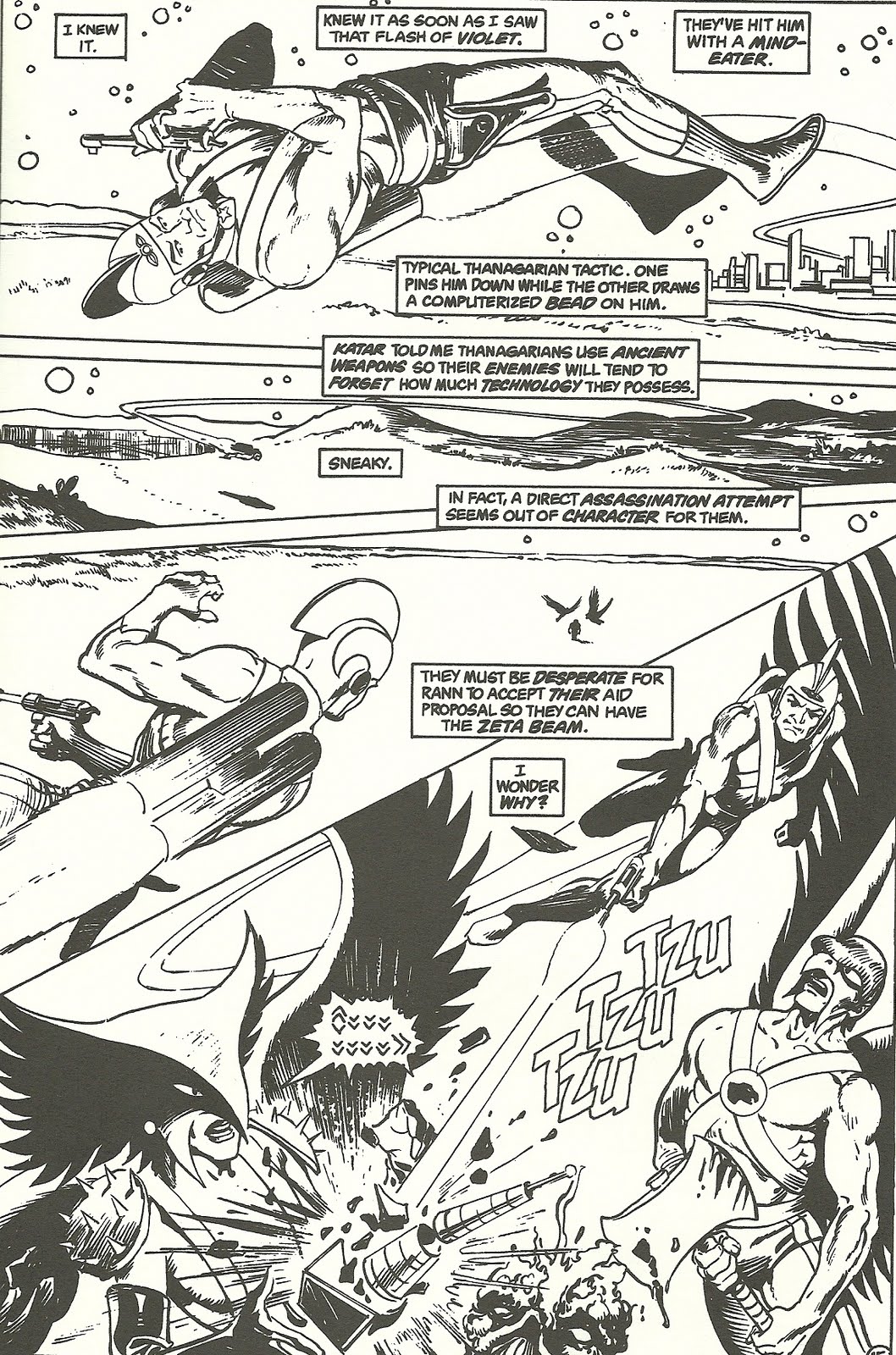
There's nothing more frightening in any comic book than a Thanagarian diplomatic mission seeking a "free exchange of information". The fascist, imperialist Hawkpeople of "Exiles" remain a far, far more terrifying threat than any Dracula, Dr Doom or even Darkseid could ever be, because they're so recognisably of our own world. They're the amoral and militaristic practitioners of realpolitik. They're the Greeks bearing gifts. They're the folks

without mercy, but with the grand strategic plans, and they have the same contempt for the ordinary women and man as Keel Roo and Scira Ek have in "Exiles" for Adam Strange. The appalling attack of these Hawk creatures upon the Swamp Thing as he tries to heal the ruined and radioactive eco-system of Rann is for me one of the few superhero fight scenes which can still inspire genuine anxiety. The stakes are so high, the weapons being used so disgustingly invasive, the revulsion inspired by the Thanagarians so intense; it's as if Alan Moore had abstracted everything that's depraved and repellent about the culture of Nazism and then fused it with this imaginary off-world society in order to bring home with the shock of the new how these people, or any people like them, from any political system of any kind, must never be trusted or tolerated.

Mr Moore's wasn't presenting an entirely new version of the peoples of Hawkworld in "Exiles". The Thanagarians had been depicted as an authoritarian race before, more notably in Tony Isabella's thoroughly enjoyable "Shadow War Of Hawkman" series, which really does deserve to be reappraised and reprinted. But Moore turned a formidably hostile alien race into a


recognisably fascist culture. Instead of a people of mostly-identical Hawkmen prone to be corrupted and then redeemed by various individual leaders, Mr Moore and the exquisite art team of Rick Veitch and Alfred Alcala provided us the informing details of Thanagar's military/diplomatic hierarchy, with its language of deception and domination, and with the stomach-turning stench of the assumption of racial superiority which marks every panel of the Hawkwomen and men in this book. Here is the rank and protocol and phraseology of the fascist state, and the straight-faced and yet clearly sneering contempt by which these Thanagarians judge everyone and everything beyond their own narrow mission is enough to make this reader's fists begin to ball. Alan Moore's loathing for the authoritarian mind-set saturates this book, and it will give nothing away to a reader who's never read "Exiles" to note that things do not end well for these Hawkpeople.

"We Terrans may not be much on the eight basic principles of aerial inertia tactics ... but we are complete bastards." explains Adam Strange to the drowned corpse of Keel Ro.

Well, she deserved it.


1o. "Superman Adventures, # 25; "(Almost) The World's Finest Team", writer, Mark Millar, artists, Mike Manley & Terry Austin

Mark Millar's "Superman Adventures" aren't simply a joy to read, though they certainly are that. They're also the irrefutable proof that he's a highly skilled professional craftsman with an impressive command of the more traditional forms of comicbook storytelling. Too often he's judged solely with reference to a partial understanding of his post-millennium style, to his widescreen, summer-blockbuster approach to harnessing much of the appeal of the movies while maintaining the distinct strengths of superhero comic books. And because much of that more recent work, from "The Authority" through the "Ultimates" and on to the Millarworld superbooks of today, is so very idiosyncratic and single-minded in its approach, there's a tendency at times for folks to miss the fact that Millar's 21st century work is built upon an absolute command of the basic language of the Silver-Age superhero tale. He can pull off the grand extremes of a "Nemesis" or a "Kick-Ass" because he knows, and has clearly and consistently shown, how to write the likes of the Flash, the Justice League and, in particular, Superman in an intensely respectful and concise form.


In "(Almost) The World's Finest Team", Millar has The Mad Hatter kidnap Bruce Wayne, a conceit which allows him to convincingly pair a feisty and impressively competent Batgirl with his own take of a thoroughly decent and dignified Superman. There's nothing arch about how Mr Millar approaches these characters; there's no irony on show, or knowing nudges in the text to show that he's a more sophisticated and modern-minded writer than the subject matter might otherwise allow. In fact, his work on "Superman Adventures" was as likely to escape critical acclaim because it didn't seek to draw attention to itself as his later work is often attacked for being the product of a man with no respect for tradition and too much concern for himself. The question isn't, of course. which of these writers is the "real" Mark Millar, the modest scribe or the Hollywood hustler? The fact is that different properties require different approaches, just as writers at different stages of their lives have distinct and different things to say for themselves in their work. Here, Millar was intent on establishing that he was a reliable pair of hands with a trustworthy command of scriptwriting, as well as presenting a take on the character of Superman which reflected Millar's fundamental affection for the man of steel and the moral values most commonly associated with him. It's a version of Superman which deserves to be ranked in the front row of work on the character, but sadly, because of the title's low profile, and because of the fact that "Superman Adventures" was supposedly a "kid's" book about a non-continuity version of Kal-El, it's a comic that's rarely granted the respect it's owed.


Present in this all-ages, will-not-frighten-the-censors, comic book are a great deal of the techniques which would later come to be associated with Millar's writing style. The splash page is a typically intense affair, the story is arranged around a series of spectacular superhero-fan-pleasing scenes, and Millar works hard to make sure each character on display has an absolutely distinctive personality on the page. Readers new to "(Almost) The World's Finest Team" will note, for example, water-cooler moments the likes of which would be quite familiar components of Mr Millar's later work; the scene in which Robin launches the Bat-Plane with a cry of "Let's party!" is in many ways the equivalent of Tony Stark blasting off in his ultimate universe armour, a great celebration of the opportunities for fun that the superhero can bring. (The exuberance of the art by Mike Manley and Terry Austin perfectly matches the sheer good cheer of the script.) Yet, matched with these superheroic moments here is a conscious and constant fidelity to the moral principles historically associated with the World's Finest team. A stern but decent Batman's closing speech in praise of Superman's effectiveness is one example of that, as is Superman's advice to Batgirl that "you don't have to break someone's ribs to solve a case".

Unpretentious, disciplined, life-affirming and fun. I'd recommend it.


Thank you for reading.
I really do wish a splendid day to you all. "Stick together!", as Superman would say.


.
More about