Number 1239: The inside joke

Người đăng: Unknown on Thứ Sáu, 5 tháng 10, 2012

There’s an inside joke in this Steel Sterling story. Charles Biro wrote his buddy, Bob Wood, into the story as “Pig-Pan Wood.” His face, we are told on the wanted poster, “resembles that of a pig.” I wonder if Wood had any foreknowledge of this alleged joke, or what he thought of it.

About 15 years later Wood killed a woman in a hotel during an alcoholic binge. That tale is told in Blackjacked and Pistol-Whipped, Crime Does Not Pay. It’s an excellent anthology of lurid stories from the Biro-Wood edited Crime Does Not Pay comic book, which had its own nefarious history. These pictures of Bob Wood and Charlie Biro are from the book:


If anyone had a pig-pan it wasn’t Wood.

I found a real Pig-Pan — the resemblance is striking, you must admit — while surfing through some local mugshots. Yes, I entertain myself, not only by reading comics, but gawking at ID photos of people who end up in jail with their pictures posted on the Internet. The man whose photo this is was charged with “failing to register as a sex offender.”


From Zip Comics #11 (1941), by Joe Blair and Charles Biro:


More about

Review: Batman: The Dark Knight Vol. 1: Knight Terrors hardcover/paperback (DC Comics)

Người đăng: Unknown on Thứ Năm, 4 tháng 10, 2012

The Batman and Detective Comics titles are stalwarts of the DC Comics line, and Batman and Robin fills the void left by the old Robin solo title. The Batman: The Dark Knight series, however, continues to struggle to find its identity and to justify itself among the Batman line.

Cynically, one notes that the Dark Knight title emerged pre-Flashpoint just as excitement ramped up for the Dark Knight Rises movie. To some extent, Dark Knight has seemed a title in search of content, meant perhaps to survive solely on its own name recognition. Still, it had a promising first outing with the collection Golden Dawn, which spotlighted writer/artist David Finch and suggested Dark Knight's focus might be on Batman's more supernatural adventures.

With the DC Comics New 52 Batman: The Dark Knight: Knight Terrors, however, writer Paul Jenkins comes on, and while Finch remains as artist, the book's focus changes again. Knight Terrors echoes very subtly Devin Grayson's old Gotham Knights series, a team book for people who don't like team books, one that portrays Batman in the context of his teammates and allies. It also has aspects of what Gotham Knights later became, a villain spotlight book.

This is good, and Knight Terrors starts strong, but it falters in the end with a poor solution to the book's mystery and some badly-written characters. That the Knight Terrors collection then ends with a "Night of the Owls" crossover issue, months before DC releases the main Night of the Owls collection, only adds to the unevenness of the volume.

[Review contains spoilers]

A mystery villain frees all the inmates from Arkham Asylum, and gets them hopped up on a wonder-drug that gives them extra strength and rage. Summarized like that, it's not hard to guess the identity of Paul Jenkins's culprit, and indeed there's a good amount of the Knight Terrors story, in total, that takes from the earlier Knightfall. But Knight Terrors is not so much about story as it is letting artist David Finch go wild, drawing a good cross-section of Batman's foes (as with Jim Lee on Batman: Hush) and in distorted, super-muscular form, to boot.

But it's not just Batman's rogues that Finch gets to draw -- just about every major member of the Batman family receives a cameo in Knight Terrors, and some of Batman's Justice League teammates actually appear quite prominently. In this way, Dark Knight does offer something distinctive from the other Bat-titles; it's not a Justice League book per se, but this is the book that just so happens to feature the adventures where Batman gets by with a little help from his friends.

Finch's Flash Barry Allen is especially striking -- he makes the New 52 stripes on Barry's costume hum -- and overall Finch's art and his depiction of the wider DC Universe largely sell Knight Terrors, especially when things get rough.

That roughness is Jenkins's revelation that Bane is the mastermind behind the Arkham prison break, further evidence that Dark Knight's intention is to be the book most familiar to viewers of Christopher Nolan's movies (as when Superman's costume changed to reflect the Superman Returns movie version after in the "One Year Later" event). Enticing movie viewers to become comics fans isn't the worst thing, but Jenkins's Bane is neither so compelling as Nolan's nor as Chuck Dixon's original. In Bane's incessant bellowing here about his hate for Batman and plans to take over Gotham City, Jenkins has reduced the villain to his lowest common denominator. Jenkins's Bane is a hulking behemoth with a predilection for breaking people over his knee, without the intelligence or particular code of honor that drove his original appearances and his role in Gail Simone's Secret Six and elsewhere.

More's the pity, because in Jenkins's use of the Scarecrow, Two-Face, Commissioner Gordon and Alfred, even the intentionally over-sexualized White Rabbit character, Knight Terrors begins rather well, and the sole sore spot is when Bane emerges toward the end.

Finch, Jenkins, and later writer Joe Harris -- who contributes a one-off story toward the end of the book with artist Ed Benes -- do all gets points for continuing Commissioner Gordon's conflict with Gotham Internal Affairs detective Forbes throughout the book. This storyline, begun in Finch's pre-Flashpoint book Golden Dawn, could easily have been a victim of the reboot, but the fact that Jenkins picks it up, and even guest-writer Harris, is impressive. Gordon has faced conflict in his department before, but Forbes seems unrelenting, and the strain it puts on the relationship between Gordon, Batman, and Batman's supposed supporter Bruce Wayne is a great triangle. If this story continues with Dark Knight's next new writer, Gregg Hurwitz, all the better.

The final chapter of Knight Terrors is a single "Night of the Owls" crossover story by Judd Winick with art by Finch. The story spoils a little of "Night of the Owls," not a lot, and readers might decide to read it or save it depending on what knowledge they have of "Night of the Owls" already. The story itself is a profile of one of the Owls' Talon warriors, an "aside" apparently that takes place between the pages of Batman Vol. 2: City of Owls proper. It is strange for DC to release a "Night of the Owls" issue in a New 52 Volume 1, when "Night of the Owls" doesn't reach the Bat-family until the Volume 2s, but perhaps this was to lump Winick and Harris's stories with Jenkins's so that the next Dark Knight collection could be Hurwitz's own.

Fans, specifically, of the DC New 52 Justice League may want to give Batman: The Dark Knight: Knight Terrors a look, because what really sells the main story is its role as a Batman-focused Justice League story. Otherwise, Dark Knight is overall well done about to the point where Bane comes in, and aptly drawn by David Finch throughout, but until Dark Knight offers a little bit more, it's still the book Bat-fans can cut if they're looking to trim their buying list.

[Includes original covers, penciled pages by David Finch]

Some guest reviews next week while I flip through this here Absolute edition ... back soon!
More about

Review: The Authority: Relentless trade paperback (Wildstorm/DC Comics)

Người đăng: Unknown on Thứ Tư, 3 tháng 10, 2012

[Guest review by Doug Glassman.]

There’s a trope called “Seinfeld Is Unfunny," in which a groundbreaking work seems less groundbreaking due to what’s come afterwards. In my review of X-Men: Phoenix Rising, I mentioned that it seemed a little old-hat due to the many major retcons that have happened since then. This book, The Authority: Relentless, does the same for rampant violence in comics. Back in 1999, the actions of the book’s “heroes” were shocking. Today, something similar might happen in the pages of a particularly grim issue of Secret Avengers.

However, as we all know from TV Tropes, tropes are not bad, and Relentless shouldn’t be judged by what came after it. This is Warren Ellis at his crazy finest. When Ellis is at the top of his game, he comes up with memorable characters and, more importantly, complex villainous schemes. Of the two stories in here, one is a world-conquering plan ramped up to an incredible degree, while the other is an invasion from a parallel world. Each is led by a dynamic plotter -- the former by pre-existing Wildstorm villain Kaizen Gamorra, the latter by Yngvi, ruler of a blue-skinned alien race.

Like Infinity Gauntlet, Relentless is another book that leads on from other major events. In this case, it’s the crumbling of the Wildstorm universe after the destruction of Stormwatch, which was also written by Ellis. If you’re not aware, the majority of Stormwatch was killed off in WildC.A.T.S./Aliens, making it the intercompany crossover with the most lasting effects in comic books. The remnants are brought together by Jenny Sparks, a “century baby” who literally personifies the twentieth century. Her cursing, smoking, drinking and overt sexuality say a lot about how Wildstorm in particular and comics in general perceived the then-present day.

On its surface, the Authority follows many of the normal superhero team dynamics. You have the Superman analogue in Apollo and the Batman analogue in the Midnighter. Swift is the almost obligatory winged character, while the Engineer has the technical edge. The Doctor has the equivalent of a Green Lantern ring with his magical powers. Jenny Sparks’ electrical powers have a precedent with Black Lightning and Living Lightning. Even Jack Hawksmoor’s ability to “talk to cities” gives him control over the ground, like Geo-Force, and telepathy, like the Martian Manhunter. Add in a growing or shrinking character and a maybe a god and you’re set. The team almost seems a little underpowered, with Apollo being the only strongman.

What makes the team truly powerful is its coordination. Warren Ellis has a talent for taking unusual teams and making them incredibly effective by using their powers in unusual ways. He did it again in his Secret Avengers run. Jenny keeps the team under her firm control, although she knows when to let some of her soldiers run loose. One unusual element of the team is a lack of arguments over leadership [and then we saw such arguments in spades in Paul Cornell's first DC New 52 Stormwatch volume. -- ed.]. She has to compensate for some of their personalities, such as the new and self-doubting Doctor and the almost lethally headstrong Apollo. But due to the sheer scale of the villains they face, they almost immediately throw their weight behind Jenny to lead. As someone who gets annoyed when team books devolve into internal squabbles, like The Ultimates or Justice League: Cry for Justice, it’s almost refreshing.

As far as the team member personalities go, Jack and Swift get less of a focus. As they were part of a team with Jenny previous to The Authority, Ellis probably wanted to concentrate on the newer members, which was likely the right move. Swift in particular seems to not be as effective as the others. Hawkman and Hawkgirl work because they are portrayed as powerful warriors -- almost barbarians at times. The tiny Swift, though, doesn’t carry the same weight in a literal sense. Jack’s powers are just strange, and I can imagine that he’s hard to use in a story, but Ellis does his best.

Let’s talk about the violence. Make no mistake: even by modern standards, there’s a lot of blood. But compare it to, say, the fight between Superboy Prime and the Teen Titans in Infinite Crisis and the feel is similar. That fight was even more macabre than some of the fights in Relentless. Editorial and storytelling standards have simply changed, making blood and gore more acceptable to both readers and publishers. The sexual content is also limited in this book. There is a lot of discussion about rape, for instance, as the alien society is dying out and is propagated by turning entire countries into “rape camps.” But Ellis wisely decides to not actually show anyone getting raped, which is a disappointing relief -- disappointing because we do have to be concerned these days about that kind of graphic content in other books.

Though he worked with Warren Ellis on Stormwatch, The Authority: Relentless helped Bryan Hitch get widespread attention. He even got to design the Cybermen for the current series of Doctor Who, which is an impressive feat. Hitch’s artwork is absolutely gorgeous. Most pages are broken down into three large panels, and he uses this space to create intricate backgrounds and detailed characters. I especially like the designs of the alien Shift-Ships, which resemble the Predator drone. Even the Engineer, who is simply a metal woman, has a great design. I also enjoy his dynamic and varied covers; Hitch has some innovative group shots, which is an impressive feat.

With the New 52 version of Stormwatch out there, I would highly suggest looking at its roots. The Authority: Relentless has strong storytelling and great art and, despite being dulled a bit by age, it holds up well.
More about

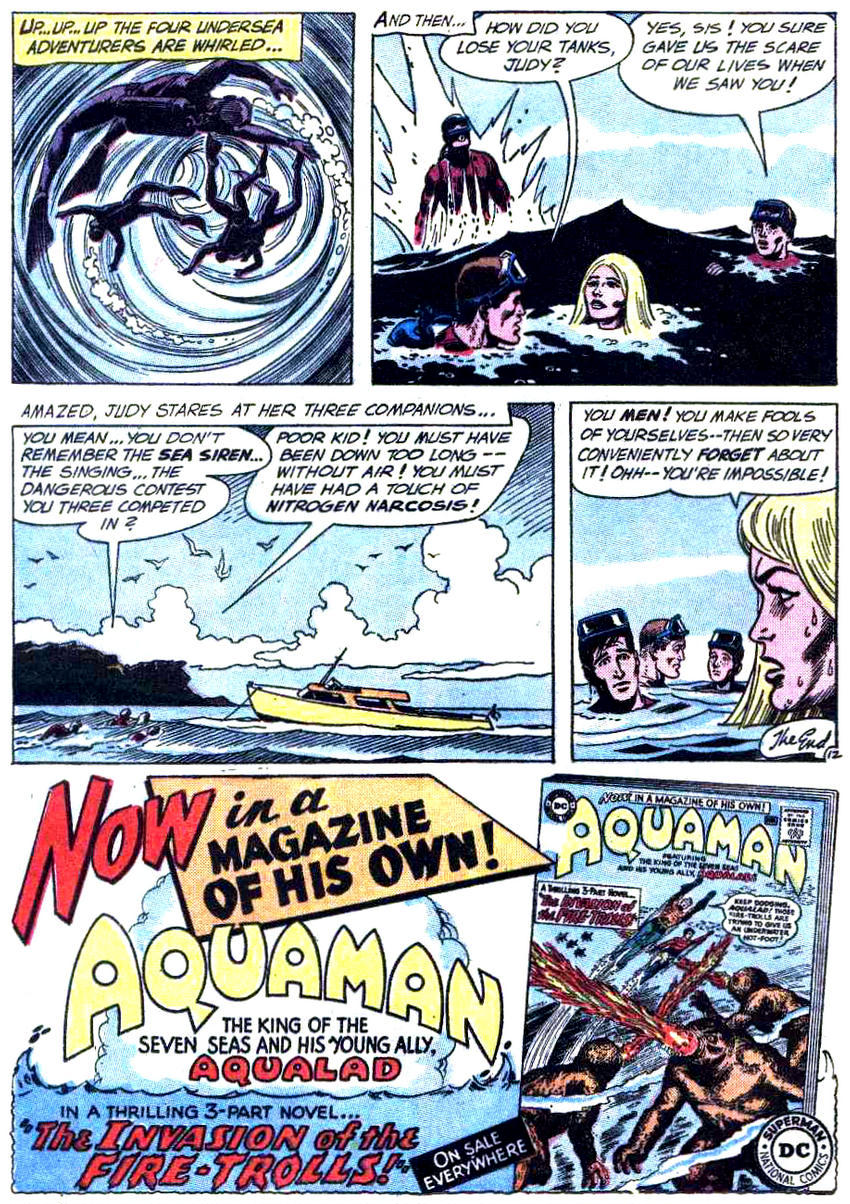
Number 1238: Sea Devils sing-a-long with Circe

Người đăng: Unknown


I was disappointed when artist Russ Heath left Sea Devils after issue #10. He and editor/writer Robert Kanigher had created the characters for Showcase, and after a brief tryout the regular series began in 1961. Heath, one of my favorite artists of all time, was the reason I bought and read the comic book.

This story, from Sea Devils #3 (1962), is one that sticks out in my mind from my original reading. In my adolescent eyes Circe was pretty hot, Comics Code or not. Wouldn’t you love to own the original art for the splash page or cover?

Something I like about Kanigher’s comics is that girls and women figure in, not just as eye candy but significant characters. Judy is a strong and resourceful woman, and of course the jocks she swims around with don’t appreciate her enough.


More about

Best DC Comics New 52 Guides and Reading Orders

Người đăng: Unknown on Thứ Ba, 2 tháng 10, 2012

Best DC Comics New 52 Guides and Reading Orders

When DC Comics announced their New 52 initiative, there were a lot of reading guides online for the various New 52 series, which were coming and going, the best and the worst and so on.

Now that the DC New 52 is in full swing, however, you might be looking for something more detailed, a reading order guide to how to read the DC New 52 or who DC Comics's new or relaunched characters are.

Presented here are some guides to the DC Comics New 52 universe I've used or that have impressed me (plus our homegrown edition). If you've got more, please leave them in the comments section and I will continue to update this post. What we're looking for are guides on how to read and understand the DC New 52, not just recaps or reviews of the first issues.

Return to this page at http://bit.ly/dcnew52readingorder

* Comicosity - Read Between The Lines: History of the DC Universe 3.0

A lot of hard work went into Keith Callbeck and company's timeline of the DC Comics New 52, which puts the major events of the New 52 in chronological order. They sorted through over 700 comics; this list is especially good for understanding how some of the New 52's more far-flung titles like Demon Knights, Shade, and All-Star Western fit into the grand scheme.

* The Unofficial Guide to the New DC Universe

This wiki is an offshoot of the equally amazing Unofficial Guide to the DC Universe, which catalogs and includes details almost every post-Crisis on Infinite Earths DC comic, along with character chronology information. The new site, editable for registered users, is building the same kind of database for the New 52, also with chronology information. For detailed, issue-by-issue questions of who's who and what happened when, this is your source.

* DC Comics Database

Also good, with maybe a smidgen more artwork but slightly less chronological information, the DC Comics Database also includes issue lists, notes, and synopsis, as well as creator credits. They've also got a great mobile site for your superhero questions on the go.

* Tor: Reader's Guide to the New DC Universe

Though Tim Callahan's reader's guide started out as snapshots of the initial DC New 52 series, he's added to it with addendum updates for the Second and Third Wave series. This set of posts may not be as technically detailed as some of the others, but it stands as a good guide to how the New 52 has unfolded over time with short write-ups of all the books.

* DC New 52 Trade Paperback Timeline

Last but not least, if I can be permitted a plug, some readers still haven't noticed that the DC Comics Trade Paperback Timeline now includes DC New 52 books! The timeline contains all the New 52 Vol. 1s, as well as a majority of the Vol. 2s and 3s. As always, the DC TPB Timeline offers a clear reading order for how to read the New 52 collections, as well as explanations for why the books are listed the way they are. Our New 52 TPB timeline follows the "old" DC Universe timeline, and makes reference to events of the past where they're still in continuity.

And even though you can go to the DC Universe Trade Paperback Timeline for all your reading order information, here's a snapshot of the guide to the DC New 52 trades -- you can find more information and future volumes on the timeline.

Justice League Vol. 1: Origin (review)
Superman: Action Comics Vol. 1: Superman and the Men of Steel (review)

Both of these titles take place around five years prior to the present. The story in Action Comics takes place before Justice League, but DC published Justice League first and meant it to be the starting place for the DC New 52.

Green Arrow Vol. 1: The Midas Touch (review)

A number of DC New 52 titles reference Green Arrow Oliver Queen's company Q-Core, introduced in Green Arrow: The Midas Touch.

Flash Vol. 1: Move Forward (review)
Captain Atom Vol. 1: Evolution (review)
Static Shock Vol. 1: Supercharged (review)
Savage Hawkman Vol. 1: Darkness Rising (review)

The Static Shock book mentions Hawkman, Captain Atom, and the Teen Titans; Flash appears in the Captain Atom book.

Supergirl Vol. 1: Last Daughter of Krypton (review)
Superboy Vol. 1: Incubation (review)
Teen Titans Vol. 1: It's Our Right to Fight (review)

Supergirl appears first in her own collection, then in Superboy and then in Superman: What Price Tomorrow? Superboy: Incubation takes place concurrent with the Teen Titans collection.

Batman Vol. 1: Court of Owls (review)
Batman and Robin Vol. 1: Born to Kill (review)
Batgirl Vol. 1: The Darkest Reflection (review)
Nightwing Vol. 1: Traps and Trapezes (review)
Birds of Prey Vol. 1: Trouble in Mind (review)
Batwoman Vol. 1: Hydrology (review)
Batwing Vol. 1: The Lost Kingdom (review)
Red Hood and the Outlaws Vol. 1: Redemption (review)

The Batman, Batgirl, and Nightwing books all interconnect.

Animal Man Vol. 1: The Hunt (review)
Swamp Thing Vol. 1: Raise Them Bones (review)

The Animal Man and Swamp Thing collections take place concurrent to one another.

Frankenstein: Agent of SHADE Vol. 1: War of the Monsters (review)
Men of War Vol. 1: Uneasy Company (review)
OMAC Vol. 1: Omactivate (review)

The Frankenstein and OMAC volumes cross-over with one another. Frankenstein appears in Men of War. The OMAC book alludes to the Challengers of the Unknown story in DC Universe Presents.

Hawk and Dove Vol. 1: First Strikes (review)
Blue Beetle Vol. 1: Metamorphosis (review)
Justice League International Vol. 1: The Signal Masters (review)

Green Arrow, Frankenstein, Hawk and Dove, Captain Atom, Hawkman, Blue Beetle, and Batman appear or cameo in the first Justice League International book.

Blackhawks Vol. 1: Great Leap Forward (review)
Mister Terrific Vol. 1: Mind Games (review)
Huntress: Crossbow at the Crossroads (review)

The Blackhawks appear in the Mr. Terrific book, and also in Deathstroke and Voodoo.

Deathstroke Vol. 1: Legacy (review)
Resurrection Man Vol. 1: Dead Again (review)

Deathstroke appears in flashback in Resurrection Man.

I, Vampire Vol. 1: Tainted Love (review)
Justice League Dark Vol. 1: In the Dark (review)

I, Vampire and Justice League Dark take place concurrently.

Superman Vol. 1: What Price Tomorrow? (review)
DC Universe Presents Vol. 1: Deadman and Challengers of the Unknown (review)
Stormwatch Vol. 1: The Dark Side (review)
Grifter Vol. 1: Most Wanted (review)
Demon Knights Vol. 1: Seven Against the Dark (review)

Stormwatch takes place after the formation of Justice League International; a member of Stormwatch guest-stars in Grifter. Superman, Stormwatch, Grifter, Voodoo, and Demon Knights each refer to a certain alien threat.

Legion of Super-Heroes Vol. 1: Hostile World (review)
Legion Lost Vol. 1: Run from Tomorrow (review)

The Black Razers Blackhawk group appears in Legion Lost and Voodoo.

Green Lantern: New Guardians Vol. 1: The Ring Bearer (review)
Voodoo Vol. 1: What Lies Beneath (review)
Green Lantern Vol. 1: Sinestro (review)
Red Lanterns Vol. 1: Blood and Rage (review)
Green Lantern Corps Vol. 1: Fearsome (review)

The Green Lantern book is most closely connected with the "old" DC Universe, taking place right after War of the Green Lanterns: Aftermath. Green Lantern: Sinestro, Green Lantern: New Guardians, and the Red Lanterns book all interconnect.

Catwoman Vol. 1: The Game (review)
Batman: Detective Comics Vol. 1: Faces of Death (review)
Suicide Squad Vol. 1: Kicked in the Teeth (review)

The events of Detective Comics: Faces of Death take place specifically after Catwoman: The Game and I, Vampire: Tainted Love, but before the Suicide Squad book. Suicide Squad makes a minor reference to the events of the Stormwatch book.

All-Star Western Vol. 1: Guns and Gotham
Aquaman Vol. 1: The Trench (review)
Fury of Firestorm: The Nuclear Men Vol. 1: God Particle (review)
Wonder Woman Vol. 1: Blood (review)

The All-Star Western, Aquaman, Firestorm, and Wonder Woman books are mostly independent from the rest of the DC Universe in their first volumes.

Superman: Action Comics Vol. 2: Bulletproof

Takes place five years before the current DC Universe.

Batwoman Vol. 2: To Drown the World (review)
Batman, Incorporated Vol. 1: Demon Star

The Batwoman and Batman, Inc. collections are generally unrelated to the other Batman collections at this time. Batwoman Batgirl: Knightfall Descends.

Batman Vol. 2: City of Owls (review)
Batman: Night of the Owls (review)
All-Star Western Vol. 2: The War of Lords and Owls
Batgirl Vol. 2: Knightfall Descends (review)
Nightwing Vol. 2: Night of the Owls
Batman: Detective Comics Vol. 2: Scare Tactics
Birds of Prey Vol. 2: Your Kiss Might Kill
Batman: The Dark Knight Vol. 1: Knight Terrors (review)
Batman: The Dark Knight Vol. 2: Cycle of Violence
Catwoman Vol. 2: Dollhouse (review)

All of these trades tie in to Night of the Owls except Batman: Dark Knight: Cycle of Violence.

Superman Vol. 2: Secrets and Lies
Red Hood and the Outlaws Vol. 2: The Starfire

The last chapter of Superman: Secrets and Lies relates to the last chapter of Red Hood and the Outlaws: The Starfire.

Captain Atom Vol. 2: Genesis
Justice League Vol. 2: The Villain's Journey (review)

Captain Atom: Genesis is unrelated but takes place before the end of Justice League: Villain's Journey.

Blue Beetle Vol. 2: Blue Diamond
Justice League International Vol. 2: Breakdown (review)
Fury of Firestorm: The Nuclear Men Vol. 2: The Firestorm Protocols
Batwing Vol. 2: In the Shadow of Ancients (review)

The Justice League International trade reflects the events of Justice League: Villain's Journey. Justice League International, Firestorm, Blue Beetle, and Batwing tie into one another or contain guest appearances by the JLI.

Green Lantern Vol. 2: The Revenge of Black Hand (review)
Green Lantern Corps Vol. 2: Alpha War
Green Lantern: New Guardians Vol. 2: Beyond Hope
Red Lanterns Vol. 2: Death of the Red Lanterns (review)
Stormwatch Vol. 2: Enemies of Earth (review)

Green Lantern: New Guardians: Beyond Hope intersects with Blue Beetle: Blue Diamond. Stormwatch: Enemies of the Earth crosses over with Red Lanterns.

Culling: Rise of the Ravagers
Superboy Vol. 2: Extraction
Teen Titans Vol. 2: The Culling

The Culling collection includes the Teen Titans Annual #1; otherwise the "Culling" issues are also found in the Titans, Superboy, and Legion Lost trades.

Swamp Thing Vol. 2: Family Tree (review)
Animal Man Vol. 2: Animal Vs. Man (review)
Frankenstein: Agent of SHADE Vol. 2: Secrets of the Dead (review)

Swamp Thing and Animal Man interconnect; Frankenstein leads into the Animal Man/Swamp Thing crossover "Rotworld."

Sword of Sorcery Vol. 1: Amethyst
Justice League Dark Vol. 2: The Books of Magic
I, Vampire Vol. 2: Rise of the Vampires (review)

I, Vampire and Justice League Dark cross over. Amethyst appears in the Justice League Dark trade.

Earth 2 Vol. 1: The Gathering (review)
Worlds' Finest Vol. 1: Lost Daughters of Earth 2 (review)

Worlds' Finest will reflect events in the Batman titles with its second volume.

Legion: Secret Origin
Legion of Super-Heroes Vol. 2: The Dominators

Legion: Secret Origin expands the Legion's origin for the New 52.

Aquaman Vol. 2: The Others
Dial H Vol. 1: Into You (review)
Green Arrow Vol. 2: Triple Threat (review)
Wonder Woman Vol. 2: Guts (review)

Aquaman, Dial H, Green Arrow, and Wonder Woman remain generally unrelated to the rest of the New 52.

Shazam Vol. 1 Vol. 1
Aquaman Vol. 3: Throne of Atlantis
Justice League Vol. 3: Throne of Atlantis
Flash Vol. 3: Gorilla Warfare

The Throne of Atlantis books cross over. Shazam takes place prior to Throne of Atlantis; Flash: Gorilla Warfare takes place at the same time.

Green Lantern: Rise of the Third Army
Green Lantern: Wrath of the First Lantern
Green Lantern Vol. 3: The End
Green Lantern Corps Vol. 3: Willpower
Green Lantern: New Guardians Vol. 3: Love and Death
Red Lanterns Vol. 3: The Second Prophecy

These books include the Green Lantern crossovers "Rise of the Third Army" and "Wrath of the First Lantern."

Batman Vol. 3: Death of the Family
Joker: Death of the Family
Batman and Robin Vol. 2: Pearl
Batman and Robin Vol. 3: Death of the Family

These titles tie in to Death of the Family but not Requiem.

Justice League Dark Vol. 3: The Death of Magic
Trinity of Sin: Phantom Stranger Vol. 1: A Stranger Among Us
Birds of Prey Vol. 3: A Clash of Daggers
Teen Titans Vol. 3: Death of the Family
Red Hood and the Outlaws Vol. 3: Death of the Family

The Phantom Stranger appears in Justice League Dark; Raven appears in Phantom Stranger and then in Teen Titans; Teen Titans crosses over with Red Hood; Birds of Prey and Teen Titans connect.

Batman, Incorporated Vol. 2: Gotham's Most Wanted
Batman: Detective Comics Vol. 3: Emperor Penguin
Nightwing Vol. 3: Death of the Family
Batgirl Vol. 3: Death of the Family

These trades deal with both Death of the Family and Requiem.

Demon Knights Vol. 3: The Gathering Storm
All-Star Western Vol. 3: The Black Diamond Probability
Team 7 Vol. 1: Fight Fire with Fire
Catwoman Vol. 3: Death of the Family

Demon Knights, All-Star Western, Catwoman, and Team 7 are all part of the "Black Diamond Probability" event. Catwoman connects to Death of the Family and Requiem.

Savage Hawkman Vol. 2: Wanted
Green Arrow Vol. 3: Harrow
Deathstroke Vol. 2: Lobo Hunt

Deathstroke, Hawkman, and Green Arrow participate in the "Hawkman: Wanted" crossover.

Superman: H'el on Earth
Superman Vol. 3: Fury at World's End
Superboy Vol. 3: Lost
Supergirl Vol. 3: Sanctuary

Superman, Superboy, and Supergirl participate in the "H'el on Earth" crossover.

Ravagers Vol. 1: The Kids from N.O.W.H.E.R.E.
Legion Lost Vol. 2: The Culling
Fury of Firestorm: The Nuclear Man Vol. 3: Takeover

Superboy and the Ravagers appear in Legion Lost; Legion Lost and Firestorm connect regarding a Captain Atom storyline.

Animal Man Vol. 3: Rotworld -- The Red Kingdom
Swamp Thing Vol. 3: Rotworld -- The Green Kingdom

Animal Man and Swamp Thing cross over with "Rotworld."

Hope this helps you sort things out. If I've missed a good site or you have any corrections, leave a comment and I'll check it out. Cheers!
More about

Review: Deathstroke Vol. 1: Legacy trade paperback (DC Comics)

Người đăng: Unknown on Thứ Hai, 1 tháng 10, 2012

From the Simon Bisley covers that precede each chapter of Deathstroke: Legacy, the reader can easily tell that this is a comic book weird, violent, and outlandish. What's less apparent in the image of a spiky-armored Deathstroke waving his sword at a purple and green-costumed behemoth with a cape is that Deathstroke: Legacy is also meant to be deeply, deeply ironic.

Throughout Legacy, writer Kyle Higgins teases the worst impulses of the DC New 52 (some of which actually manifested) and then demonstrates how Deathstroke Slade Wilson is the antidote for them. Deathstroke is terribly bloody and mercilessly violent, but its aesthetic is "old school" rather than "kewl," and that makes Deathstroke an unlikely hero for the readers even as he's assuredly a villain on the page.

[Review contains spoilers]

The first chapter of Legacy reads like an issue of Green Arrow: The Midas Touch, quite unfortunately -- Deathstroke Slade Wilson begins a mission with a trio of young, hip kids just as interested in making sure their weapons are loaded as they are that they've got an appropriate playlist for the assassination. At the end of the chapter, however, Wilson shoots the three teens in a bloody spree -- not because the kids had betrayed him, but simply because he didn't want the competition.

Kyle Higgins demonstrates, on one hand, that Wilson is just not a nice guy -- bloodthirsty, remorseless, and often prideful and insecure -- and it's to Higgins's credit that he never tries to sugarcoat this aspect of Deathstroke. On the other hand, Higgins's first chapter is a repudiation of buzzwords and technobabble; Slade Wilson is older -- not far removed from his "old" DC Universe iteration -- older than his competitors and than most of the New 52 newly-rejuvinated superheroes. As he tries to prove that he's still "got it," Wilson serves as a figurehead of the "old" DC Universe -- that young and new is not necessarily better than old, experienced, and dangerous.

Higgins carries this through a variety of Wilson's increasingly explosive missions. In a battle on a highway, Wilson dispatches the ridiculously mechanized "Road Rage"; later, he fights a trio of opponents known as Legacy, each visually more superheroic and flamboyant than the last. In this, Higgins continually demonstrates, Slade Wilson is tough -- tougher than the new generation, tougher than the latest fad, and tougher than the stereotypical superhero community. It's only a pity Higgins isn't able to pit Wilson against an actual member of the New 52 superhero elite in this volume (the closest the reader gets is a Blackhawks guest-spot) to fully cement Wilson's place in the pecking order.

Legacy turns, in the beginning, on the contents of a mysterious briefcase shown to Wilson as a message; this ever-present McGuffin lends Legacy the character of a caper early on. When the briefcase contents are revealed as Ravager Grant Wilson's mask and weapon, however, experienced readers will get some sense where the story is going. Higgins balances tenuously between re-treading old Deathstroke ground and telling a new story -- readers have seen Slade's son Grant die before and also seen Deathsroke battle his children, and the saving grace is again Higgins positioning of Slade Wilson as the old guard proving the worth of the old ways of doing things. Joe Bennett's art is solid as always, and his depiction of Wilson -- in line with his drawing the Wilson family during the Teen Titans tie-ins to Blackest Night -- further cement this book somewhere between the "old" DC Universe and the New 52.

Thoughtful as it is, however, there's no escaping that Higgins's Deathstroke is a violent book, of the kind rarely seen before in the "old" DC Universe. If chopping off arms and heads was meant to be shocking roundabouts Infinite Crisis, it's old hat here, to the point where Wilson is decapitating his victims by the second page -- and that same page is used as the book's credits page. In the book's favor, the violence feels deserved, not gratuitous, in the context of the story; there's little torture, as opposed to Adam Glass's Flashpoint: Legion of Doom, so it's action-violence not horror-violence, and Bennett is explicit but doesn't linger longer than needed. Depicting the level of violence in Deathstroke on-screen is not a positive step for the DC Universe, but if it has to happen then Higgins and Bennett comport themselves well.

Deathstroke's closest tonal relation in the New 52 so far is probably Grifter: Most Wanted; both are given to knives stabbed through people's skulls, though Grifter's enemies are mostly alien, and Deathstroke's are flesh and blood. Grifter fights his battles with an effort to protect the innocent; Higgins Bennett demonstrate specifically that when Deathstroke fights, bystanders get hurt.

Whereas Grifter is continuous, with the anti-hero constantly on the run, Deathstroke is episodic -- just about every issue sees him going after a different target; Higgins's stories likely read as well in a collection as they did individually, as each issue has a strong focus but also ties into an ongoing storyline. More importantly, however, whereas Grifter: Most Wanted lessens in quality as the book goes on, Deathstroke remains strong throughout, with an intriguing beginning and a striking finish.

After Deathstroke: Legacy, Kyle Higgins departs the title and Rob Liefeld takes over -- previews suggest a greater tie between Wilson and the rest of the DC Universe, which is good, but also that Wilson's adventures become less grounded and more cosmic; whether that means they become even more action-packed and less thoughtful remains to be seen. Irrespective, Higgins's Batman: Gates of Gotham was an uneven introduction to the writer, but with Legacy, he's impressed. This is a mostly standalone book that ought not disappoint longtime Deathstroke fans.

[Includes original covers. Sketchbook and designs from Cully Hamner, Jim Lee, Joe Bennett, and Simon Bisley]

Later this week, Paul Jenkins and David Finch's Batman: The Dark Knight: Knight Terrors, including ... a "Night of the Owls" tie-in issue?  Don't miss it!
More about

Number 1237: “. . . the one about the farmer’s daughter.”

Người đăng: Unknown

I like a good dirty joke as much as the next guy. But I've heard the question, “Have you heard the one about the traveling salesman and the farmer’s daughter?” many times in movies, yet have never heard anyone tell an actual traveling salesman and farmer’s daughter joke. I didn't know there really were jokes about the traveling salesman and the farmer’s daughter.

The Farmer's Daughter #1 (1954) is interesting. This story is about the traveling salesman and the farmer’s daughter! Aha. Now we're getting somewhere. It’s published by Stanhall. Its indicia lists Adolphe Barreaux (“Sally the Sleuth” and various crime comic books) as executive editor, and Hal Seeger as editor. Hal Seeger, an animator, went on in the ’60s to create Batfink. A copyright notice in The Farmer's Daughter gives him the copyright for the book.

Paul Spector, in his apparently vacated blog devoted to his father’s work, Spectorphile, credits Irv Spector with writing and art on The Farmer's Daughter. A commenter to that posting said that title character Amy appears to be drawn by Bill Williams, who also did comic books for Stanhall, and later in association with John Stanley.

The head swims. The Farmer's Daughter, despite its racy-sounding premise, Amy's busty, bare-legged and barefoot cuteness, and its cast of very funny characters, was short-lived. It lasted four issues in 1954. Seeger created a couple of other short-lived comics for Stanhall with Oh, Brother, and G.I. Jane, both with art signed by Bill Williams. The comics all ended just about the time the Comics Code was implemented. Had they submitted The Farmer's Daughter to the Code it might not have passed, based on the storyline and dialogue, and one of the best punch lines ever in a mainstream comic book.


More about