Number 1185: Mooning the cyclops

Người đăng: Unknown on Thứ Hai, 2 tháng 7, 2012


Moon Girl, the Pre-Trend EC Comics' version of Wonder Woman, fights off the cyclops, who has escaped from the prison, "miles inland on the island of Sicily," where he has been since Ulysses put him there. Having been out of action for a couple of thousand years at least, ol' One-Eye needs to eat. He grabs a shipload of grub before rising up sometime later on an American beach.

The story is from Moon Girl and contains at least one major howler: When meeting Moon Girl's enemy, the Professor, the caption reads, "In archaic Latin, the one-eyed giant speaks . . ." Maybe to 1948 comic book readers archaic Latin and archaic Greek were the same. But I'm surprised it slipped by even the most lax editor. That editor would have been William M. Gaines, as the indicia credit reads. Gaines took over Moon Girl from his father, Maxwell Charles Gaines, who had started Educational Comics after DC bought out his share of their publishing empire, All American Comics. The elder Gaines* had died in the summer of 1947, leaving the publishing company to his wife and son.

From Moon Girl #4 (1948), drawn by Sheldon Moldoff:


*The elder Gaines had also been the original publisher of Wonder Woman. Moon Girl was never close to being as bizarre as Wonder Woman, a comic in a class all its own. On Sunday, July 8, I'll be featuring a wild story featuring our favorite Amazon.
More about

Number 1184: “The man who dares to cut holes in the Iron Curtain!”

Người đăng: Unknown on Chủ Nhật, 1 tháng 7, 2012

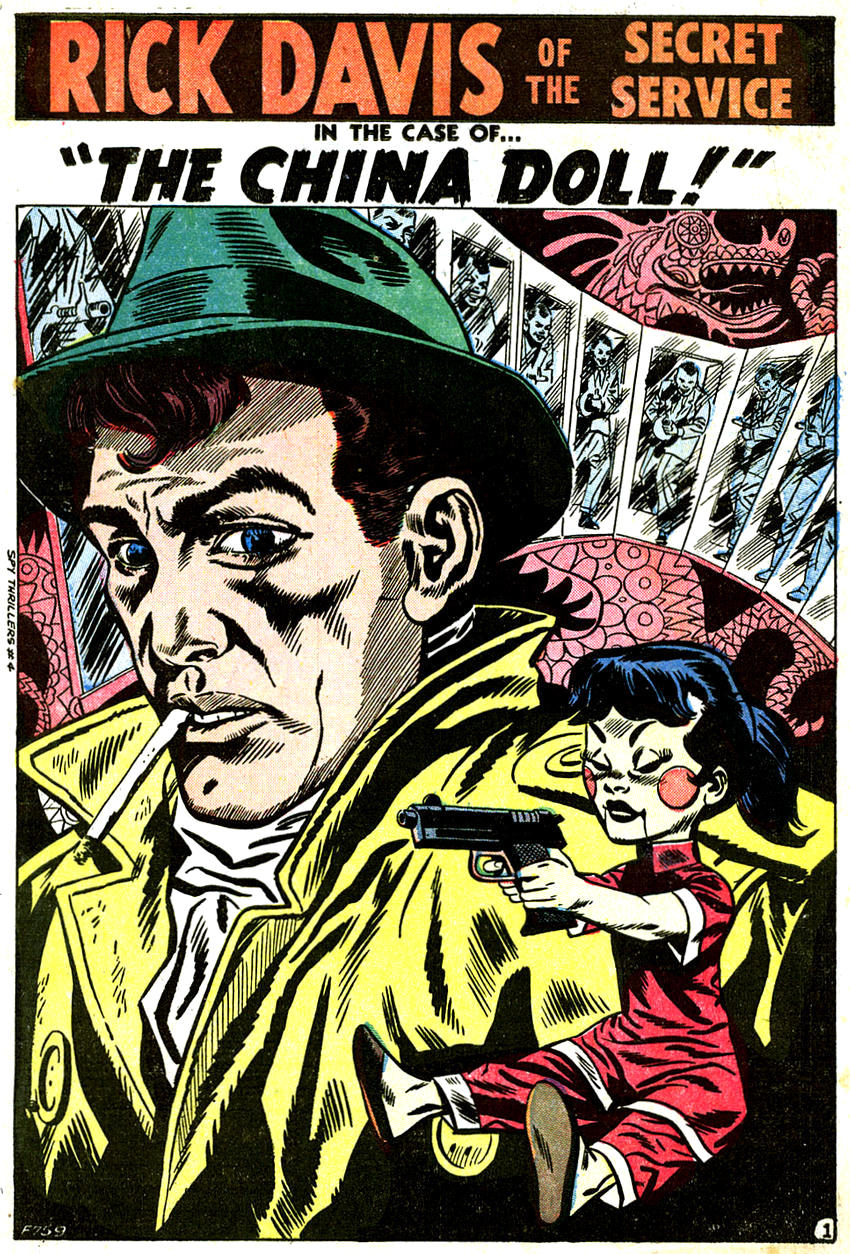
Three fast-moving, well-illustrated tales from Atlas Comics' Spy Thrillers are presented for your pleasure. It's the pleasure of seeing Ross Andru and Mike Esposito's artwork, especially the dynamic and symbolic splash pages.

AtlasTales.com equivocates on the cover credits, giving both Sol Brodsky? and/or Carl Burgos? a credit. Kind of.


Rick Davis is a globe-trotting United States Secret Service agent who answers his country's call to duty in Dick Tracy's yellow topcoat, and suits only a color blind person would pick. Green with a red tie. Nice Christmas colors. Where's his black suit and sunglasses, the uniform we consider appropriate for a Secret Service agent? Rick's world of the mid-'50s is full of Reds and commies, those treacherous and dangerous Cold War enemies of America. They have an advantage over Rick, able to spot him from quite a distance, glowing like a neon sign.

A couple of months ago the Secret Service took a beating over some rogue agents and some unprofessional conduct in Colombia. I have a high regard for the agency and believe they will get through this and do the job they should be proud to do, and with much better sartorial sense than Rick Davis.

From Spy Thrillers #4 (last issue, 1955):


More about

Number 1183: Caught with her panthers down

Người đăng: Unknown on Thứ Sáu, 29 tháng 6, 2012


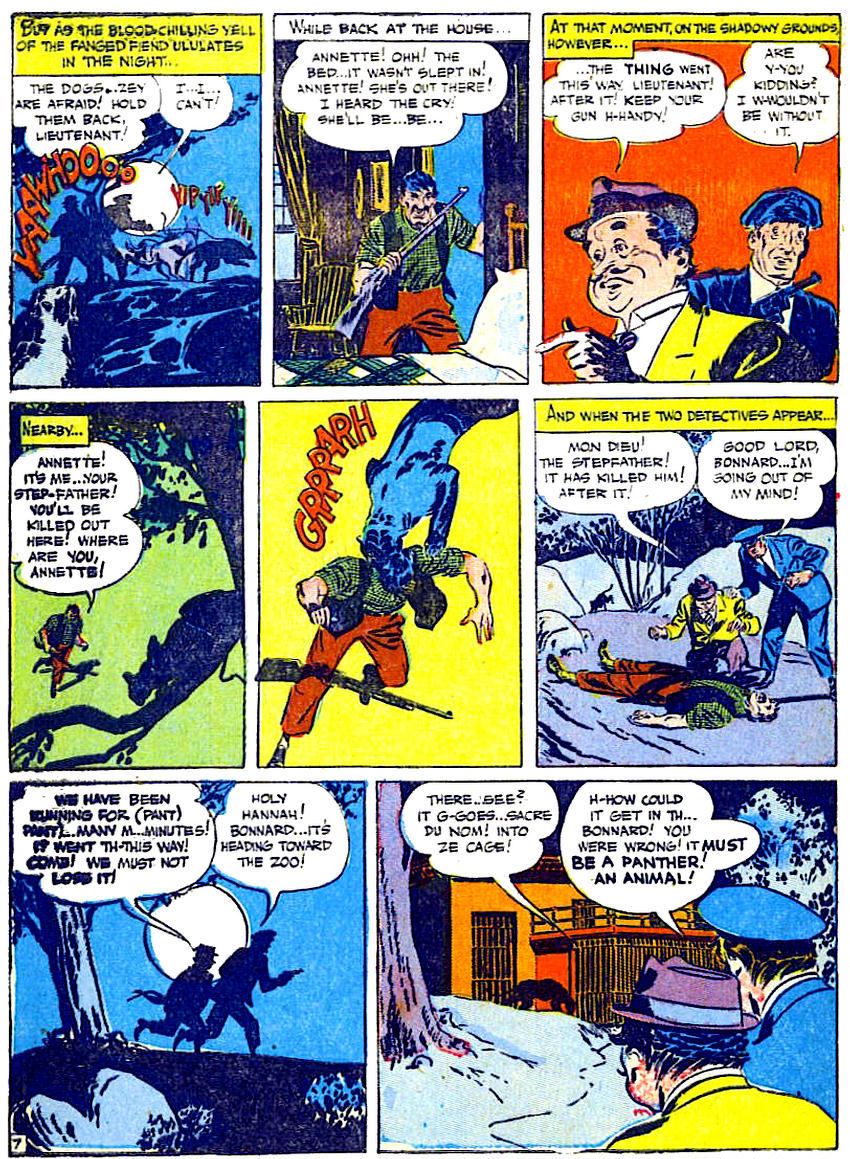
"Fangs of the Panther," from Harvey's All-New Comics #11, which is cover-dated Spring 1945, is probably at least partially inspired by the movie, Cat People, which was a big hit in 1942. Jerry Robinson, who had started his career assisting Bob Kane on Batman, is the artist. He was proud of this story, or appeared to be, since he signed it in both the splash and last panels. Signed comic book stories weren't unusual, but signed in two places was unusual.

Robinson died December 8, 2011, at age 89. He was active at that late stage in his life, based on this drawing of Robinson which appeared in The New Yorker magazine in May, 2011. Robinson was one of the pioneers of comic books, having joined Kane's studio as a teenager in those days when comics were finding their form.

Another pioneer, Bob Powell, was also represented in the same issue of All-New Comics, with a predecessor to the character, The Man in Black Called Fate*, the Man in Black Called Death, a name with a morbid air about it. It's the same character, though, with the gimmick of the Fate/Death character's face always in shadow.


*The Man in Black Called Fate is represented here by issues number 1 and 2 from 1957 in Pappy's #822, and Pappy's #1019. In 1947 the character appeared in Green Hornet Comics as The Man in Black, who introduced himself as Mr. Twilight! I showed a story in Pappy's #867.
More about

Review: Hulk Vol. 6: World War Hulks hardcover/paperback (Marvel Comics)

Người đăng: Unknown on Thứ Năm, 28 tháng 6, 2012

[The final of our trio of Marvel guest reviews this week comes from Zach King, concluding his look at Jeph Loeb's Hulk. Zach blogs about movies as The Cinema King]

With World War Hulks, Jeph Loeb's six-volume run with the Gamma Green Giant and his Crimson Counterpart comes to a close, and it accomplishes everything a conclusion should in an ongoing title. It isn't perfect, and it's far from Loeb's best work (for my money, The Long Halloween), but there's enough here for comics fans -- myself included -- to enjoy.

[Spoilers ahead -- it's impossible to discuss this volume without assessing the revelations behind Red Hulk and Red She-Hulk's identities. Then again, maybe everyone already knows those secrets.]

World War Hulks wraps up Loeb's Red Hulk plotline but opens with the moment we've all been waiting for -- Red Hulk stands revealed as Thunderbolt Ross, and Red She-Hulk admits she can't kill him because she's his daughter Betty. It's as unambiguous a resolution to that mystery as Loeb could deliver, but it's not the central plot. Red Hulk still has to face the Hulked-Out Heroes of the Marvel Universe (including Thor, Storm, Captain America, and The Thing), The Intelligencia and their attempt at a hulked-out military coup to overthrow the U.S. government, and the return of Hulk himself. Green and Red collide in a final battle to determine which Hulk is the "strongest there is," but as we've been reminded throughout this is a conflict about who's smarter, not who's stronger.

Loeb wisely doesn't break any of the toys he's created but leaves open the possibility for future Red Hulk stories, doing so with a nice callback to the story's first issue. In the back matter, we get a very interesting interview with Loeb on his collaboration with all the artists from the final volume, as well as three more of Audrey Loeb's Lil' Hulks tales about sharing blankets, shopping lists, and chemistry.

As I've said before, I had the ending spoiled for me and it was difficult to read this volume not knowing that Thunderbolt Ross was the Red Hulk; fortunately, I didn't have the Red She-Hulk bit ruined, and so I took more pleasure in that reveal -- especially in the way Loeb pulled back the curtain on both reveals in the same splash page. But having this information in my pocket let me step back and notice how well Loeb was running this mystery. Despite red herring after red herring, Loeb clearly knew what he was doing; as the interview points out, it would have been impossible to write the story without the ending in mind, and I had a great deal of fun tracing the clues (i.e., Red Hulk's constant references to military policy and his long-standing hatred for the Hulk).

But those are all general comments. I really enjoyed this last volume as a single entity because it effectively concludes the story with enough action that I could almost overlook the slim page count. (Almost.) Picking right up from Fall of the Hulks, World War Hulks opens with a classic slugfest and never really lets up. Even the middle chapter, a retrospective look at Thunderbolt Ross's life from his own perspective, doesn't feel like filler, in part because of the "jam session" artistic rotation of major Hulk pencillers past. No, this volume is all adrenaline.

As before, though, my principal complaint isn't with the story collected but the manner in which it's been collected. At three issues, this is once again another very small trade. (Ironic for a Hulk book to be too small, eh?) Collecting the Red Hulk chapters of Fall of the Hulks and World War Hulks might have made for a more enjoyable reading experience, giving a more totalizing sense of the story without the unnecessary division -- the same complaint, for example, I've made of Tarantino's Kill Bill.

Also as before, there's a bit of a sense that important parts of the story are happening in other trades -- a cheat that could have been mollified by, at the very least, a prose page of exposition. While I'm perfectly content to have the "Hulked-Out Heroes" spinoffs in their own collection, I'm miffed by the fact that Green Hulk returns to the action without any explanation as to how he regained his powers; when last we saw, Red Hulk drained Bruce Banner of his gamma energy and effectively killed Green Hulk. But here he is again, in prime clobberin' mode. While the story only takes a moment to reintroduce Hulk, it's a moment that distanced me from the story I was reading.

Quickly, though, World War Hulks throws itself back into action mode without ever feeling like it's merely filling pages (a complaint I've had about previous trades). In the end, I can say that I enjoyed Loeb's run on Hulk, for all its inconsistencies and collection problems (brevity being chief among them). A few "deluxe edition" volumes or even a single "Omnibus" might have mitigated those complaints; while not Loeb's finest work it's still a smashing good read.

Zach pleased.

[Thanks to Zach, and also to Doug and Damien for their contributions. Coming up next week, it's the Collected Editions review of Judd Winick's Catwoman: The Game (get ready, I kind of liked it) and Geoff Johns's Batman: Earth One. There's sure to be lots to talk about -- don't miss it!]
More about

Review: Daredevil: Reborn hardcover/paperback (Marvel Comics)

Người đăng: Unknown on Thứ Tư, 27 tháng 6, 2012

[Continuing our trio of Marvel guest reviews, Damien Lockrow has some strong feelings about this one ...]

It’s interesting to compare and contrast Marvel and DC’s takes on the "Rebirth/Reborn" story. While DC typically uses it to denote the start of a new status quo, if not necessarily a completely fresh start -- Green Lantern: Rebirth, Flash: Rebirth, Batman Reborn, etc. -- Marvel seems keen to use the “Reborn” moniker for the end of long-running storylines. Or in the case of Daredevil: Reborn, the end of an era.

Daredevil has been immersed in crime noir for so long it’s almost difficult to think of a time when he wasn’t. Certainly seems like it’s been forever since we haven’t seen him falling into dark depths, clutching dead lovers; Murdock’s record of dead love interests nearly matches Mobile Suit Gundam, a series known for the rule of “you hook up with a Newtype, you will die in the next few episodes.” You can’t destroy your main character's life forever -- I’m amazed they managed it this long -- so Andy Diggle is left to clear the deck for a more optimistic take on the character.

After the events of Shadowland -- where our hero “lost his nut” and killed a villain or two -- Matt’s wanted by the Feds, so he does the logical thing: grows a beard and leaves New York for the mid-west on your typical “quest to rediscover himself.” Inevitably, he blunders into some trouble. Seems a town he runs across had a nice arms trafficking thing going on. Cue lots of angst about how he shouldn’t get involved due to royally screwing things up with that whole “leader of the Hand” business. It goes without saying that he finds himself involved anyways.

It’s all fairly unremarkable. The story is meant to get Matt over his hangups before Mark Waid takes over, but I’m not sure it needed to be quite so generic. It seems like it’s copied right from the “reluctant hero cannot walk away” playbook; while it’s perfectly fine to start with that, you expect something new. Here, we’re pretty much going through the motions; despite Murdock's inner monologue telling us otherwise, he only half-heartedly tries to keep his nose out of this mess.

But man, even if he was making a concentrated effort to keep out, it’s not like they gave him much choice. The town itself has to be populated with the most rock stupid criminals I’ve seen in a while. It’s like they’re trying to arouse suspicion. Random stranger blowing through town? Have the local good-ol'-boys rough him up; it’s not like it will throw up any red flags or anything. Send him on his way out of town before he’s suspicious? Good plan, until the sheriff finds out he was a superhero once and decides to send a couple normal, small town cops to stop him. That’s not going to come back to bite them in the ass or anything; I’m sure they can handle Daredevil. Find him trying to put a stop to your drug running? Knock him out and throw him in the back with all the guns; nothing to worry about, it’s not like he killed Bullseye recently or anything.

The villains are incompetents of the highest order. It’s amazing that the Murdock -- complete with his own variation of Ghost Rider's "Penance Stare" -- looked twice at these guys, much less decided to work with them. Then again, it’s not like Matt is the sharpest knife in the drawer either: he’s wanted by the FBI -- who know his real name -- and his superpals are kind of sore at him for Shadowland, so clearly the intelligent thing to do is waltz right back to New York City -- superhero central -- and re-open Nelson and Murdock. That won’t raise any eyebrows at all! Unbelievable

As dark as Daredevil's adventures got over the long years, they were still of high quality, so this is kind of a cruddy way for that era to go out. Reborn is not out-and-out horrible, but even given how lenient and forgiving I can be, I can’t really find many reasons to recommend this book to you. Not even for the art, which is admittedly pretty damn good. It’s all fairly disappointing.

But hey, it does have some pretty spiffy covers by Jock, so that’s something, right?

[Contains full covers and cover concepts, half the script for issue #1 included]

I’m not particularly fond of being down on things or overly negative, but Daredevil: Reborn is sadly not worth your money. It’s far from the best and far from the worst Daredevil story, meaning it’s probably destined to end up forgotten. Feel free to skip this and jump right into Mark Waid's Daredevil if you want. I doubt you’ll miss much.
More about