Number 1182: “Chilluns ought to be seed and not hearn!”

Người đăng: Unknown on Thứ Tư, 27 tháng 6, 2012

I like to think if there's an afterlife, perhaps Walt Kelly and Lewis Carroll are talking to each other in their own funny versions of the English language.

Other Kelly Pogo postings on this blog include “Floyd the Flea is lost at sea!” from Pappy's #756, “A couple of miles of jollity,” from Pappy's #567, and “Cinderola and the Three Bears” from Pappy's #483.

From Pogo #2 (1950), by Walt Kelly:


More about

Review: Agents of Atlas hardcover/paperback (Marvel Comics)

Người đăng: Unknown on Thứ Ba, 26 tháng 6, 2012

[Beginning three days of Marvel guest reviews! First up, a new review from Doug Glassman.]

While Marvel may have a literal Justice Society of America analogue in the Invaders, Agents of Atlas is more similar in tone to Geoff Johns’ vaunted JSA run. Both books feature veteran heroes -- kept young through unusual means -- assembling to take on new threats from their past. But whereas the Justice Society was the most widely respected superhero team in the DCU, the Agents of Atlas pretend to be criminals.

It’s all explained in the original Agents of Atlas story. The seed of this tale goes back to What If? Vol. 1 #9: “What If . . . The Avengers Had Fought Evil During The 1950s?” This issue united some of early Marvel Comics’ heroes from back when they were called Atlas Comics. The resulting team broke up after it was decided that such a concept was far too revolutionary for the time. For a while, this was simply just a fun out-of-continuity tale, and it played a huge part in Kurt Busiek's Avengers Forever. Writer Jeff Parker takes this a step farther by transplanting this time into the main Marvel Universe, but without calling them the Avengers. The Agents of Atlas trade collects the What If issue along with the first historical appearances of all of the major characters, plus Parker's 2006 miniseries.

Leading the Agents is Jimmy Woo, a Chinese-American S.H.I.E.L.D. agent and the arch-enemy of the fearsome Yellow Claw, perhaps the first villain to have his own title. Woo actually aged in real-time in comics, and he gets a reset back to his 1950s looks and personality after nearly getting killed by the Claw. Jimmy’s trusted right-hand ape is Gorilla-Man, a.k.a. Ken Hale, a former soldier of fortune whose greed turned him into a strange form. Hale is aided in rescuing Woo from S.H.I.E.L.D. custody by X-11 the Human Robot, a powerful oddity who may have a human soul. The third conspirator in Woo’s rejuvenation is Bob Grayson, the original Marvel Boy. Long thought dead (and with his power bands given to Quasar), he’s been brought back by one of many eagerly-received retcons.

As Woo tries to find the Yellow Claw, Parker introduces the rest of the group: Venus, who believes herself to be the Greek goddess and whose song can entice the minds of all around her, is found in a formerly war-torn part of Africa. She’s literally sung the opposing civilizations into tranquility. The last recruit is Namora, also retconned back from death. The seventh member of the group is S.H.I.E.L.D. Agent Derek Khanata of Wakanda. Assigned to investigate Woo’s kidnapping, he becomes their unofficial liaison with the agency as they keep one step ahead of Dum-Dum Dugan.

The plot isn’t exactly intricate, but the fun comes from the personalities involved. All six are outcasts due to their looks or origins, and they form a tight bond despite quirks like Bob eating by extending his esophagus and Venus walking around topless all the time. At the center of it all is their loyalty to Woo, which comes together when they find Yellow -- now "Golden" -- Claw. Parker draws on the “Yellow Peril” themes of the old Yellow Claw series to explore the racism involved in Woo’s relegation to desk duty, the change in his enemy's name from “Golden” to “Yellow,” and their interwoven destiny. The Claw is the heir to the Spirit Banner of Temujin and thus the power of the empire of Genghis Khan . . . a power he wants Jimmy to wield. The always-practical Woo takes him up on the offer, setting up the theme of a villainous enterprise secretly doing good.

While Bob’s weirdness and shyness mark him as an interesting character, Hale is easily the most memorable member of the bunch. Like Congorilla over at DC, he’s gone through a renaissance, turning into a hard-edged, seen-everything veteran. The series’ recap and final pages go to Hale, including some of my favorite lines of the book. As the Agents investigate the thousands of arms of Atlas Enterprises, Hale keeps notes of what they visited. These include a mine which employs brainwashed CD-listeners, a ninja dojo, a super-addictive cookie company and a comic book publisher with a “constant crossover” racket. The last two may or may not be legitimate, according to Hale.

Further linking Atlas and JSA is the presence of Leonard Kirk, my second-favorite artist on that book. (Sorry, Leonard, but the artist Buzz drew the revenge of Atom Smasher, so he gets first-billing.) Kirk demonstrates his excellent sense of page layout a few times, such as when Bob beams his life story into the minds of his teammates, who act out the story as if they were Marvel Boy. I really enjoy the level of detail and cleanliness; in fact, Kirk is perhaps my standard when it comes to art.

The first trade of Agents of Atlas comes with numerous extras. Along with the first appearances of every main character, making this a great "historical" Marvel book, there is a lengthy section documenting the publicity done for the book through Comic Book Resources. Each chapter has false documents, like Ken’s list of Atlas businesses and a radio show transcript from the point of view of a bystander in an issue. These make the trade thick, but well worth the purchase.

While the Agents of Atlas has had trouble gaining popularity, it’s most certainly worth a look, especially if you miss the old days of JSA. It may help to know some Marvel history, but if you don’t, you’ll get an education very quickly.
More about

Review: Stormwatch Vol. 1: The Dark Side trade paperback (DC Comics)

Người đăng: Unknown on Thứ Hai, 25 tháng 6, 2012

For fans not even of the original Stormwatch necessarily, but of Stormwatch's bolder, edgier, more popular sibling The Authority, the title page of the DC New 52's first volume, Stormwatch: The Dark Side, is the realization of all the hope that followed DC Comics's announcement of the revamped title as part of their relaunch. Apollo, Midnighter, the Engineer, Jack Hawksmoor, Jenny Quantum, and randomly yet fittingly Martian Manhunter sit around a table peering at threats to the earth below. Call it what you like -- this is the Authority come to the DC Universe, and that's a good thing even if the concept must necessarily be watered down for mainstream consumption.

Writer Paul Cornell succeeds in what feels like a two-hour television pilot for Stormwatch. The story is clumsy at times, accidentally and also in the way Authority had of running at top speed and leaving the reader to keep up and fall behind. There is however great joy in seeing these characters together, and what Stormwatch offers is something that can't be found anywhere else in the DC Universe; those facts alone argue for this title continuing through its second collection and beyond.

[Review contains spoilers]

Cornell brought humor, action, and philosophy to Superman: The Black Ring (starring Lex Luthor, no less), so there was little doubt he could do the same for Stormwatch. But the first few issues of Dark Side clunk along not quite smoothly, and that's troubling for a new title. There's a rather fearsome image of the moon attacking the earth that turns out to be "just a picture," not actually representative of the threat at hand, kind of a tease to the reader. On one hand team members essentially state their powers aloud for no reason other than the writer needs it; on the other, the story starts with babble about an alien horn, a "Moscow mission," and the threat of the moon, with little background for the reader to grab hold of.

This second item is less a problem than the too-obvious dialogue. It is not unlike Authority to start in the middle of things, whether a sudden attack by clones or Sliding Albion. But Cornell confuses things when character Adam One asks what "blew" the alien horn, when it's never quite clear that anything played the horn at all nor whether it simply appeared in the Himalayas, crash-landed, or what happened. Moscow and the moon are ultimately cleared up by the end of the issue, and the Stormwatch creative team gets extra points that someone, editor or letterer, uses the classic Wildstorm font for the narration of the moon-beast, an excellent throwback to Stormwatch/Authority of yore.

The difficulty with some DC New 52 premieres is that, in an effort to tell one whole story in the collection, the writers double-back over the same plot points; Green Lantern: Sinestro is somewhat guilty of this, as is Justice League International: The Signal Masters. Had The Dark Side dealt with the moon-beast Scourge of Worlds through all six of its issues, it would fall into this category too, but Cornell smartly turns to something completely different for the final two. The murder of the team leader by Stormwatch's ruling Shadow Cabinet, the betrayal of a teammate, and a conflict with the team's own ship packs a lot into the final issues, and makes this book about more, ultimately, than heroes fighting a monster.

That a "Shadow Cabinet" runs Stormwatch seems to be a new addition by Cornell to Stormwatch/Authority lore. It is perhaps too much for the reader to hope that this refers at all to the old Milestone Shadow Cabinet title, but it's promising to see Cornell innovate and not feel compelled to follow either Stormwatch or Authority's old rules (to some extent this Stormwatch greater resembles the Authority just as the UN-chartered Justice League International better resembles Wildstorm's old Stormwatch).

Also the Authority had captured and tamed their sentient hyperspace headquarters off-screen prior to the series' start, so it's interesting too to see Cornell take up a "lost moment" from Authority to have Jack Hawksmoor and Stormwatch actually have to negotiate terms with their headquarters here and now.

Though largely a Doctor Who writer, Cornell has dabbled in Star Trek reading guides, and the end of Stormwatch (especially issue five) is notable because it's a bottle episode (named not in the least for Trek episodes that take place entirely on the ship). DC Comics does not lack for space-faring titles, especially in the last few years, but R.E.B.E.L.S., for instance, had not such a small group of regular characters nor such a distinct headquarters. The Justice League may have a satellite headquarters (had at one point, and might again) but aren't quite right for such cosmic nor character-driven stories.

In this way, Stormwatch: The Dark Side represents not just the integration of a major Wildstorm institution into the DC Universe, but also a new kind of title for DC Comics proper, of the kind it may not have ever seen before. The Dark Side does not excel -- like Justice League International, this is a functional story but not until the end does it really begin to do anything different -- but it's a pleasure to see the Authority characters again, and front-and-center and in the DC Universe sandbox. That alone ought be worth even the most cynical reader giving this one another volume to really find its feet.

[Includes original covers, sketchbook section by Cully Hamner with Jim Lee]

Coming up tomorrow, Wednesday, and Thursday, our guest reviewers take the reigns, with three new Marvel reviews. And next week, two big reviews you won't want to miss -- the Collected Editions review of the DC New 52 Catwoman: The Game and Geoff Johns and Gary Frank's Batman: Earth One. Be here!
More about

Number 1181: Robin Crusoe

Người đăng: Unknown


How old is Batman's ward, Robin, anyway? I've seen stories where he seems very young and then stories like this, where he appears to be sixteen or seventeen. It wouldn't matter except that he's allowed to fly the Batplane on a high altitude test flight. "Hey, Bruce, can I have the keys to the Batplane today? I'd like to take it for a spin, you know, see what it can do."

"Okay, but remember to wear your seat belt and no texting on the Batphone while you're flying."

You think Batman would just let Robin take off in an expensive plane without him along? Robin must've sneaked it out of the hangar when Batman was busy with something else. Teenagers — always getting into trouble.

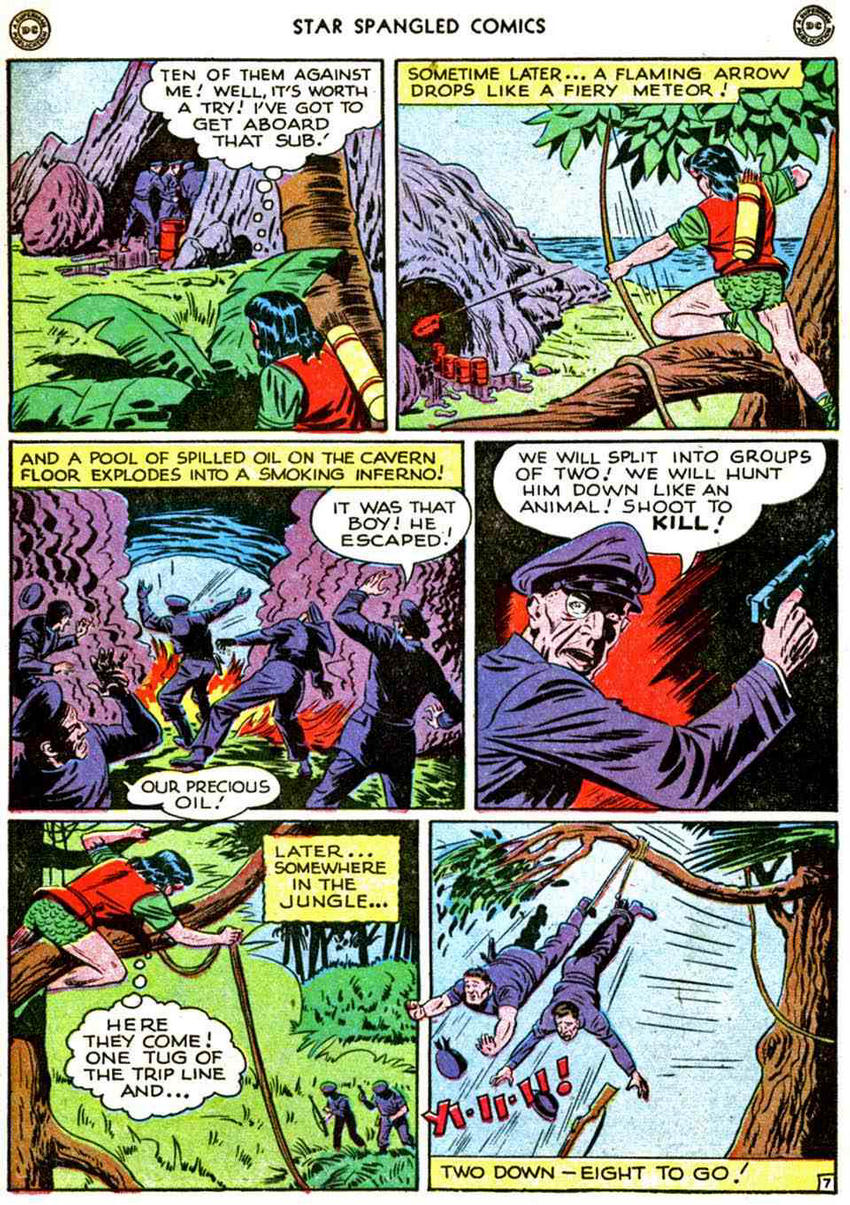
Robin took the Batplane quite a distance before it cracked up and he ended up on a tropical island. There probably aren't any tropical islands close to Gotham City. Robin used his survival skills to kill game and when he encountered an enemy, Nazis no less, from a submarine looking for a secret oil base, he was able to fight adult sailors using his Bat-training. Even I learned something when Robin demonstrated how to swim out of quicksand. Next time I find myself being sucked into a quicksand bog I'll know what to do.

Robin is on the island long enough to grow a mullet, and in that kind of time you know Batman was frantic with worry. Which brings me to the question, how close were Batman and Robin? This page of original art from Batman #13, the scan provided by Heritage Auctions, has Batman telling Robin he'd "rather lose both arms than you."


In the splash panel of "The Trial of Bruce Wayne" from Batman #57 (1950), they reach for each other when in danger of being separated. I'd say these examples show they were mighty close. So I imagine during the weeks Robin was missing Batman was anxious and upset.


"Robin Crusoe" is from Star Spangled Comics #72 (1948). According to the Grand Comics Database it was written by Bill Finger, and drawn by Curt Swan, ghosting for Bob Kane, and inked by John Fischetti. The cover is by Curt Swan and Stay Kaye.


More about

Number 1180: The stolen saucer

Người đăng: Unknown on Chủ Nhật, 24 tháng 6, 2012


Sixty-five years ago today, June 24, 1947, Kenneth Arnold, flying his small private plane over the Cascade Mountains of Washington State, spotted nine strange flying objects in the sky. The story has come down as the event that kicked off flying saucer fever. I'm commemorating the anniversary with a story featuring Mandrake the Magician, "The Flying Saucers."

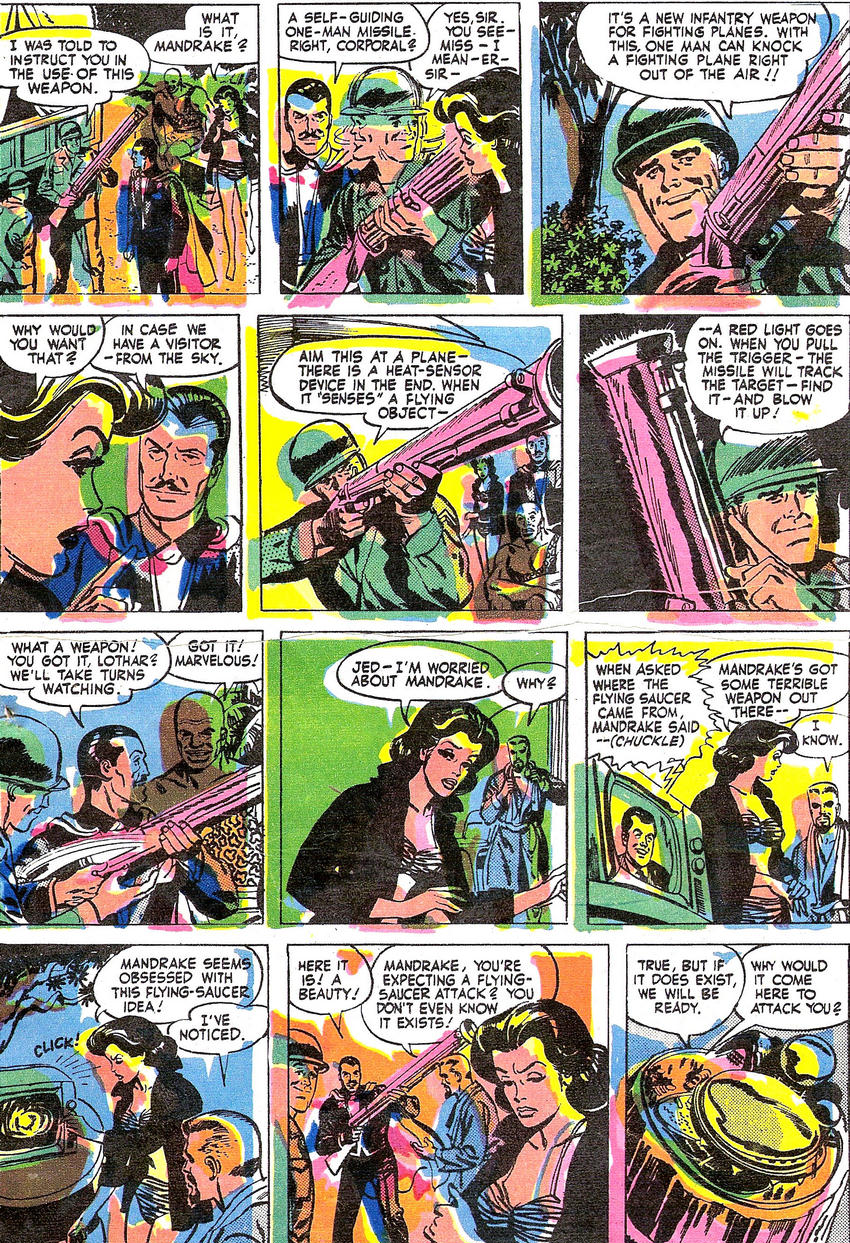
The story, taken from a newspaper comic strip continuity with dates unknown to me, was printed as part of the Indrajal Comics line in India, published by the Times of India. I have never seen an Indrajal Comic in person, only in digital form. I found this online, and after a minor clean up of the scans I am presenting it to you as I found it. (You may remember me saying a few weeks ago that off-register colors were a problem of American comics, but when it comes to off-register the Indian printers of this issue were more than a match for the Americans.)

Reading the Wikipedia entry on Indrajal Comics I see they quit publishing them in 1990, but they had a good run and are appearing more and more in online versions.

I'm not trying to spoil the end of the story for anyone, but as a further bit of introduction I need to go back again to 1947. When Kenneth Arnold first observed the mysterious craft, and when the stories of them went out through the news media the "saucers" were thought to be secret weapons. Perhaps, as was speculated, they were aircraft flown by the Soviets invading our airspace, or maybe they were secret weapons being tested by the USA. In those early days no one used terms like extraterrestrial. All of that came along sometime later. All I'll say about this story is that Mandrake encounters no real extraterrestrials.

From 1972, Indrajal Comics #155, written by Lee Falk, drawn by Fred Fredericks:


Mandrake had a real-life counterpart, Leon Mandrake.


More about