Người đăng: Unknown on Thứ Sáu, 10 tháng 2, 2012


Number 1103


Gangster and Gothic Ghastly


I've shown stories from different eras of "Ghastly" Graham Ingels' career, including a Western (Pappy's #707) and a love story (Pappy's #712.) But today I'm showing a 1948 crime story, and then a fine 1952 example of Ingels' gothic art for the EC horror comics.

Major differences in the stories are the violence levels in the artwork. In the EC story the violence is toned down. The rat-killings are shown just before the kill, and the retribution of the king and queen's subjects is told in the captions, yet the drawings are camouflaged by coloring and silhouette. The last panel of the royal couple writhing is more slapstick than gruesome, until you read of their fate in the caption. On the other hand, in "Spanish John" we see a couple of graphic knifings (one through the arm, another through the neck), some shootings, including a cop, and the dying Spanish John, bleeding on a tombstone.

Ingels drew some ghastly things in his career (hence his nickname), but I believe it was his ability to evoke mood that made his work so special. Mood is mostly missing from "Spanish John." It's well drawn, but not as effective in pushing its knife-like point as "A Grim Fairy Tale."

From Underworld #4 (1948):


From Vault of Horror #27 (1952):


More about

Review: Supergirl: Bizarrogirl trade paperback (DC Comics)

Người đăng: Unknown on Thứ Năm, 9 tháng 2, 2012

Sterling Gates's Supergirl: Bizarrogirl is an effective tribute to Superman stories gone past. Though Bizarrogirl was not originally intended as the last Supergirl collection before the DC New 52 reboot, it works to bring this Supergirl's story to a close and tie up a number of loose ends and plot threads -- both Gates's, and some almost two to three decades old. As a long-time Superman fan, I was more than happy to see Gates re-treading old ground one last time before everything changes.

[Contains spoilers]

Gates tells three stories here: that of Supergirl on Bizarro World, Supergirl teaming up with the Legion of Super-Heroes, and Supergirl and Daily Planet columnist Cat Grant investigating the Toyman. Each of these are quite firmly steeped in past stories; the first plays off what Geoff Johns established in Superman: Escape from Bizarro World; the second mashes up the continuity of this Supergirl and the pre-Crisis on Infinite Earths iteration; and the third takes up both early 1990s Toyman stories in the Superman "Triangle Titles" and also Johns's recent changes to the Toyman.

All in all, I felt it had the positive effect of making this Supergirl -- a relative newcomer to DC continuity and something of a mis-fit during her first few creative teams -- actually feel like a character who's been part of the modern Superman mythos all along instead of a recent drop-in.

Like Bryan Miller on Batgirl, Gates had a lot of work to do in the beginning, and we'll pause a moment to recognize that. Though I thought the edgy, hard-partying, flirts-with-Captain-Boomerang-Jr. Supergirl of Identity was interesting if only for the risk DC was taking, but truly by the time Gates took over the title, DC did not have a tenable, consistent Supergirl to show for themselves.

That artist Jamal Igle subtly demonstrated that no, Supergirl is not flying around with a thong under her skirt was notably but only a cosmetic change, really, laid atop what else Gates was doing -- preserving some of the volatility in this Supergirl as created by Jeph Loeb, but also making her more heroic, more responsible, and more, essentially, normal. That we first meet Gates's Supergirl fighting Silver Banshee is significant because, y'know, that's what superheroes do.

Gates followed Who is Superwoman with a handful of collections that weaved in and out of the "New Krypton" storyline, with plenty of mystery and betrayal, especially strong themes at one point of faith versus science, and some excellent continuity nods to boot. While Supergirl might've thrown a couple fits, we never found her grinding away in a Metropolis club, just regular ol' superhero action. That "regularity" might have been why Gates's Supergirl never got the recognition that Miller's revitalization of Stephanie Brown as Batgirl did, but I'd venture Gates faced no less of a challenge and was equally successful in making his character readable.

Bizarrogirl wraps up two aspects of Gates's Supergirl run, one short(er)-term and one long-term. The former is the aftermath of the destruction of New Krypton; Gates could have handled this with a greater amount of pathos, but addressing it against the backdrop of saving Bizarro society offers Supergirl self-actualization without bringing the story to a standstill for four issues. The latter partners Supergirl with Grant, who's been Supergirl's detractor since Gates's first issue; it's no surprise Gates would end with Grant, nor that Grant's story ought involve the Toyman, who killed her son -- but it's clear Gates knows the pins he's set up during his Supergirl run and what need to be knocked down (including ending the book as he began it, with "This is my life"), and the final book is a satisfactory close.

Gates has the benefit, too, of his last Supergirl stories not quite running up against the DC New 52 reboot, so Bizarrogirl doesn't feel as rushed as Batgirl: The Lesson, for instance.

Taking up Cat Grant and the Toyman is something of an ambitious endeavor for Gates, given that the story in which Toyman killed Cat's son Adam (or, when Toyman's robot killed Adam, after Geoff Johns's Final Crisis-era alteration to the story) was published in 1993. The brassy, overblown Grant of the Superman-family titles of late is a somewhat far cry from the same character in the 1980s-1990s Superman stories that actually dated Clark Kent (the present Grant is more in line with Tracy Scoggins portrayal of the character on Lois and Clark); I wouldn't have been surprised of Gates and Johns had jettisoned Grant's past entirely, much like how Lucy Lane, who appears here, never married or had a child with Daily Planet reporter Ron Troupe.

Instead, Gates has Lana Lang narrate a through-way for Grant from the former characterization to the latter, throwing a bone to "Triangle Title" Superman fans at the end. Lana's saying, "[Grant] was different woman back then. Heck, we all were," is a cute bit on Gates's part, given that Grant was not so ostentatious, Lang was not a businesswoman who might one day head LexCorp, and Supergirl was a protoplasmic shapeshifter also called Matrix (you all know Matrix, right?). Here at the soon-to-be-end of the DC Universe, some looking back is warranted, and it's comforting to intuit that Gates has as much a touchstone with those old days as the readers do.

Speaking of old days, the Supergirl Annual that appears in the center of this book pairs Supergirl with the Legion of Super-Heroes -- that is, the newest iteration of the Legion, which itself is based on the Legion that DC published from the 1960s to 1986's Crisis on Infinite Earths. The mixture of new and old runs throughout the annual; the current iteration of Supergirl is a relatively new one that had her own adventures with Mark Waid's "Threeboot" Legion, as it's called, but Gates essentially posits this Supergirl as the same who had pre-Crisis adventures with the Legion, up to and including dying an untimely death (in Crisis, though Gates stops just short of showing said scene).

In essence, at the near-end of her title, this Supergirl becomes the "once and future" Supergirl, both her own character and the character she was created to replace, which also seems fitting. All of this brought clear to me that in DC's New 52, we understand Crisis on Infinite Earths never happened, so this major moment of Supergirl's death will no longer be a plot point. So strong was Supergirl's death in Crisis that even though the event is out of continuity, here twenty-five years later Sterling Gates finds a way to make it relevant again. Maybe that's what they mean by the New 52 jettisoning too many years of baggage -- a new reader couldn't reasonably be expected to go back twenty-five years to understand the greater meaning in a recent Supergirl annual -- but the fact that no character will refer to "when Supergirl died" again brought me up short.

(Or maybe they will. Legion continuity remains the same, so maybe they can just insert the New 52 Supergirl into the same role as this Supergirl as far as the future's concerned. The good thing, I imagine, about Legion adventures taking place in the future.)

All of that said, done, and muddled, then, it remains that Supergirl: Bizarrogirl is enjoyable, and caps off a nice Supergirl run by Sterling Gates. It was almost twenty years after Crisis before DC decided to bring back the Kryptonian Supergirl, relatively late altogether, and then it took them a while to get her portrayal right. Gates accomplished that portrayal, and it's nice that he got it right just before we lost the character altogether.

UPDATE: This review received this very nice response:


[Includes original and variant covers. Printed on glossy paper. Apparently Sterling Gates wrote a foreword or afterword to this volume that DC never published; still hoping we see it online one of these days]

The theme of next week is super-teams, with reviews of Outsiders and Secret Six. Also, get ready for a big DC TPB Timeline announcement ...
More about

Review: Marvel Legacy: The 1960s-1990s Handbook trade paperback (Marvel Comics)

Người đăng: Unknown on Thứ Tư, 8 tháng 2, 2012

[A new guest review from Doug Glassman]

Ever since I began collecting the Star Wars Essential Guides, handbooks and guidebooks have been on the top of my reading list. There’s something compelling about getting all of your information in one place, especially if it gives you an expanded view of its fictional universe. It’s also a great way to save money if you don’t want to search for expensive or hard-to-find works which may or may not have anything to do with what you’re reading.

When it comes to comic book guides, Marvel is at the forefront. Compared to DC’s paltry Who’s Who in the DC Universe (which hasn’t been updated since the early 1990s) and Secret Files issues (which are few and far between), the Marvel Official Handbooks are constantly updated.

One of the problems with these kinds of guidebooks is, naturally, that they’re covering a work in progress. The Star Wars books are already starting on Volume 3 of their guides, while Marvel has had at least half a dozen major revisions. Even as they published fourteen (!) definitive Handbook hardcovers, they had to put out update issues with character updates and minor things that they missed. As of the writing of this review, those hardcovers have now been published as softcovers with the updates collected within them ... and there are still monthly update issues. However, this has an upside: you can track the history of Marvel Comics through the various retcons and changes. The original Handbook, for instance, is collected as an Essential volume; read through its “Book of the Dead and Inactive” chapter and see how many characters have been resurrected since then.

The subject of this review, Marvel Legacy: The 1960s-1990s Handbook, takes this approach to the history of the Marvel Universe. While the original Handbook series comes from the 80s, the four issues collected here use era-specific entry designs; the '80s issue resembles the original, for instance, while the '90s issue uses the current design. The Avengers and Captain Marvel have entries in all four books to really see how much they have evolved; the X-Men, Iron Man and Spider-Man appear in three of them. Instead of lumping everything together, I’ll go through each book separately and point out some interesting bits.

The '60s book includes Bull’s Eye, Colossus, Dr. Strange, Death’s Head, the Exiles and the Wrecker. In this case, however, they are respectively a stealthy sniper (with a different spelling); a robot and a computer (two different beings); a evil sorcerer; a radioactive man on a radioactive horse; a bunch of old evil World War II veterans; and two different criminals. Name reuse is nothing new, but it’s interesting to see how far back some of the names go.

Many of the entries are for one-shot aliens and monsters, along with some of Marvel’s non-superhero women such as Patsy Walker (who later became Hellcat) and Chili Storm. At the end of each book, there’s a “Where Are They Now” featuring further appearances and retcons. If they never appeared again, they are listed at the top along with the authors asking where they went, almost as a challenge to writers out there. The Avengers entry is, naturally, very short, with the newest members being Black Panther and Hercules. Captain Marvel is in his original green-and-white costume.

The '70s book features profiles on a number of corrupt organizations, including the back-to-back Committee, Conspiracy and Corporation. (I’m surprised no one has retconned those into one giant evil group that's probably run by Hydra.) Watergate was the cause of many of these, as well as the infamous Royalist Empire of America, Marvel’s second-most insidious organization of people in funny anachronistic costumes; they can’t hold a candle to the Hellfire Club, of course.

There are also many entries dealing with the supernatural side of the Marvel Universe, centering around Dracula and Werewolf By Night. These include some great ideas, such as the mind-controlling Devil’s Heart, and some odd ideas, such as Steve Gerber’s brilliant Bessie the Hellcow. If Bessie can’t sell you on this book -- or on Essential volumes of Dracula -- then there’s little else I can do.

Here, the Avengers are in the “pick seven members” era, with new members such as the Falcon, Hellcat and the entire Guardians of the Galaxy. Again, I’m not making any of this up. Captain Marvel, meanwhile, is in his famous red and black costume, and is joined by Ms. Marvel in her own entry.

On the topic of name reuse, there’s a weird case when it comes to the name “Star Thief.” There’s one each from the '70s, '80s and '90s, and all of them have yellowish-green coloration, but they have no other obvious connection. Is it just synchronicity and a popular name, or was there an attempt to create a villain dynasty that just never went through? We may never know. [A secret invasion, perhaps? -- ed.]

On to the '80s book, from an era which was dominated by Secret Wars. As such, the Captain Marvel presented here is Monica Rambeau, an African American light-controlling woman best known from Nextwave. The Avengers introduced in this era include a personal favorite line-up: Captain America (as “The Captain”), Thor, Mr. Fantastic, the Invisible Woman and Gilgamesh the Eternal. It’s not that I really enjoy those stories; it’s just such a bizarre membership, and it also makes Johnny Storm the only member of the original Fantastic Four to have never served on the Avengers.

Characters from Marvel’s New Universe imprint, such as Nightmask and DP7, have entries here, as do the main characters from Shogun Warriors and Rom: Spaceknight. These latter entries do a fairly elegant tapdance around Marvel’s lack of character ownership, with Combattra, Raydeen, Danguard Ace and Rom never even shown. She-Hulk and the famous Thor-Frog both appear in this book, which is only worth pointing out because I was sure that both took place in the '70s.

In my opinion, one important character missing from this volume is Venom. While he has a profile in other Handbooks and he is discussed in the Spider-Man entry as part of the black costume era, Venom helped define modern super-villains and the late '80s in comics in general.

Finally, we come to the '90s, which was even weirder than the '60s. The Captain Marvel here is Genis-Vell, who was killed a few years ago in Thunderbolts, which means he’ll probably be back by the end of whatever crossover comes after “Fear Itself.” While the Avengers entry is weighted more towards the excellent Busiek and Perez title, it would have been great to see a picture of the team-jackets era of the mid-'90s. Unfortunately, the entire Modular Armor era of Iron Man is ignored in favor of Teen Tony and “The Crossing,” a crossover which basically never really happened thanks to Avengers Forever. The entry on Force Works member Century is the only place which tells the story of my favorite Iron Man era.

Other '90s replacement characters include the female Dr. Octopus, Phil Urich as the Green Goblin, Lobo knockoff Lunatik, Lady Punisher, Paradox (half of Dr. Strange) and Vengeance, the Purple Warthog Ghost Rider. There’s some truly bizarre characters in here including Stunner, who was Otto Octavius’ overweight girlfriend piloting an Amazonian virtual reality body, and Stephen Loss, who … well, let’s just say he’s from Warren Ellis’ Hellstorm, which out-Vertigoed the weirdest Vertigo comics. That’s without getting into the time when the Punisher died and became an angel, which was so stupid that it doesn’t get mentioned at all.

One of the great advantages of the Marvel Legacy Handbook is that you don’t need to know anything about Marvel Comics. In fact, it almost helps to not know a lot, since you can learn so much about such interesting, little-known facets. The “Where Are They Now” chapters direct you to even more stories.

The only unique illustrations are three covers by Sal Buscema and one by Ron Lim (for the '90s book). All are group shots, and the title page is a great mash-up of Buscema’s '70s characters and Lim’s '90s characters. Otherwise, the art comes from the original comic books, for better or for worse. There’s art from Kirby, Perez, Adams, Liefeld and even Unknown, that classic '70s penciller for minor Spider-Man titles.

Twenty dollars might seem like a tall order for profiles of characters you’ve never heard of, but if you want to get into the history of the Marvel Universe, this book is a wonderful way to dive in head-first.
More about

Người đăng: Unknown


Number 1102


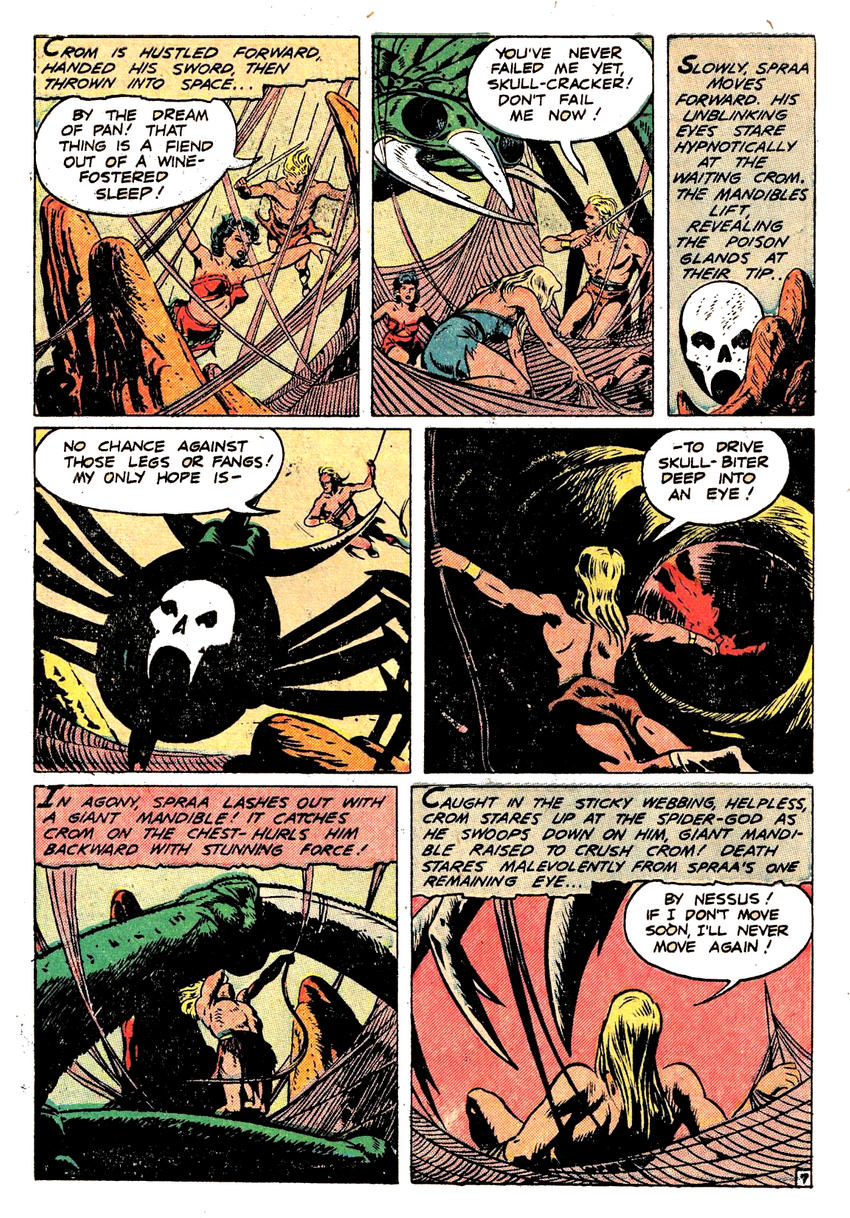
Crom the Barbarian


As promised Monday, here's another story by John Giunta, this time signing himself "Jay Gee."

Giunta did "Crom the Barbarian and the Spider God of Akka" for Avon's Out Of This World #2, in 1950. It appeared in a 32-page comic book insert for an issue of Avon's pulp magazine of the same name, where I got the scans for this story.

From what I understand, Gardner Fox wrote "Crom," and based him on Conan the Barbarian. Crom was Conan's god, to whom he swore mighty oaths. I'm not sure why Fox named his character after Conan's god, but appears to have been giving a nod to readers in the know, referring to the stories of Robert E. Howard.

Giunta, who worked in comic books during the 1940s through at least the mid-'60s, died in 1970 at the young age of 50.


More about

Watch this (DC TPB Timeline) space!

Người đăng: Unknown on Thứ Ba, 7 tháng 2, 2012


Next Tuesday, Collected Editions will announce something new regarding the DC Universe Trade Paperback Timeline and Reading Order. This will be accompanied by a much-requested Timeline update.

I'm quite excited by this announcement and what it heralds for Collected Editions. I hope you'll come back here next Tuesday (Valentine's Day!) to check it out.

Writers and bloggers, if you'd like a special sneak peek of what's coming, please email me at the Yahoo account (collectededitions).

New reviews tomorrow ... and see you next week!

UPDATE: The announcement was made in this post.
More about

Review: Batgirl: The Lesson trade paperback (DC Comics)

Người đăng: Unknown on Thứ Hai, 6 tháng 2, 2012

I've chastised DC Comics before their release of copious tie-in series to each and every event they publish, a kind of maniacal "throw it at the wall and see what sticks" mentality. Every once in a while, however, this practice proves valid for DC. While neither Gotham City Sirens, Streets of Gotham, nor Azrael ever made headlines as "Batman Reborn" spin-offs, on the other hand you have Bryan Q. Miller's Batgirl. If ever a DC series warranted the title of "instant classic," Batgirl is it; more's the shame that Miller doesn't have a series in DC's New 52, because after Batgirl I'd read Miller writing the DC phonebook.

Miller's final collection, Batgirl: The Lesson, reflects a little bit of the rush to wrap things up before the DC relaunch, but nonetheless Miller completes the book in quite satisfactory fashion. If we accept that there was a general ennui in the DC Universe that necessitated the relaunch, here we can say the opposite: Batgirl went out while the series still shined, a specific book to be proud of in the waning days of the old DCU.

[Contains spoilers]

If Batgirl Rising was the story of former Spoiler accepting the mantle of Batgirl and Batgirl: The Flood was the story of those around her accepting Stephanie in the role, Lesson is where Stephanie's story comes full circle -- the apprentice, if you will, becomes the master. Almost every story in the book is a team-up, notably with Stephanie's innocuous stalker, the Grey Ghost.

Most striking, to be sure, is toward the end of the book, when Batgirl warns of Grey Ghost from crime-fighting lest he hurt himself, and even threatens him to make her point. Miller doesn't dive into this directly, but it's clear how far Stephanie has come as Batgirl when she's discouraging untrained heroes just the same as Robin did to her when she was Spoiler. The Gray Ghost follows an equally Spoiler-y path and tries to infiltrate the villainous Reaper gang, meeting his death; I'd like to think Batgirl pursues the Reapers so stringently in the end in part because she recognizes that there by other circumstances she might have gone herself.

Another study in contrasts is that even as this book is filled with team-ups, it's actually a story about Batgirl growing increasingly alone and learning to rely on herself. With her mentor Oracle declaring herself dead, "Team Batgirl" becomes Stephanie and the computer-whiz Proxy only briefly before Proxy departs on a spiritual journey. Batgirl has plenty of company in the final pages, from the British Squire to Detective Gage to a bevy of her fellow young superheroines -- but it is Batgirl alone who ultimately faces down her father, the Cluemaster, and breaks the hold of the illusion-inducing Black Mercy plant (something, Miller is no doubt aware, gave even Superman pause).

Miller closes out Batgirl just right with seven splash page sequences, ostensibly Batgirl's Black Mercy illusions but perhaps, one hopes, maybe glimpses of the future. Each is more fun than the last, making the reader all the more reluctant that the series is at an end -- a "regular" adventure with Oracle, Batgirl, Proxy, and Robin Damian Wayne; the young heroines in storybook garb versus the Queen of Fables; Oracle, Batgirl, and Robin as multi-colored Lanterns fighting Black Lantern Zombies; a time-traveling team-up with the Blackhawks courtesy of Booster Gold, with Batgirls Barbata Gordon and Cassandra Cain (and is that Damian?); and Stephanie's college graduation, rife with an attack by the Royal Flush Gang.

The final two images are a married Stephanie putting her son to bed, the Bat-signal beckoning (let's hope the dark-haired child is Red Robin Tim Drake's, and we don't have an Anakin/Padme situation with Damian here); and that same Stephanie flying through the air as the new Nightwing, with the young girl Nell who's appeared throughout the series as her protege Batgirl.

Miller and artists Pere Perez and Dustin Nguyen know all the notes to hit (see Klarion the Witch Boy sitting "Batgirl style" on her car on the final cover, and the lurkng vampires). I also appreciated that Miller reveals Batgirl's identity to her mother at the end of the book (shame, again, we won't get to see that play out). Miller even breaks the rules and has Batgirl reveal Oracle's identity to Detective Gage in the end -- and why not? What's the end of the universe if you can't crack a couple eggs?

Still, it's clear the Batgirl title could have used another issue or two (or maybe that's just my wishful thinking). That Detective Gage was a member of the Reaper cult and that they killed his fiance seems too convenient and less dramatic than I expected -- I wondered if Miller simply went for the easiest tie with time running out. Proxy bows out suddenly and without much resolution; I also imagine that readers of just Batgirl will be confused by the "death of Oracle" references, which are not well explained here if one's not also reading Birds of Prey.

Also, as with the recent Chase trade, my copy of The Lesson's cover started curling the minute I brought it home from the store, and that got worse as I was reading it. You've got to love a ten-issue trade (and indeed, The Lesson offers a nice, lengthy read), but there's a lot of issues crammed in here on thin paper, and I wonder if the physical quality of this book is slightly less than others to put so much content in an affordable trade.

None of that, however, should keep any reader from running out and buying for themselves and any comics-interested friends copies of all three Batgirl volumes. This is fun comics, fun comics with a teenage star (when many often read like poor soap operas), and fun comics that's also a brilliant study in how every character is redeemable -- Bryan Q. Miller put a comic starring Stephanie Brown -- the erstwhile Spoiler, who became nearly unreadable during Batman: War Games -- on the New York Times bestseller list.

In its heyday, Batgirl was undoubtedly one of the best books DC Comics was publishing. At the end of Batgirl: The Lesson, Stephanie says with a wink that "it's only the end if you want it to be." I don't think we have quite the control that Miller would have us believe in this moment -- but it's certainly nice to wish so.

[Contains full cover. Printed on glossy (if thin) paper]

What Bryan Miller did for Batgirl, Sterling Gates did for Supergirl, no less of an uphill battle. We'll look at the final Supergirl trade coming up next, plus guest-reviewer Doug Glassman on the Marvel Handbook.
More about

Người đăng: Unknown


Number 1101


What ho, it's Tally-Ho!


Tally-Ho Comics might be one of the oddest comic books ever published. The cover makes it look like a kiddie comic, and parents might have been fooled into buying it for their kid. The unsuspecting kid would be turning the pages past "Snowman" and find himself reading a gory horror story featuring a–YIKES!–bloody dismembered hand.

The comic is dated December 1944, and is one of a series of oddball releases during the latter part of World War II. Paper was rationed, but comic books were selling well–entire print runs, whatever they could get to newsstands or to military bases–so my guess with Tally-Ho is that a package was created with material at hand (credited by Overstreet to "[Bernard] Baily Publishing Company"). They found someone with a paper ration (in this case, the Swappers Quarterly from Chicago) and either made them part of the package deal or paid them for their paper ration. That's an educated guess on my part based on what little evidence I have.

The comic is known as Frank Frazetta's first published comic book work, inking John Giunta. An artist I don't recognize did "Man In Black,"*, the aforementioned horror story. I'm showing both stories today. "Snowman" is another recycled story I've shown before, but these are new scans.

Wednesday: Another John Giunta story.


*Not to be confused with Bob Powell's Man In Black.
More about