Người đăng: Unknown on Chủ Nhật, 10 tháng 7, 2011


Number 979


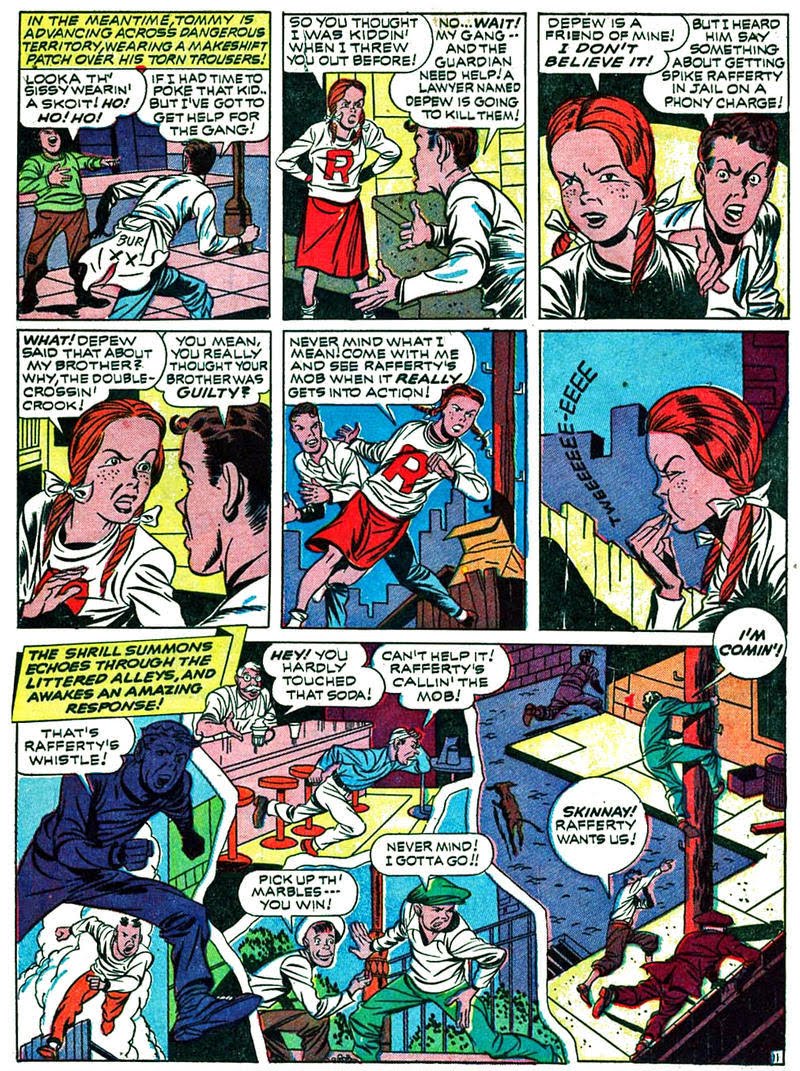
The Newsboy Legion meets the Rafferty Mob


As promised a couple of days ago, here is the second story this week from DC's Star Spangled Comics #17, 1943, this time featuring the Simon and Kirby Newsboy Legion. Don Markstein in his Toonopedia website explains the Newsboy Legion and their adult friend, the Guardian:

The Newsboy Legion is the second such feature Simon and Kirby did, debuting in Star Spangled Comics #7 (April, 1942, the same issue that introduced Robotman), about eight months after The Young Allies, their first. DC Comics, publisher of Star Spangled, showed such confidence in the new feature that they put it on the cover, permanently displacing the title's original stars, The Star-Spangled Kid & Stripesy.

The newsboys were Tommy (the leader), Big Words (who, inevitably, wore glasses), Gabby (a little guy with a big mouth. . .) and Scrapper (a little guy with big fists). They were orphans living in Suicide Slum, who, as the title suggests, made their living selling newspapers — but as the series opened, they weren't above supplementing their income with a little petty crime. Naturally, this led to skirmishes with the law, specifically, police officer Jim Harper. But Harper took a liking to the boys, and became their legal guardian in the first story. After that, they stuck to the straight and narrow. Harper was a "guardian" in more ways than one. Earlier in the story, while off duty, he'd been chased by three thugs into a closed costume shop. There, he helped himself to a set of blue tights (complete with mask), plus yellow shorts (worn outside), shield and hard hat (leaving money behind to cover what he took). Declaring himself to be The Guardian, he proceeded to bring his assailants to justice. Afterward, he maintained his new persona, finding it a convenient way to avoid all the little legalities that so badly hamper a policeman in his battle against crime (a ploy also used by The Black Hood, The Ghost Rider and The Woman in Red). He may have been the first superhero to be used as a supporting character in a non-superhero series.

I like that the boys go up against a "...GOIL!" in this story. It's never too early for a boy to learn that women are tougher than they look, and and he'd be smart to never underestimate them.


More about

Người đăng: Unknown on Thứ Sáu, 8 tháng 7, 2011


Number 978


Flying Saucer Day at Pappy's


Today marks the 64th anniversary of the headline in the Roswell (New Mexico) Daily Record, which claimed the Air Force had recovered a crashed flying disk. The story was quickly retracted, but the story has blossomed into something that has a life of its own, still causing discussion over six decades later.


At some point aliens from space were said to have been recovered from the crash site, so our postings today feature little alien guys.

First up we have Swift Morgan, scanned from the 1954 Spaceways annual from the UK. The writer/artist is famed British illustrator Denis McLoughlin. Since I know little about this artist, due to the paucity of information on this side of the Atlantic about comics from the UK, I've included a link to the Wikipedia entry on McLoughlin, who died in 2002. Even though the annual with the story is dated 1954, according to sources the story itself comes from 1949, and is an early entry in the comic book flying saucer mythos.

More aliens, this time white and not gray, come from Dell's Flying Saucers #1, 1967. There were several UFO "flaps" around that time, and interest was high. These three stories appear to have been coordinated to make the aliens look like one species. The tales themselves, while part of UFO lore, are a bit suspicious as to their credibility. I'll leave that to you to determine. As for me, I'm a skeptic, but even so, I love the iconography and images of flying saucers, and have all my life.

The stories are drawn by José Delbo, Sam Glanzman and Sal Trapani.


More about

Review: Time Masters: Vanishing Point trade paperback (DC Comics)

Người đăng: Unknown on Thứ Năm, 7 tháng 7, 2011

Dan Jurgens's Time Masters: Vanishing Point, in contrast to the original Time Masters miniseries, offers a rather touching portrayal of Rip Hunter as a young boy whose childhood is built on time travel, and then again as an adult doing his best to preserve the family business. Constant readers know one of my comics soft spots is Dan Jurgens drawing the time-traveling heroes he popularized in Superman and elsewhere, so this is a book I'm predisposed to enjoy even if just for the art.

Aside from the Rip Hunter vignettes, however, Time Masters: Vanishing Point is somewhat thin. Though billed with connections to Return of Bruce Wayne and Flashpoint, it offers significant exploration of neither. There's a good amount of story that, though drawn well and tied to esoteric DC Comics continuity, ultimately doesn't affect much and seems only there to pad out the pages. And while Jurgens has written Booster Gold well in his own series, there's a certain stiffness to some of the other characters that's surprising.

[Contains spoilers]

Vanishing Point is essentially a continuation of Dan Jurgens's Booster Gold run, told from Rip Hunter's point of view; it probably would have made a lovely Time Masters one-shot. Rip, as revealed in Booster Gold, is Booster's son, and the elder Booster still lives and fights his own battles through time even as Rip works to guide his young father to greatness. Each chapter of Vanishing Point opens with scenes of Rip's childhood, how being the son of a time traveler exposed him to wonders of greatness but also left him without a home and often in constant danger.

What comes through is the adult Rip's love of his father and his dedication to his cause of preserving the time stream. Rip is neither Superman nor Batman -- neither a stranger to his own birthright nor acting from a sense of tragedy or guilt; rather Rip likes his parents, makes them proud, and does his job because he was taught it was right. This is refreshing and fascinating, and the times that Jurgens pulls back the curtain to show the emotional sides of Rip that the DC heroes don't get to see are the best parts of this book.

Unfortunately, those Rip Hunter scenes only account for about two pages per issue. Most of the rest of the book offers a convoluted wild goose chase in which Rip, Booster, Skeets, Superman, and Green Lantern Hal Jordan purportedly set out in search of the time-lost Bruce Wayne, but are instead almost immediately side-tracked. The team encounters Claw the Unconquered and DC Comics's "sword and sorcery" Starfire, both late of the 1970s Star Hunters series, and with them fight a pair of wizards up to no good.

This takes up pretty much most of the series, and then ultimately Claw and Starfire have no bearing on the end of the story. Maybe Jurgens intends to use them again later, but for now their only role seems to be to give the heroes something to do before they start off again after Bruce Wayne at the book's end.

Far more interesting -- but ultimately not much more relevant -- is "Time Stealers" Black Beetle, Despero, Per Degaton, and Ultra-Humanite's jaunt through time. It's not entirely clear what the latter villains are doing here -- they last appeared in Geoff Johns's Booster Gold and Justice League stories -- as even Black Beetle, when asked, can't quite explain why he needs them. They make nice window dressing, however, while Black Beetle frees the imprisoned original Linear Men Matt Ryder and Liri Lee, and tricks them into helping him steal the corpse of Armageddon 2001's Waverider.

Again, as a fan of Jurgens's Armageddon, Zero Hour, and Superman, seeing Jurgens draw Ryder and Lee again is pure delight. They too, however, leave just before the book's conclusion, and neither seem to bear on the Bruce Wayne aspect of the book nor the Flashpoint. I don't get the sense looking at what DC's producing going forward that these characters will be popping up anywhere else soon, either, so I have to qualify these appearances as for fans of the characters only, and not for anyone hoping for anything substantial.

The disconnect between this book and the events it's supposed to connect is clearest in the "blink and you'll miss it" appearance by Professor Zoom, who proceeds to soundly beat up our heroes, notes that they "aren't what [he] was looking for anyway," and then leaves. Zoom is on only about four or five pages (two of them splash pages); yet the cover of the fifth issue announces Zoom's presence when he doesn't show up until the last page. I can't fault Jurgens directly for this, though; obviously DC wanted a miniseries to spin off from Return of Bruce Wayne and to tease Flashpoint. This book misses no opportunity touting those connections, at least superficially, but there's nothing here to concretely tie to any of the other events -- as we also saw, frankly, in some of the lead up to Final Crisis and in some of the Blackest Night tie-in books.

Jurgens portrays Rip and Booster's loneliness as time travelers well. Throughout the book, Superman and Green Lantern ask all the difficult questions -- Superman wonders at Rip's origins, how he came to be a time traveler and where he got his equipment, while Green Lantern insults Booster relentlessly over Booster's apparent fame-seeking. I felt the characters came off a little stiff here; Superman and Green Lantern argue with Rip about saving a disease-stricken man in the past (not even someone being specifically attacked) in a way that seemed naive for two experienced heroes. Often the characters act as sounding boards to narrate what's going on in the scene, and Superman and Green Lantern serve mainly to ask Rip questions so he can explain the time travel pseudo-science. I haven't felt that Jurgens's recent Booster Gold stories suffered from the same problems, so my hope is that this is isolated to this series and not something we'll also see in Jurgens's DC Relaunch Justice League International.

[Contains original and variant covers]

If you like time travel in the DC Universe, and you like Dan Jurgens, Time Masters: Vanishing Point is an enjoyable, attractive book. Certainly fans of the current iteration of Rip Hunter will recognize the main character here far more readily than in his original post-Crisis on Infinite Earths portrayal. But Vanishing Point is also an example of the kind of thing I wish DC just wouldn't do any more -- a miniseries without any real purpose or point to make, published mainly for the purpose of capitalizing on better books and adding some money to the coffers. This kind of thing, I continue to believe, only serves to foster mis-trust between DC and fans, and makes fans less likely to take a chance on new series, and that's not good for anyone. I'd like to believe that with the DC Relaunch, editorial's attitude toward this kind of thing will change, though I admit I'm not greatly optimistic.

... But hey, dig Jurgens drawing the Linear Men again!
More about

Người đăng: Unknown on Thứ Tư, 6 tháng 7, 2011


Number 977


Robotman and the bad robot


Jerry Siegel and artist Ed Dobrotka are credited with this Robotman story, which appeared in DC's Star Spangled Comics #17, in 1943.

There's something familiar about the criminal robot: he looks like he was inspired by the Golem from the 1920 German movie.

The bad robot's size changes throughout the story. In one panel he's shown riding in the back seat of a car with two thugs, and in another panel he's shown nearly as big as a car, holding a much smaller Robotman.

Come back Sunday for another story from this issue of Star Spangled Comics: the Newsboy Legion by Simon and Kirby.


More about

Review: Time Masters (1990) trade paperback (DC Comics)

Người đăng: Unknown on Thứ Hai, 4 tháng 7, 2011

We know from the current Booster Gold series that Rip Hunter is kind of a jerk. Ordinarily the chip on Rip's shoulder, however, has to do with Booster's hijinks, and the weight of keeping all of the timestream safe. In future-DC Comics Senior VP Bob Wayne and Lewis Shiner's Time Masters miniseries, however, Rip is more than preoccupied -- he's downright obsessive, singularly focused on his nascent time travel research and a history-spanning villain built from the best of conspiracy theories.

Wayne and Shiner's miniseries is a dark re-creation of the Rip Hunter and Time Masters characters just after DC's Crisis on Infinite Earths reboot, far removed from the colorful "Booster meets the Teen Titans" adventures we've seen the Rip Hunter character involved in of late. Moreover Time Masters is a send-up of some previously established superhero tropes, in a way that must have seemed vitally important in that early post-Crisis era.

[Contains spoilers]

With the upcoming DC post-Flashpoint relaunch, I find myself looking a little more closely at how DC and their creators handled the landscape just after their last big reboot. As Geoff Johns points out in his introduction to Time Masters, the larger Superman (Man of Steel) and Wonder Woman relaunches post-Crisis were followed by a number of smaller and sometimes subversive relaunches, including Grant Morrison's Animal Man and Time Masters. The writers can't help but nod to times past, as when former "Forgotten Heroes" Rip and Animal Man encounter one another in this book and Rip is sure they must have met before. At the same time, Rip meets here for the first time former Time Masters Bonnie and Corky Baxter, teaming with fourth Time Master Jeff Smith.

As Wayne and Shiner re-introduce the four established characters, they inject some unexpected reality too the mix. Shiner notes in his afterword how the makeup of the original Time Masters followed the pattern set by the Fantastic Four and others -- a team made up of two men, a woman, and a child. In the new Time Masters, however, there's no platonic friendship between the adults; Rip and Jeff both vie for Bonnie's affections -- ardently and incongruously, since both only met her days previous. Bonnie herself spends much of the book flitting from man to man -- kissing Rip but sleeping with Jeff, and before them having a scandalous relationship with her professor, Cave Carson. Young Corky is hardly the group's mascot; he can't time travel at all due to an early accident, so he mainly makes bitter comments in the background up to the point where, in the end, he hangs himself.

To be clear, picture this in Fantastic Four terms -- Time Masters is essentially a story where Mr. Fantastic and the Thing fight for eight issues over the love of Sue Storm, and then Sue picks the Thing; meanwhile, the Human Torch bides his time awhile before committing suicide.

Even the threat that the Time Masters face, in its own way, deconstructs the Time Masters concept. When a rogue employee blows up Rip Hunter's lab, Rip follows incidental clues to reveal the presence of the Illuminati, a secret organization lead by Vandal Savage that Rip believes, among other things, murdered George Washington and replaced him with their own double. Rip's clues are so vague, however, and the Illuminati's supposed crimes so conspiratorial, that a number of characters suggest over the course of the series that Rip might just be making the whole thing up.

This is the edge of time travel, something that might have been interesting to see explored in the Booster Gold series, where the fact that secret events took place in the past or the future make it hard to prove that they ever happened at all. Further, at the end of Time Masters, Bonnie finds the Illuminati working for good in the future, such that she convinces Rip to cease trying to stop them in the past. Rip's efforts against the Illuminati come to naught, with the strong suggestion that the past can't be changed anyway; as a "first look" at time travel in the post-Crisis DC Universe, the book makes time travel seem near impossible, if not useless, a wonderfully challenging idea at the time even if nowadays DC characters travel through time like walking to the restroom.

Considered in this way, Time Masters is a dark book; fighting for a cause is a thankless prospect, and time travel seems an overly desperate prospect. Rip appears to understand in the end that people can't change time, just themselves -- illustrated in the two bachelors Cave Carson and Jeff Smith adjusting to life alone, Bonnie finally defining herself in the future away from the men, the character Tony giving up her life on the street, and Rip letting go of his obsession with the Illuminati when he's stranded in the past. None of the characters achieve what they tried to through time travel; instead, they all learn to accept what they have. Shiner suggests in his afterword that an intended sequel never manifested, which might, I'm guessing, have at least resurrected Corky, if not shed a more positive light on time travel in the DC Universe.

Fans of the current incarnation of Rip Hunter won't find Time Masters essential reading. At the same time, I found fascinating how this book attempts to put to lie any of a number of comic book conceits, not in the least how blithely characters like Booster Gold travel between eras (and that these Time Masters barely get along with one another, if at all). Time Masters is a decidedly different take on time travel in the DC Universe -- probably best that it wasn't a lasting take -- and an interesting slice of post-Crisis on Infinite Earths DC Comics history, if not a terribly flattering one.

[Contains original covers with logos, introduction by Geoff Johns, afterword by Lewis Shiner]

More time travel action coming up, when Flashpoint and The Return of Bruce Wayne collide in our review of Time Masters: Vanishing Point, coming up next.
More about