[Presenting a new series of guest reviews on Grant Morrison's The Invisibles by Zach King, who blogs about movies as The Cinema King]It's all going to end next year, which makes now as good a time as any to reevaluate Grant Morrison's 59-issue magnum opus (collected over seven fairly weighty trade paperback editions)
The Invisibles. As for what's going to be ending, it's not the series; no, that wrapped in 2000 after six years of publication. What's going to end,
The Invisibles suggests, is quite simply
everything as we know it -- the world, our own consciousness, and our conception of space-time are all going to come to some sort of end on December 22, 2012.
[
Invisibles purists will know that the series was published in 59 issues dispersed throughout three volumes - 25 in volume one, 22 in volume two, and 12 in volume three. For the ease of the reader, when I use volume designations in the following reviews, I'm referring to the seven collected editions, not to the three volume divisions for the original issues' publication.]
"And so we return and begin again." For those keeping score, that's Issue One, Page One, Panel One, and already we're told what the central theme of the work is. In a way, this thematic declaration hints at the episode structure which divides this first volume,
Say You Want a Revolution (quoting John Lennon, whose spirit is contacted for guidance in the first issue, "Dead Beatles"), neatly in two: the introductory tale "Down and Out in Heaven and Hell" and the team's first mission in "Arcadia." This first volume accomplishes much that a first volume should: it introduces a familiar concept and character-types in ways that feel fresh. But
Say You Want a Revolution is not the best
Invisibles volume, flawed in ways that suggest the series had not found its feet at that time.
Meet juvenile delinquent Dane McGowan, content to be a thorn in the side of his schoolteachers by lobbing Molotov cocktails into the school library. After being sentenced to a juvenile rehabilitation clinic, Dane finds himself torn between two forces fighting over him. On one side, the apparently soulless Miss Dwyer and Mister Gelt, bespectacled advocates of conformity at all costs; on the other, the ragtag Invisibles, a countercultural answer of sorts to the JLA. The Invisibles -- led by Morrison stand-in King Mob, with homeless shaman Tom O'Bedlam, transvestite mystic Lord Fanny, Raggedy Ann doppelganger Ragged Robin, and martial arts master Boy (actually an African-American policewoman turned revolutionary) -- insist Dane is actually Jack Frost, their newest and strongest member, contender for the crucial role of "the next Buddha." After Dane/Jack's initiation, the Invisibles time-travel to recruit one more member, the Marquis de Sade, while being stalked by the faceless demon Orlando.
It's evident fairly early in this volume that Grant Morrison knows what he's doing, though much of that isn't immediately apparent until finishing the series; Ragged Robin's introduction of herself by way of an afterthought ("I'm Ragged Robin, by the way. I'm nuts."), for example, actually tells us more about her backstory than Morrison initially seems to be letting on. Recently Morrison's found a good deal of critical approval for his dexterity with long-form storytelling on his
Batman titles, but it's in
The Invisibles that this skill really comes to life, more so than in his previous works (also under the Vertigo banner)
Animal Man and
Doom Patrol. Here Morrison plants seeds that will grow over the course of the seven volumes of
The Invisibles. It's clear he knows where this is all going.
It's a shame, though, that the series itself doesn't seem to know how to get where it's going. It's a bit like preparing for a long trip out of state, planning every stage of the journey but forgetting to factor in transportation. It's here where
Say You Want a Revolution fails to live up to the latter volumes in the work, suffering a bit from problems with identity, both of the characters in the series and (on a meta-level) of the series itself. While "Down and Out" is quite good, appearing less derivative when you recognize that it was published in 1994, a full five years before
The Matrix did practically the same story, "Arcadia" is less fulfilling because its combination of historical fiction and literary analogy ultimately paints it more like a story arc from Neil Gaiman's
The Sandman than anything else (the scenes with Orlando, however, are brilliantly disturbing and grossly original, in every sense of the word "gross").
Moreover, the greatest flaw in
Say You Want a Revolution is the absolute dearth of characterization present. Aside from Dane/Jack, who is given (and given quickly) one of the richest voices in comicdom, none of the characters is really given a purpose or a personality. Indeed, they seem to be grounded primarily in compelling visuals; King Mob's catchphrase "Nice and smooth" seems to describe the way readers are meant to embrace him because of the sheer cool factor his aura reverberates, while Lady Fanny's transvestism seems gimmicky and Boy appears not to have much purpose at all beyond an apparent diversity requirement. There are hints of Lord Fanny and Ragged Robin as characters with fuller purposes and abilities, but for the most part the book relies heavily on Dane and, to a lesser extent, King Mob.
On the visual side, Steve Yeowell (on "Down and Out") and Jill Thompson (on "Arcadia") are two of the better collaborators Morrison had on a series that, near the end, was plagued with artistic misfires and imperfect interpretations of Morrison's script. Yeowell, Morrison's partner on
Sebastian O and
Skrull Kill Krew, introduces us to the world of the Invisibles with cartoonish but clear lines and King Mob at his coolest. Thompson, meanwhile, fresh off her stint on
Sandman (collected as
Brief Lives), draws what I believe are the definitive versions of Lord Fanny and Ragged Robin (not surprising, considering Robin was initially modeled after Thompson) until Phil Jimenez joins the series somewhere around the third collected edition; her lines, somewhat more realistic than Yeowell's, give historical authenticity to "Arcadia" while perfectly capturing the off-kilter nature of characters like Orlando and the blind chessman.
All told, the first eight issues (particularly the first, which functions as a distilled microcosm of the entire series) are not perfect or the best that
The Invisibles has to offer. But
Say You Want a Revolution represents something perhaps better (after all, it's a bit early for a series to peak) -- and that's potential. This first volume displays great promise and prefigures great things to come from the series.
Say You Want a Revolution is filled with fantastic moments -- the discovery of the head of John the Baptist, the raid on Harmony House, and the subway encounter with Tom O'Bedlam -- that suggest
The Invisibles is a series bubbling over with ideas. At times during the series, especially in this volume, the philosophy overpowers the narrative, but it's never as extreme as Alan Moore's
Promethea, in which the plot was quite literally put on hold for many issues for the comic book equivalent of a philosophy lecture. But the dominating presence of the philosophy behind
The Invisibles does overshadow its characters, a flaw from which the series fortunately rebounds in subsequent volumes.
[Contains full covers and an introduction by Peter Milligan. Printed on non-glossy paper.]That's the first of seven reviews, loyal readers. Stay tuned for my reviews of the rest of Morrison's
The Invisibles -- up next, it's
Apocalipstick, in which Lord Fanny and several minor characters are given origin stories and Dane/Jack finally chooses a side.


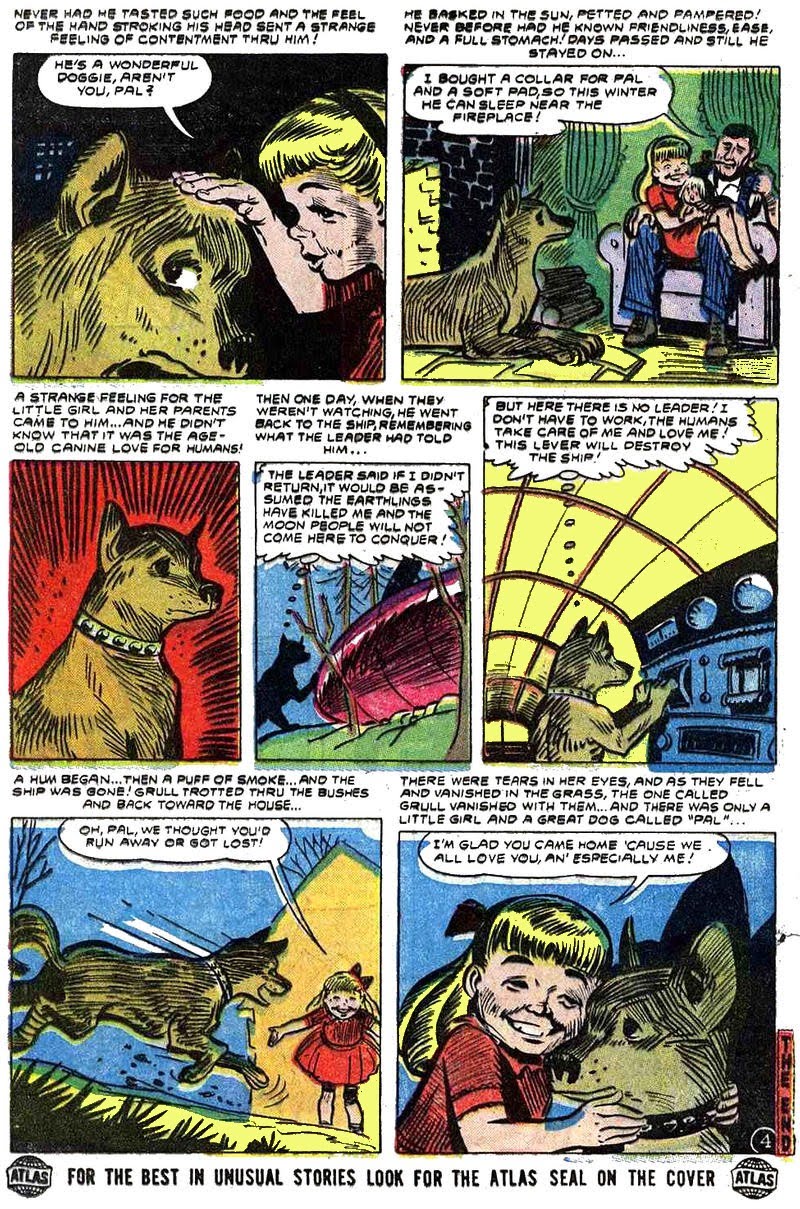
 I'm also including a page from the Marvel Comic Group "editors" in defense of comic books against the groups which were rallying at the time to clean up the comics. I especially like the line, "The grown-ups of this world owe you young people an apology, because we haven't made the world a very secure and peaceful place in which to live." As we used to say in the '60s, that's heavy, man.
 I'm also enclosing the ad for the Wolf Ring because it reminds me of a story one of my female coworkers told me. When she was a young girl, in the mid-1950s, her mother's sole sex education talk to her was to "watch out for wolves." Wolves? She thought. Like the wolf in "Little Red Riding Hood"? Her mother didn't explain, just further admonished her: "Stay away from wolves."
 I'm sure that if a wolf had approached her she might have been able to recognize him had he been wearing this $2.98 "solid Sterling Silver Wolf Ring", available from Western Craftsmen in Omaha, Nebraska.