Người đăng: Unknown on Thứ Tư, 16 tháng 1, 2008


Number 248


"Me and Whizzer McGee…"


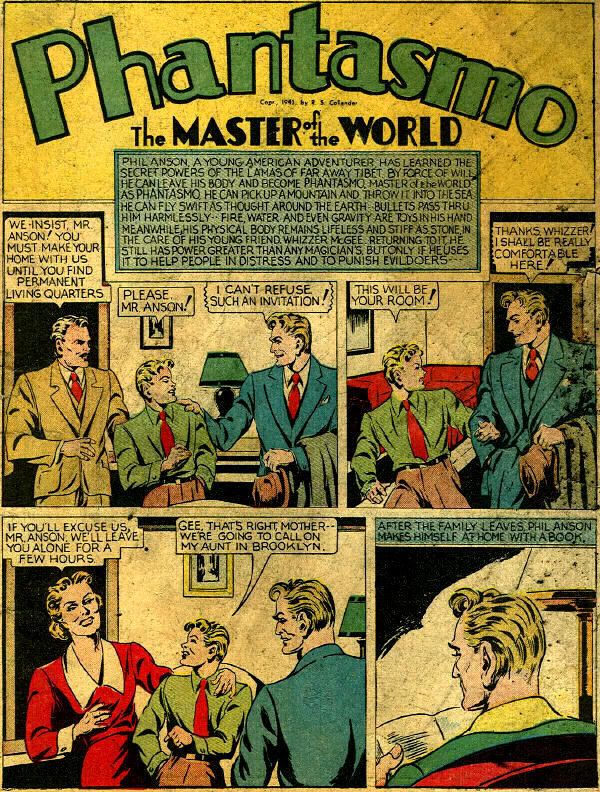
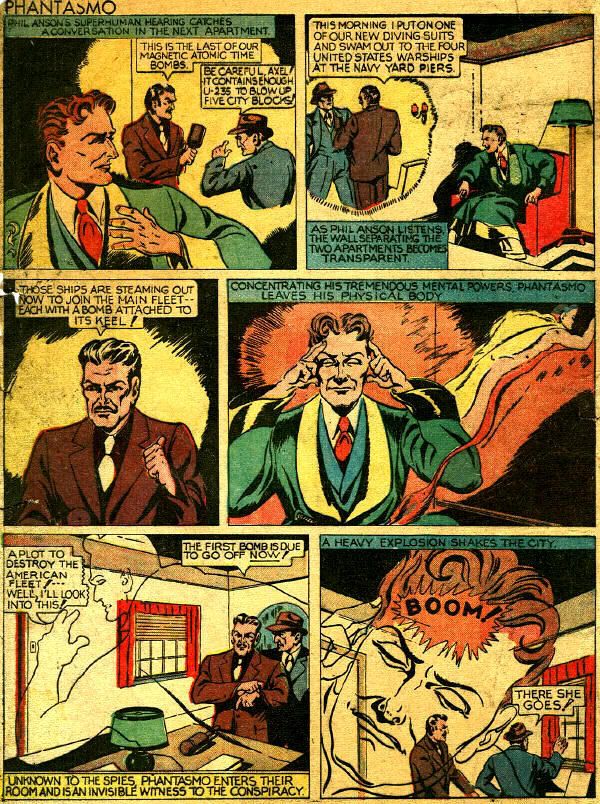
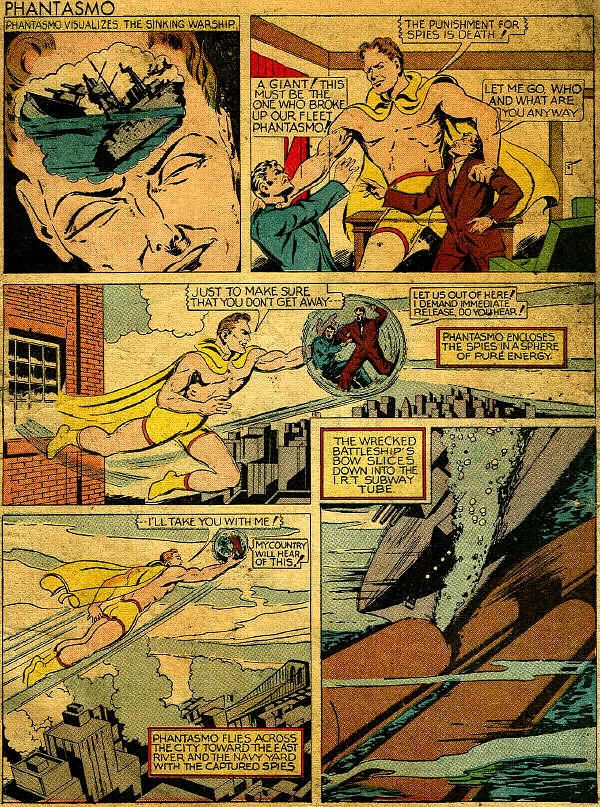
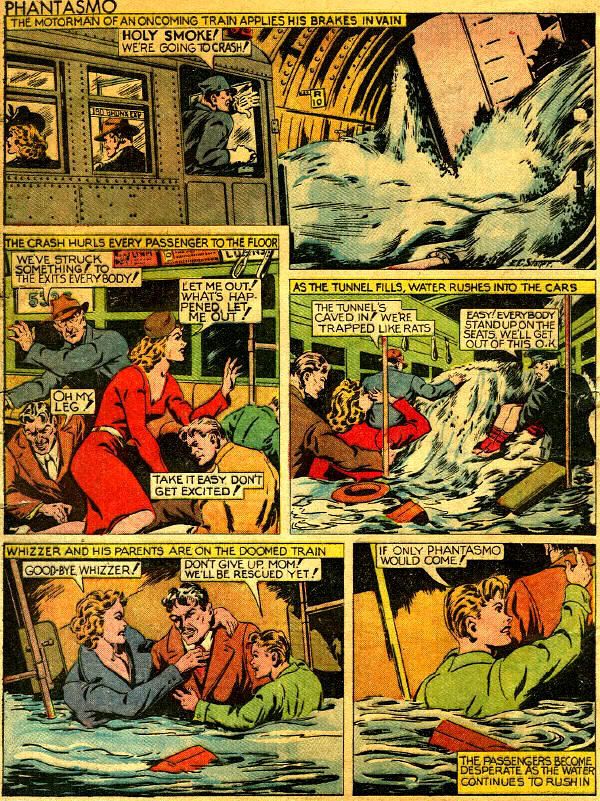
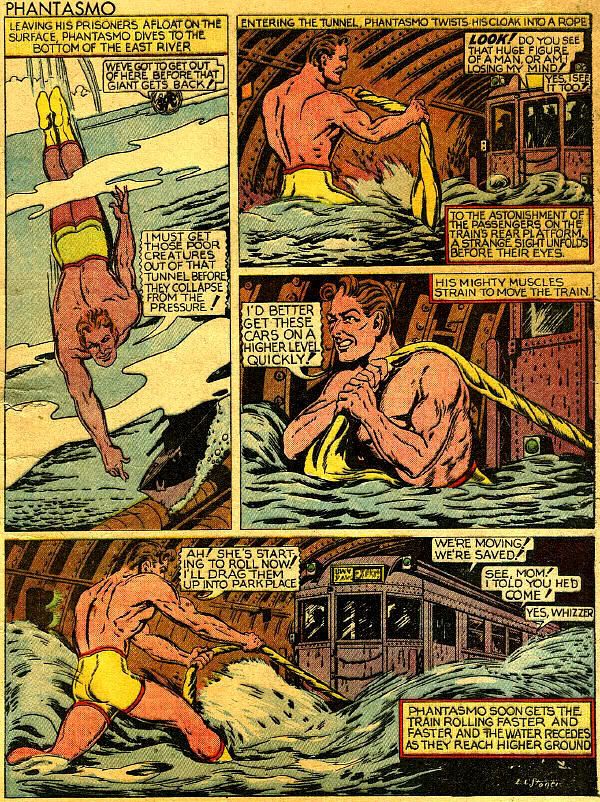
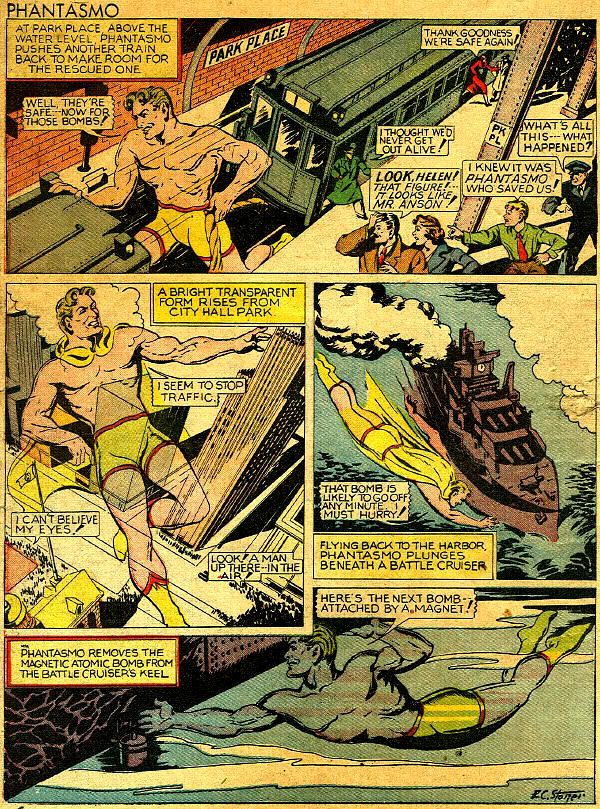
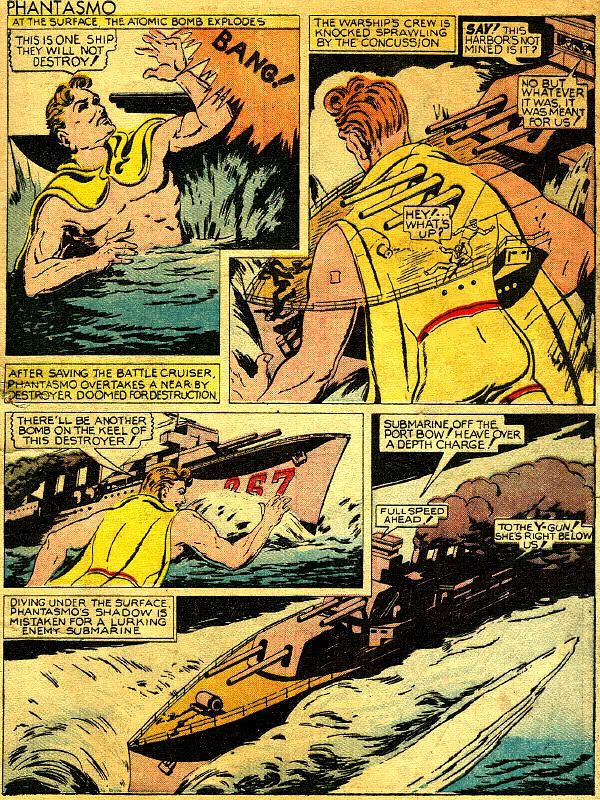
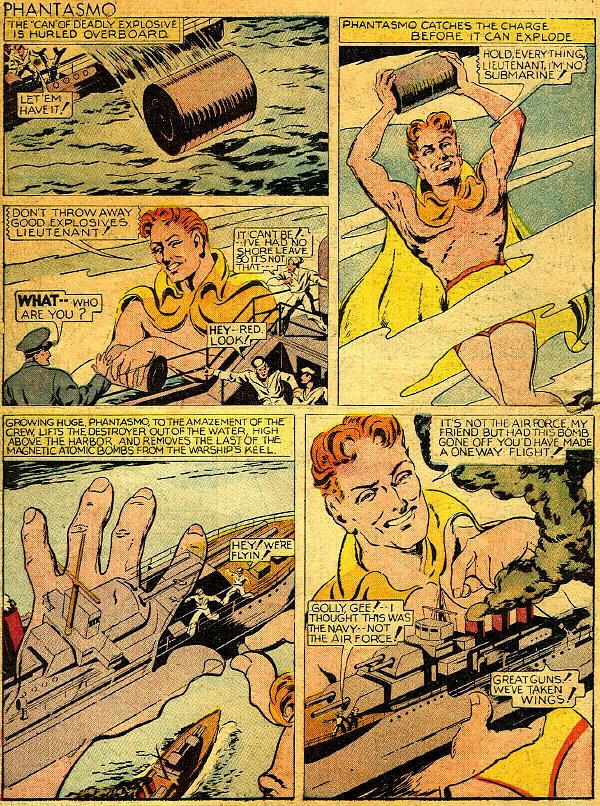
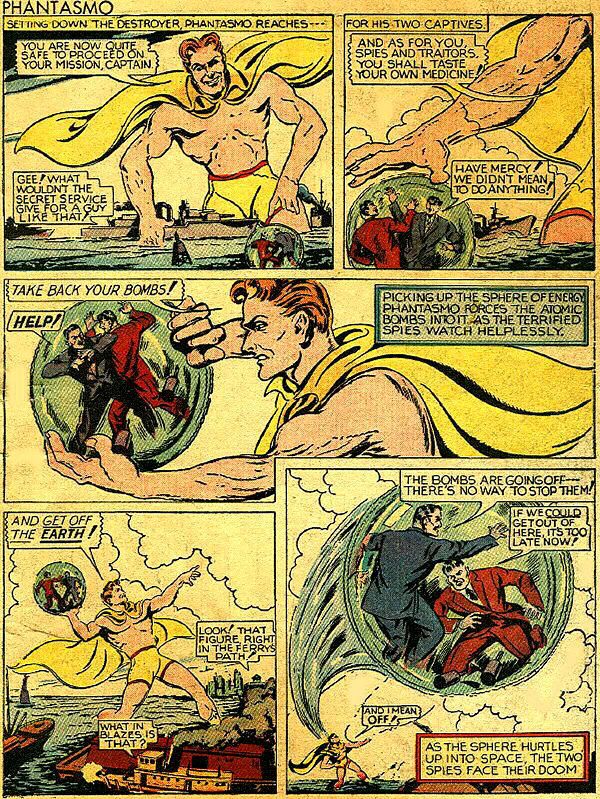
Phantasmo, who appeared in Dell Comics' The Funnies #45-63 back in the early 1940s, was really Phil Anson. Thanks to some training by some lamas in Tibet Phil could leave his body, become Master of the World, get really big, get transparent, fly, lift subway trains. He also hung out with a teenager named Whizzer McGee, who took care of his body while his spirit was outside being Phantasmo.

In this episode of the Phantasmo saga he deals with some "magnetic atom time bombs," containing enough U-235 to blow up five city blocks!

His costume was kind of a non-costume, a cape and a pair of trunks with matching boots.* The art is done in an old-fashioned style by E.C. Stoner.

My copy of The Funnies #54, from which this story appeared, was used as insulation, along with a stack of other really poor condition comics I got a few years ago. It was near an old furnace, which accounts for the streaks of coal on the first page.

Page 1 / Page 2 / Page 3 / Page 4 / Page 5 / Page 6 / Page 7 / Page 8 / Page 9 / Page 10

*And sometimes Phantasmo wore less than that.

More about

Người đăng: Unknown on Thứ Hai, 14 tháng 1, 2008


Number 247


Shriek of Araby


This past weekend Karswell showed us a gruesome horror story by Howard Nostrand from 1954. In the story I'm showing from Harvey Comics' Flip #2, also from 1954, Nostrand tries his hand at humor and satire.


Bhob Stewart interviewed Nostrand for Graphic Story Magazine #10, in 1974. Nostrand talked about "The Shriek of Araby." He gave the reason for the color scheme: the movie it's based on, Rudolph Valentino's The Sheik, was a silent film done in sepia tone. The comic book version is a good try, but because of the quick-and-dirty printing of comic books, experiments like this didn't always work out. Some of the panels are too dark, and in the captions the white-on-black lettering is hard to read in spots.

Nostrand liked the story. In part of the 1974 interview he claimed, "That was the one Kurtzman commented on." Stewart asked, "What did Kurtzman say?" Nostrand answered: "He thought it was the best one of the book, and that sort of thing. Didn't mean much 'cause I wrote the rest of the book, too." Later he confessed, ". . .I think I stole it from S. J. Perelman. He did the synopsis in his 'Cloudland Revisited' series. I just sort of changed the plot slightly, and then it said what I wanted. Some of the dialogue is pure Perelman. . .I have a feeling that Perelman doesn't read comic books, anyway, so I wasn't in…you know, when in doubt, plagiarize, but make sure the guy who wrote it doesn't read it." What, plagiarism, in a comic book?!! Say it ain't so, Howard.

Along with "Shriek" I'm including these two "Ulysses" single-page gags by Nostrand, also from Flip #2.


More about

Người đăng: Unknown on Thứ Sáu, 11 tháng 1, 2008


Number 246


Supermouse and the Timid Giant


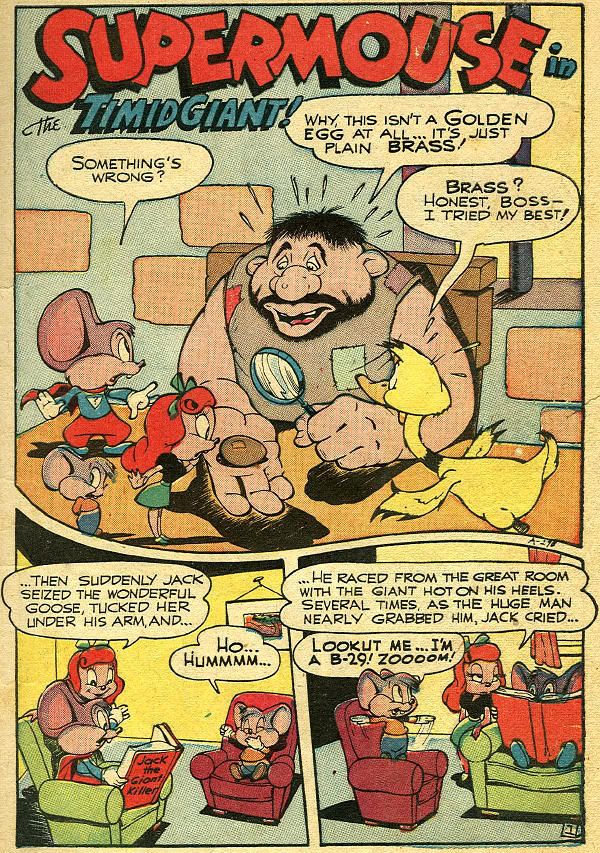
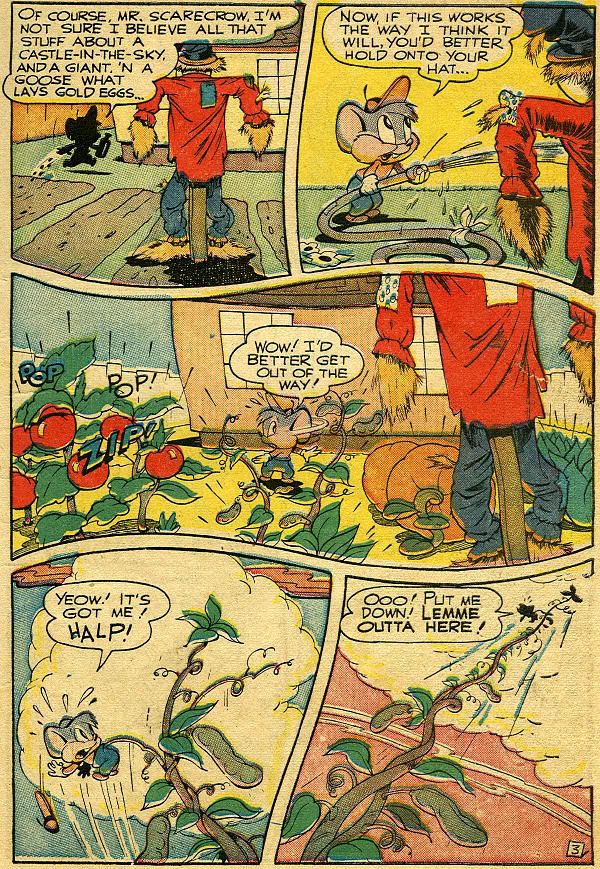
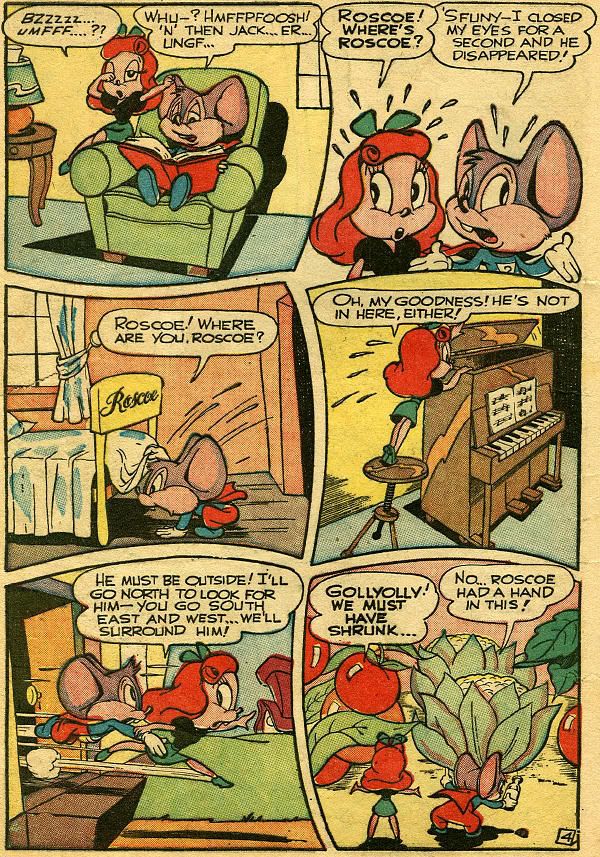
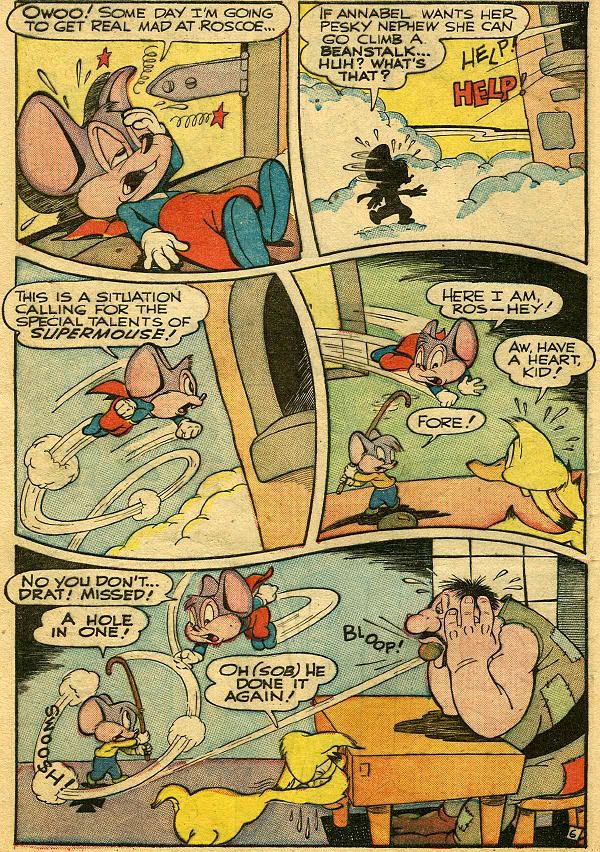
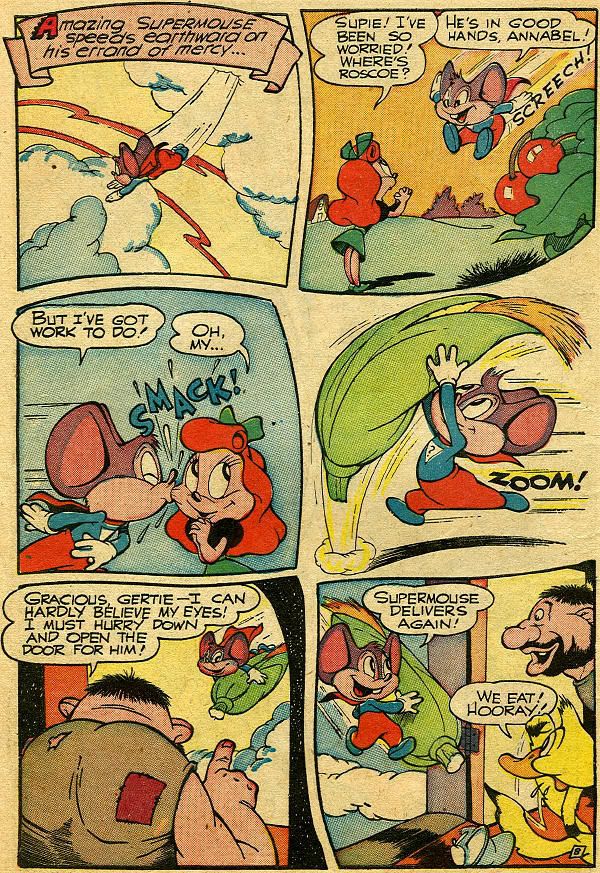
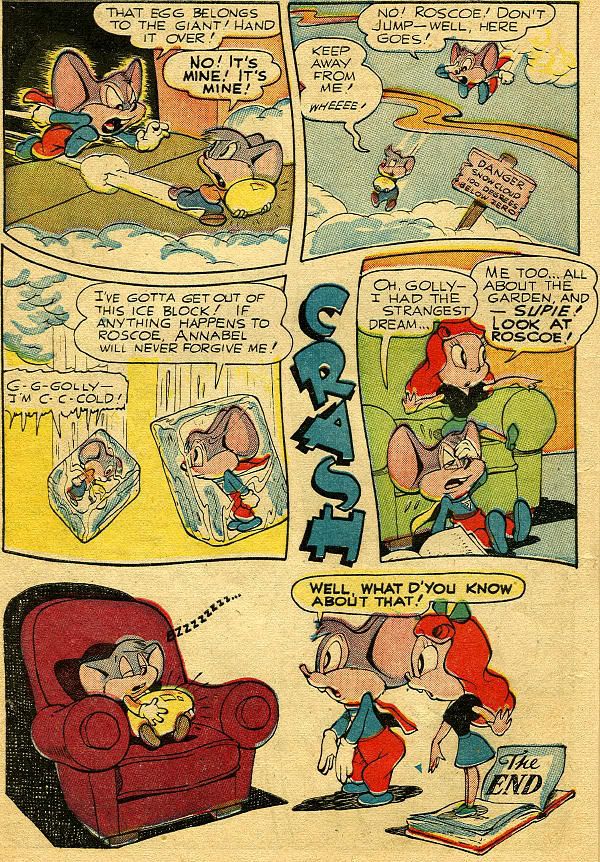
What would writers do without fairy tales, nursery rhymes or folk tales? Probably have to actually look for a plot beyond Mother Goose or the Brothers Grimm. The surprise is in the endless variations on such familiar stories. Supermouse and his nephew Roscoe go into Cloud Coo Coo Land for this riff on Jack and the Beanstalk. It's from Coo Coo Comics #40, July 1948. It's derivative, but a cute kid's story, done by an unknown writer and artist.

Page 1 / Page 2 / Page 3 / Page 4 / Page 5 / Page 6 / Page 7 / Page 8 / Page 9 / Page 10

As many comics fans know, Frank Frazetta did some illustrations in the late 1940s for text stories in these funny animal comics . This issue of Coo Coo is blessed with three:

More about

Người đăng: Unknown on Thứ Tư, 9 tháng 1, 2008


Number 245


Don't Shrink Sam's Head


With a little tweaking I think this story, originally published in Atlas Comics' Mystic #23, could have been published in one of that company's humor titles like Crazy. The last panel is a visual joke, and how many stories open up with a collector displaying a petrified vampire and stuffed werewolf?
The Atlas Tales site lists this story as drawn by Romita? with a question mark, so they aren't sure. I scanned it from the Marvel Comics reprint in Vault Of Evil #6, October 1973.


More about

Người đăng: Unknown on Thứ Hai, 7 tháng 1, 2008


Number 244


Danger Trail


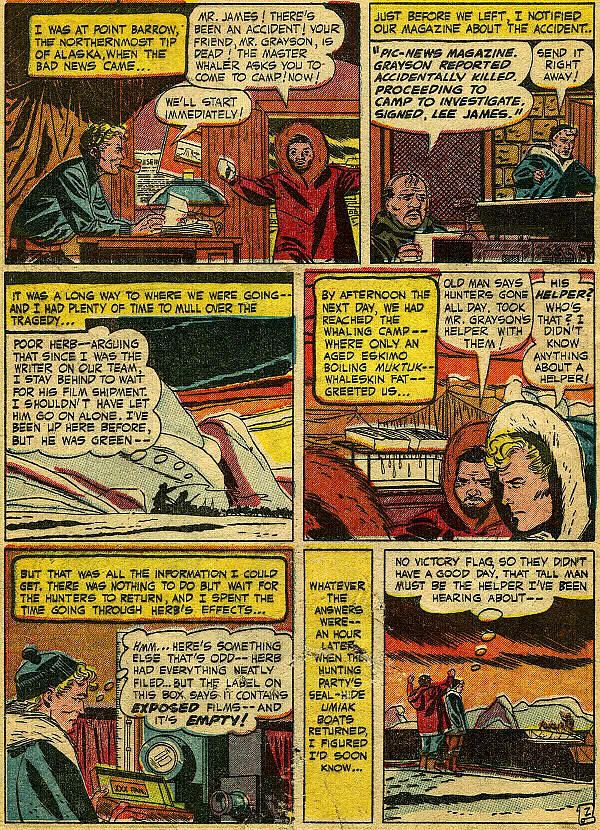
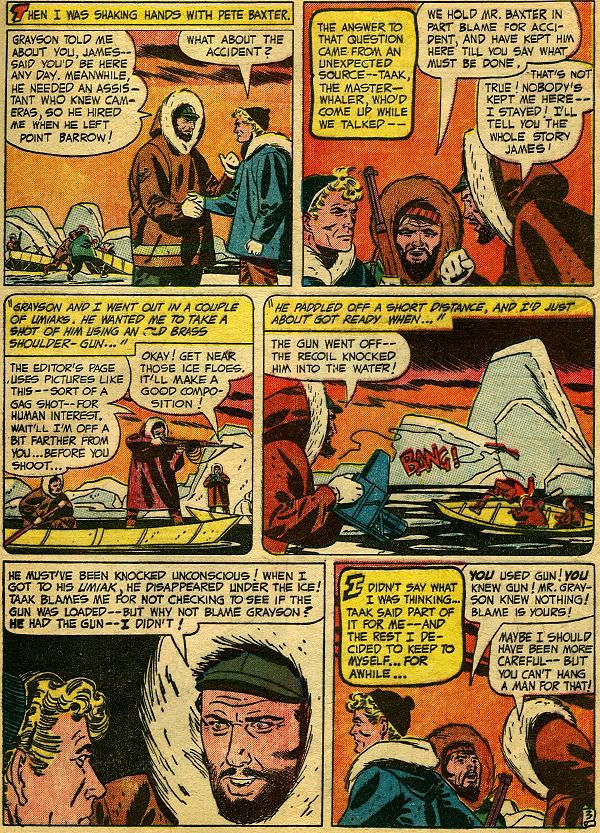
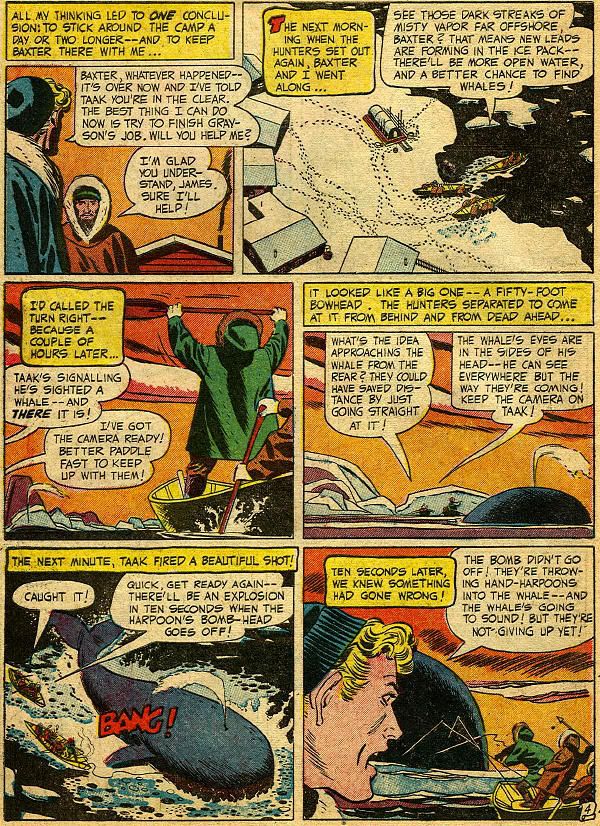
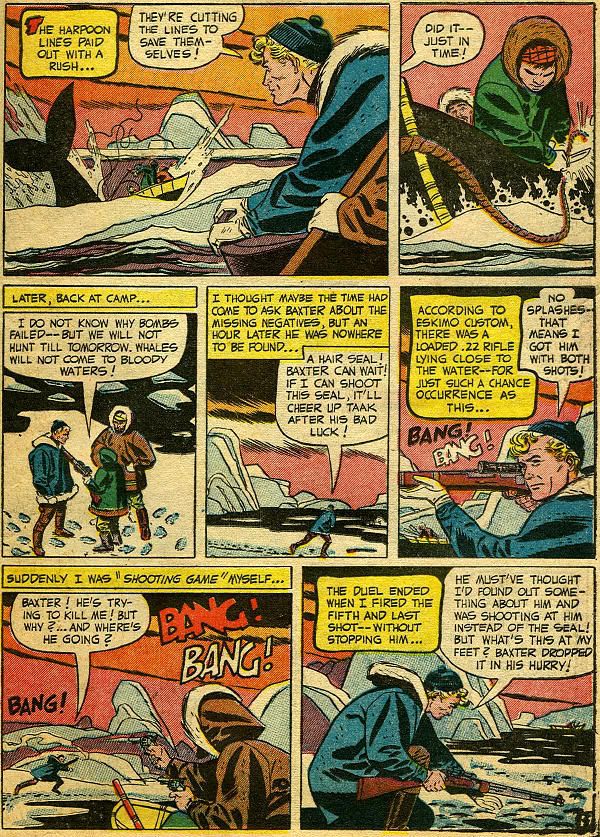
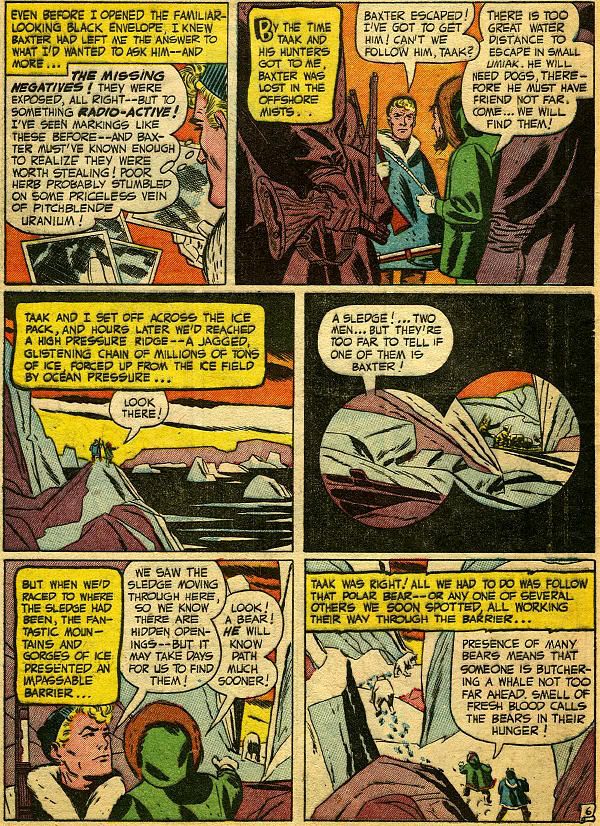
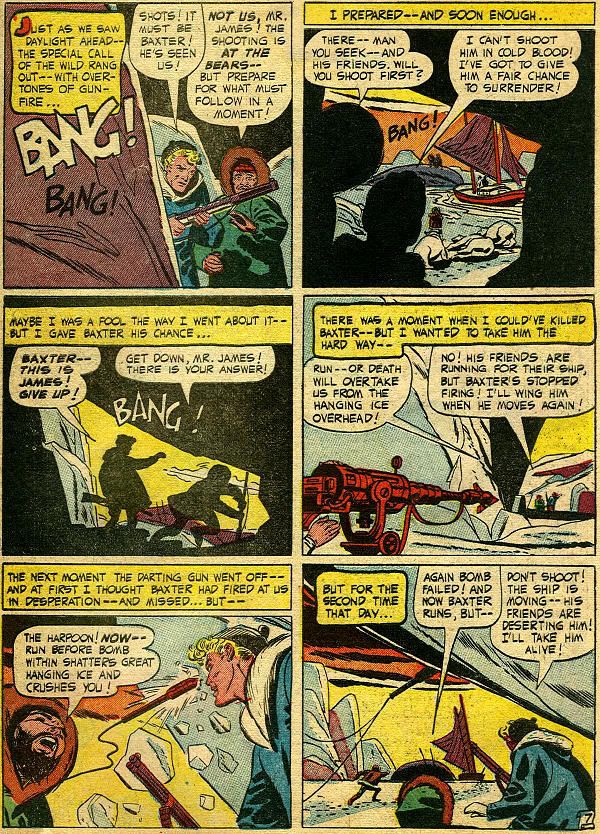
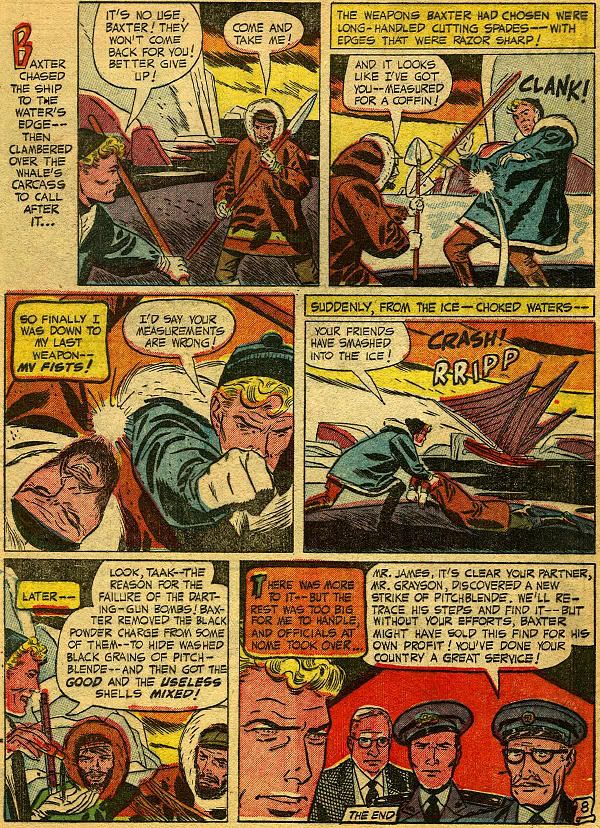
Danger Trail, the 1951 version, is one of DC's rarer titles, which is why I'm glad to have even an incomplete copy of #4; only two stories are intact, but they're by Infantino and Toth.

"End Of The Arctic" has a whale hunt using a grenade on the end of the harpoon. The grenade doesn't explode. The lead character shoots a seal just so the whalers won't feel bad about missing their whale. The seal shooting isn't shown, and since the grenade didn't explode and blow off part of the whale's top we missed that, but no one tell any animal rights group, OK? I'm on their side, but I'm just presenting the story as it was published 57 years ago. Besides the hunting aspect to the story, there's some mystery and intrigue going on. All political incorrectness considered, it's a good story with good art.

The Grand Comics Database tells us that David Vern wrote the story, Alex Toth penciled it, Bernard Sachs inked it, and Julius Schwartz was the editor.

Page 1 / Page 2 / Page 3 / Page 4 / Page 5 / Page 6 / Page 7 / Page 8
More about

Người đăng: Unknown on Thứ Sáu, 4 tháng 1, 2008


Number 243


"…I strongs to the finich..."


Animation fans of the Fleischer Brothers, and of Popeye cartoons, should be thrilled by the four-disk DVD set of the venerable sailor. Sixty cartoons, plus extras like documentaries on Popeye creator Segar, voice actors like Billy Costello and Jack Mercer as Popeye, and other extras like old Bray silents and Fleischer "Out Of The Inkwell" series cartoons. Whew. That's a lot, and like most of these types of compilations, comes at a price. I got mine for $42.99 from Amazon.

Like other Americans of my generation, I grew up with these cartoons on afternoon television, and also with the Popeye comics strips and comic books, then drawn by Bud Sagendorf. I knew there was a difference between the print Popeye and animated Popeye.

For one thing, with only seven minutes per cartoon to work with, there was no room for subtlety. They reduced the intricate storylines of the Segar strips down to a very basic formula: a love triangle, sexual jealousy, and cartoon violence. They also turned Popeye into a Fleischer character with the anthropomorphic stuff they were famous for; the Fleischers really understood how to use cartoons to their true potential. Rather than trying to duplicate reality in these early cartoons they made sure that reality rarely intruded.

In the 1934 cartoon, "Barnacle Bill," one of my favorites because most of the cartoon is sung using the popular song of the day, the formula is clear. Bluto, as Barnacle Bill, is Olive's boyfriend, even though Popeye refuses to go away. There is the inevitable fight, which Popeye wins after eating his spinach. When he beats Barnacle Bill the fickle Olive then wants him, but he doesn't want her. You could about set a stopwatch to each of the cartoons in the series to see when the fight would start, and there were endless variations on the actual fighting, but the outcome was always the same: the spinach, the victor, Popeye, gets the "prize," Olive.

In the strip there was more room to tell a story. In this comic strip sequence from the same year, 1934, Popeye is a newspaper man, who hires a cartoonist, B. Loony Bullony, because comic cartoons is what readers want! I've scanned a sampling of these from the original printed strips, clipped from a newspaper of the day. The strips are printed longer than my scanner bed, so I've split them in half. There was a lot going on every day in the strip.

The Segar Popeye and the Fleischer Popeye were two characters with the same name, appearance and some of the same subsidiary characters. Each medium had its own needs and limitations. Segar, in his silent strips, couldn't provide the catchy theme song, inspired gravelly Costello/Mercer voice of Popeye or the screech of Mae Questal's Olive. On the other hand, by reducing the animated Popeye to stories of such short length none of the richness of Segar's strip could be presented. Despite those differences, Popeye was one of the Twentieth Century's greatest comic creations. The cartoons are a joy to watch, just as the strips are a joy to read.

More about

Người đăng: Unknown on Thứ Tư, 2 tháng 1, 2008


Number 242


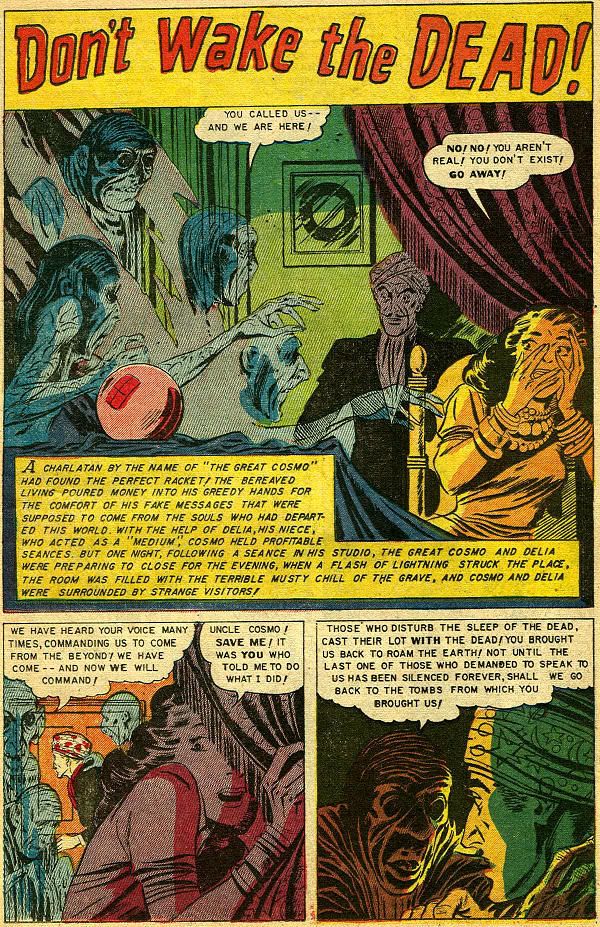
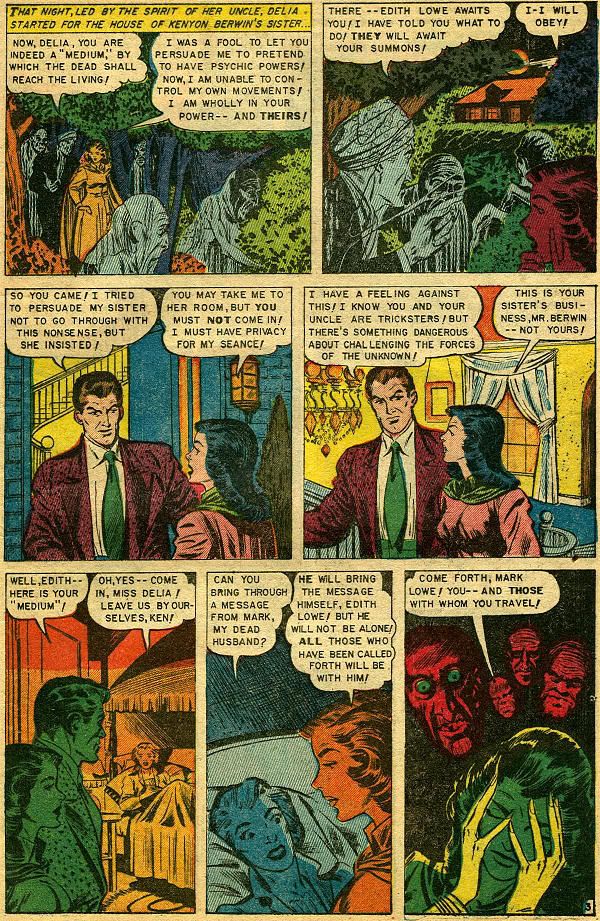
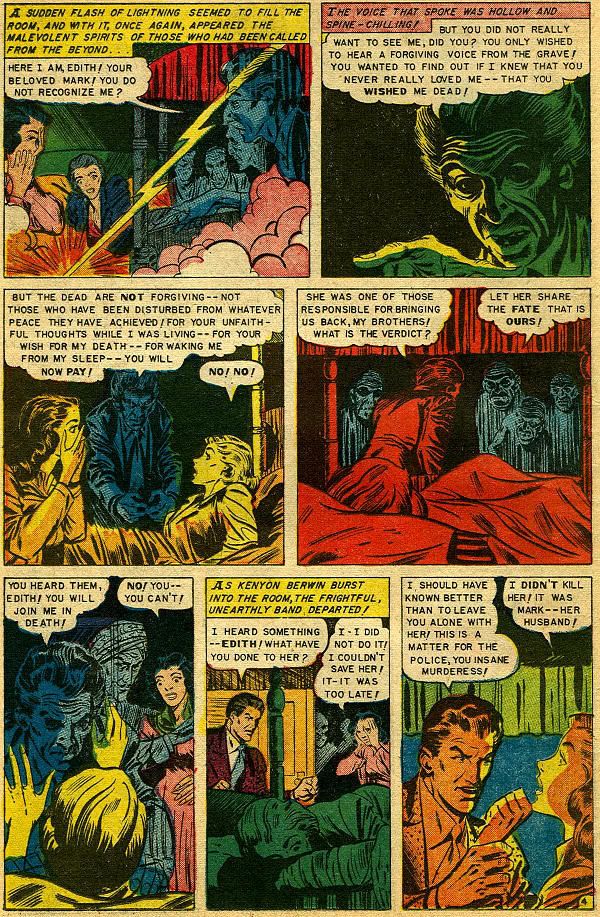
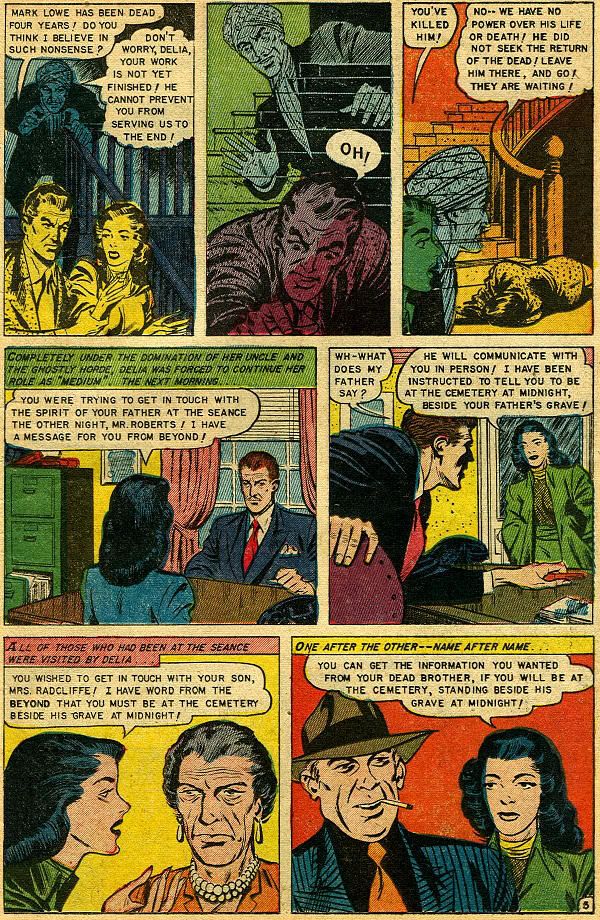
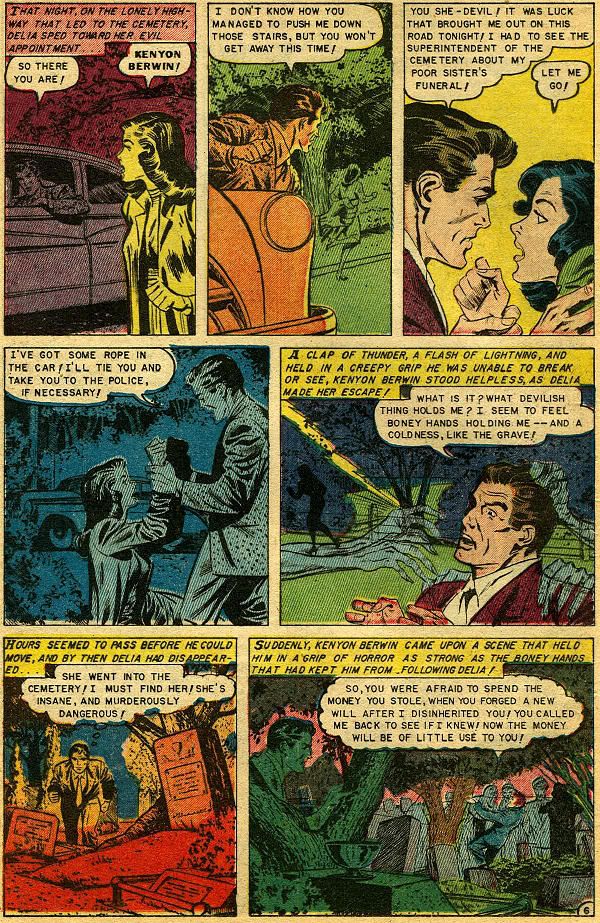
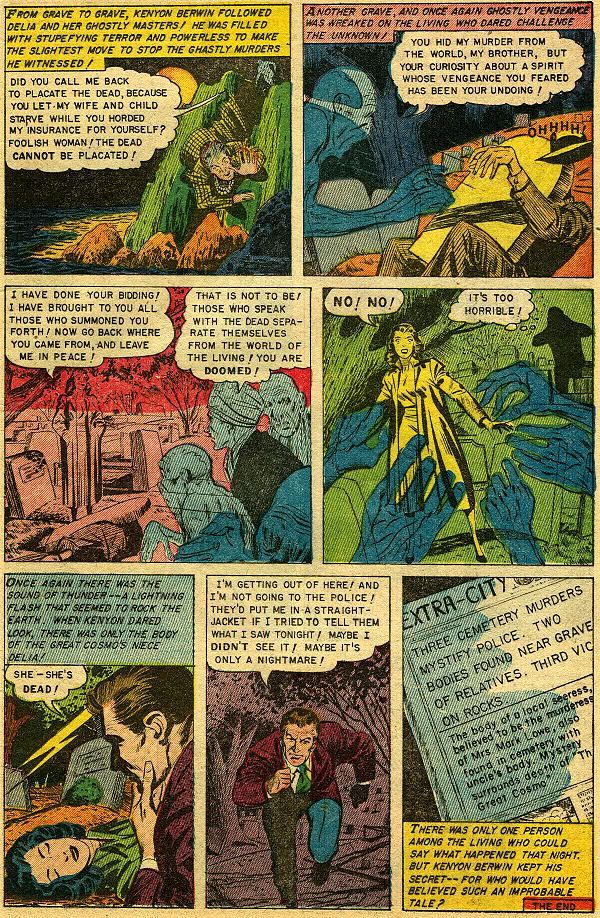
Don't Wake The Dead


I've got to go back to work today. I've been off since December 21, during which time I have been practicing retirement. I do this just about every year. I want to retire. I'm ready for retirement. When I'm not working I don't have to get up at 4:00 in the morning, which is why a title like "Don't Wake The Dead" seems appropriate.

You think this story from a coverless issue of Ace Comics' The Beyond is a horror story…how about being a wage slave going back to 1965? Now that's a horror story.

Page 1 / Page 2 / Page 3 / Page 4 / Page 5 / Page 6 / Page 7

******

During my time off I read the biography, Schulz and Peanuts by David Michaelis. In 1947 Schulz, besides his day job at Art Instruction, Inc., was moonlighting as a letterer for the Catechetical Guild in St. Paul, Minnesota. According to page 167 of the biography, "[His boss, Roman] Baltes rewarded his efficiency, reliability, and thoroughness by having him draw the climactic panels of Is This Tomorrow--a dire prophecy of a Communist takeover tricked out as a "public service comic book.

I have never seen Is This Tomorrow, although I've seen the cover reproduced many times over the years. According to the biography, the comic book had over 4,000,000 copies in circulation at one point, so there have to be a lot of them out there. Has anyone ever looked at the last few panels and said, "By god, there's Charlie Brown!"?

More about